To be a valuable global supplier
for metallic honeycombs and turbine parts


Contact number
0555-2813555
To be a valuable global supplier
for metallic honeycombs and turbine parts
Technological Innovation
Process Management
Continuous Improvement
Customer Satisfaction

Knowledge
Dedication
Diligence
Loyalty
Responsibility
Confidence
Tenacity
Respect
To be a valuable global supplier
for metallic honeycombs and turbine parts
Release time:2025-12-15
Anyone who has worked with air duct systems knows that airflow is rarely as clean as drawings suggest. Fans introduce swirl, elbows create uneven velocity profiles, and sudden expansions generate strong turbulence. In many systems, this disturbed airflow leads to noise, pressure loss, and unreliable measurements. This is where an air straightener honeycomb becomes a practical solution.
Rather than forcing airflow into an ideal condition, honeycomb structures work by guiding the flow step by step, reducing unwanted motion while preserving usable velocity.
Turbulence in ductwork is usually caused by changes in direction or cross-section. Common sources include:
Fan outlets with rotational swirl
Bends, tees, and transitions
Dampers and valves
Sudden contractions or expansions
These disturbances create velocity gradients and secondary flow patterns. Instead of moving straight down the duct, air begins to rotate, separate, and mix. In HVAC systems, this results in uneven air distribution. In measurement systems, it causes unstable sensor readings.
Completely eliminating turbulence is not realistic, but controlling it is.
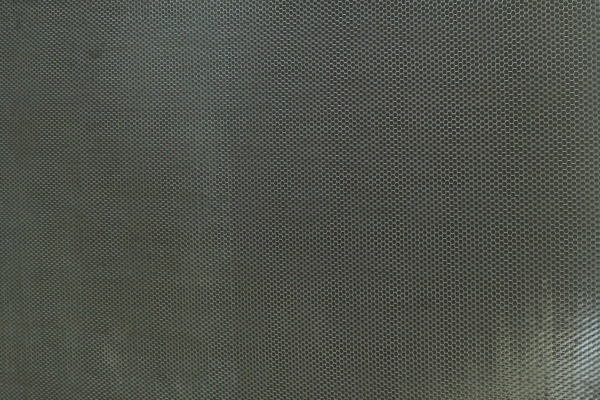
An air straightener honeycomb consists of many small, straight channels arranged in a regular grid. Each channel acts as a miniature flow guide.
When turbulent air enters the honeycomb:
Lateral velocity components are blocked by the channel walls
Rotational motion is broken into smaller flow segments
Each channel forces the air to align with the duct axis
By the time the air exits the honeycomb, most of the swirl and cross-flow has been removed. What remains is a more uniform, axial flow profile.
Importantly, the honeycomb does not “calm” the air by slowing it down. It redirects the flow, converting chaotic motion into ordered movement.
The effectiveness of an air straightener honeycomb depends heavily on its geometry.
Cell diameter determines how much lateral motion can be suppressed. Smaller cells provide stronger straightening but increase pressure drop. Larger cells allow more airflow but reduce straightening effectiveness.
Length-to-diameter ratio is another key factor. A longer honeycomb gives the flow more distance to realign, but again increases resistance. In practice, most designs aim for a balance that removes swirl without creating excessive pressure loss.
Wall thickness also matters. Thin walls minimize blockage, while thicker walls add structural strength for industrial environments.
Good honeycomb design is always a compromise between flow quality and system efficiency.
In some duct systems, flat screens or perforated plates are used to condition airflow. While these can reduce large-scale turbulence, they also introduce random wake patterns behind each hole.
An air straightener honeycomb behaves differently. Because the channels are continuous, the flow is guided rather than disrupted. This produces a more predictable and repeatable outlet profile, which is especially important for downstream sensors or diffusers.
This is why honeycomb structures are widely used in wind tunnels, test benches, and precision airflow measurement setups.
No flow conditioning device is free. An air straightener honeycomb introduces pressure loss due to wall friction and reduced open area.
However, compared to other conditioning methods, honeycombs are relatively efficient. When properly sized, they offer significant turbulence reduction with a manageable pressure penalty.
In most practical systems, the performance gain downstream—better air distribution, lower noise, more accurate measurements—outweighs the small increase in pressure drop.
Air straightener honeycombs are used wherever airflow quality matters more than raw volume:
HVAC supply and return ducts
Airflow measurement stations
Fan discharge stabilization
Industrial ventilation systems
Test rigs and calibration tunnels
In these applications, the honeycomb is usually installed after a disturbance source, such as a fan or elbow, with minimal straight duct length available.
An air straightener honeycomb is most effective when:
Space is limited
Swirl and cross-flow are the main issues
Repeatable airflow is required
Noise or vibration is a concern
It is less suitable when extreme pressure sensitivity exists or when contamination buildup cannot be controlled.
From an airflow standpoint, the strength of an air straightener honeycomb lies in its simplicity. It does not rely on complex mechanisms or moving parts. Instead, it uses geometry to guide air back into alignment.
By breaking turbulent flow into small, controlled channels, honeycomb structures reduce swirl, stabilize velocity profiles, and improve overall system performance. In air duct design, this quiet, passive approach often proves to be the most reliable solution.