To be a valuable global supplier
for metallic honeycombs and turbine parts


Contact number
0555-2813555
To be a valuable global supplier
for metallic honeycombs and turbine parts
Technological Innovation
Process Management
Continuous Improvement
Customer Satisfaction
Knowledge
Dedication
Diligence
Loyalty
Responsibility
Confidence
Tenacity
Respect

To be a valuable global supplier
for metallic honeycombs and turbine parts
Release time:2025-12-16
At first glance, an industrial catalytic converter looks simple.A metal shell. Inlet. Outlet.The real work happens inside. And most performance problems also start there.
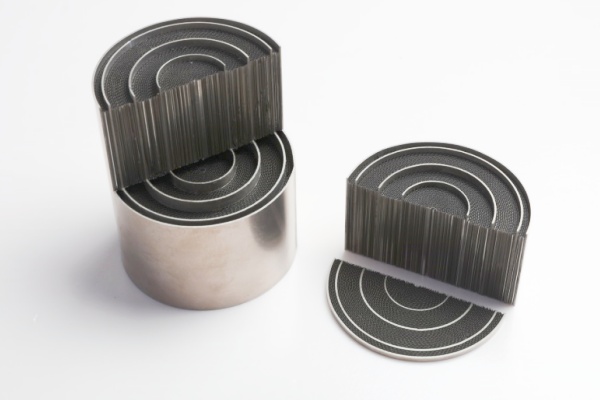
Everything is built around the substrate.
It carries the exhaust flow and holds the catalyst layer. If the substrate fails, nothing else matters.
In industrial systems, metal substrates are widely used. Not because they are cheaper, but because they survive better. Vibration, rapid temperature changes, long operating hours — these conditions are normal in industrial engines.
Ceramic substrates work well in stable environments. In harsh ones, metal usually lasts longer.
The washcoat sits directly on the substrate surface.
Its job is simple: create surface area. In practice, it is one of the most sensitive parts of the converter.
If the washcoat starts to crack or peel, catalytic activity drops fast. This often happens after repeated thermal cycling or poor surface preparation during coating.
Once adhesion is gone, performance loss is permanent.
The active catalyst is embedded in the washcoat.
Platinum and palladium are the most common choices. The ratio depends on exhaust composition, temperature range, and expected sulfur exposure.
In industrial applications, catalyst loading is rarely “standard.” Systems that run continuously need different formulations than engines with frequent load changes.
More catalyst does not always mean better results. Stability matters more.
The housing protects the internal structure and keeps everything aligned.
Most industrial catalytic converter use stainless steel shells. Thickness and weld quality matter more than appearance.
Poor housing design usually shows up later — cracked seams, distorted shells, or internal movement after long-term operation.
Between the substrate and the shell is the mounting mat.
It holds the substrate in place while allowing thermal expansion. Too loose, and the substrate moves. Too tight, and it cracks.
This component is often underestimated. In reality, many early failures start here.
The inlet and outlet cones guide exhaust flow into the substrate.
If gas distribution is uneven, some areas run hotter than others. Over time, those hot spots age faster and lose activity.
Good flow design does not increase efficiency overnight. It protects efficiency over time.
Some industrial systems include ports for temperature or pressure sensors.
They are not mandatory, but they help. Rising backpressure or abnormal temperature patterns often indicate substrate blockage or coating degradation before failure becomes obvious.
An industrial catalytic converter works only when its components are balanced.
A strong substrate cannot compensate for a weak washcoat.
A good catalyst cannot fix poor flow distribution.
Most problems are not material defects. They are design mismatches.
What sits inside an industrial catalytic converter reflects how well the operating conditions were understood at the design stage.
Converters that last are rarely over-engineered.
They are simply designed for how they are actually used.