To be a valuable global supplier
for metallic honeycombs and turbine parts


Contact number
0555-2813555
To be a valuable global supplier
for metallic honeycombs and turbine parts
Technological Innovation
Process Management
Continuous Improvement
Customer Satisfaction

Knowledge
Dedication
Diligence
Loyalty
Responsibility
Confidence
Tenacity
Respect

To be a valuable global supplier
for metallic honeycombs and turbine parts
Release time:2026-08-17
If you're an engineer buying an EMI shielding vent, you already know the basic problem. You need to cool a cabinet and keep RF inside. Those two things fight each other.
A standard grille solves one problem and makes the other worse. A solid panel solves the other and kills airflow. A honeycomb vent solves both – if you pick the right one.
Here's what you actually need to check before you buy.
The Frequency Question
Most people pick a vent based on the equipment's operating frequency. That's wrong. Harmonics, switching noise, and nearby transmitters usually create problems well above the fundamental.
Cell size sets the cutoff. The rule: keep the opening's longest dimension below λ/20 at your highest frequency.
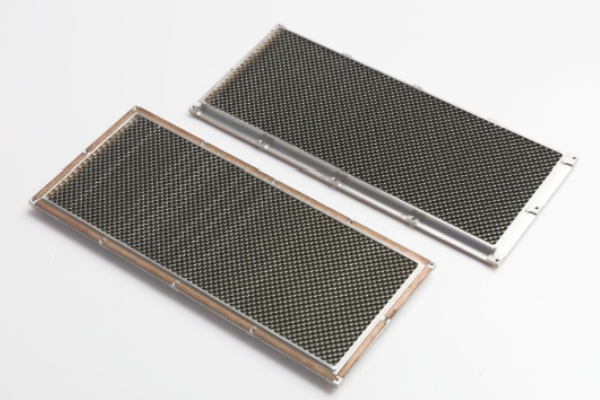
1/4‑inch cells cut off around 600 MHz. Good for low frequencies, airflow is great. 1/8‑inch is the workhorse – cutoff around 1‑2 GHz, 85% open area, covers most telecom and Wi‑Fi. 1/16‑inch cuts off around 3 GHz – 5G, radar, high‑frequency stuff – but open area drops to 75‑80%. 1/32‑inch goes above 6 GHz, 60‑70% open area, only for extreme cases.
The biggest cell that still covers your frequency is the right one. Don't overspec. If your problem is at 2.4 GHz, 1/8‑inch is fine. You don't need 1/16‑inch. You'll just choke airflow for no reason.
Shielding Numbers – Don't Trust One Data Point
Shielding effectiveness is measured in dB. 60 dB means the panel reduces EMI by 99.9999%.
But it varies with frequency. A vent might be 80 dB at 1 GHz and 30 dB at 5 GHz. Ask for the curve across your frequency range, not one number.
40‑50 dB is basic commercial. 60‑70 dB is solid – telecom, industrial. 80‑100 dB is military or medical. 100+ dB is shielded room territory.
Ask for the test report. Not a spec sheet. Report should say IEEE 299 or MIL‑STD‑285 and include batch numbers.
Depth Matters More Than You Think
Cell depth is the underrated parameter. It determines how much attenuation you get.
Rule: depth should be 3 to 4 times cell diameter. A 3.18 mm cell needs at least 12.7 mm. The formula: attenuation (dB) = 32 × t/d, where t is depth and d is diameter.
1/2 inch is standard. 1 inch gives more shielding but doubles pressure drop. At 5 GHz, a 1/8‑inch vent gives about 35 dB at 1/2‑inch depth and 55 dB at 1‑inch. Don't spec 1 inch if you don't need it – you'll lose airflow for shielding you don't use.
Airflow – Open Area and Pressure Drop
Open area is the percentage of empty space. Good honeycomb is 80‑90%. Perforated sheet is 30‑50%. That's why honeycomb flows more air.
Pressure drop is airflow resistance, measured in inches of water or pascals. Higher drop = fans work harder. Typical honeycomb pressure drop is 0.05‑0.5 inches of water at normal ventilation speeds.
Get the pressure drop curve, not just one number. The curve tells you what happens at your operating airflow. If they don't have one, they haven't tested it.
Material and Finish
Aluminum is the cheap one. Light, good conductivity, fine indoors. Doesn't handle salt spray or high vibration.
Steel and stainless are stronger and more durable. Stainless 304 or 316L for outdoor or coastal. Steel is heavier, but it lasts.
Brass is a specialty option – good conductivity and durability.
Surface finish matters too. Bare aluminum is indoor only. Nickel plating adds corrosion resistance and conductivity. Tin plating helps with corrosion. Chromate conversion is basic protection.
Ask what the base material is, what the finish is, and whether it's been salt‑spray tested.
Brazed vs. Bonded – This Is a Big One
Vacuum brazing fuses the metal layers together at high temperature. No adhesive. No aging. Stronger, longer life, handles vibration.
Bonded means glued. Cheaper to make, but adhesive degrades under heat and vibration. Shielding drifts over time.
Brazed is always better for anything that moves or gets hot. Bonded is for light‑duty indoor only.
The Gasket and Installation Are Where Leaks Actually Happen
You can spec the perfect vent and ruin it during installation.
The gasket has to be conductive. Silver‑filled silicone, beryllium copper fingers, or knitted wire mesh. Not foam.
The mounting surface has to be bare metal. Paint is an insulator.
Screw torque matters. Too loose leaves gaps. Too tight warps the frame.
Screw spacing no more than 50 mm. Too far apart and the gasket lifts in the middle.
Ask for the gasket type, torque spec, and surface prep requirement. If they can't give you numbers, they haven't validated their installation procedure.
Test Standards – How Was It Measured?
Numbers without a test method are marketing.
IEEE 299 is the commercial standard for shielding effectiveness. MIL‑STD‑285 is military.
Ask for the test report with batch traceability. One sample tested doesn't mean the whole batch is good.
One More Thing – Environment and Mechanicals
Standard honeycomb vents typically run -40°C to +85°C. If your application is hotter or colder, ask.
Vibration? Steel or stainless for high vibration. Aluminum for light duty.
Corrosion? Stainless 316L for coastal or chemical plants. Nickel‑plated aluminum for moderate humidity.
Don't buy a vent rated for a server room and put it on a train.
Bottom Line – What to Ask Before You Order
What's the shielding at my frequency? Cell size? Depth? Open area and pressure drop curve? Material and finish? Brazed or bonded? Gasket type and torque? Test standard and batch report? Temperature and vibration rating?
Overspec kills airflow. Underspec fails EMC. The right vent balances shielding, airflow, material, and installation.
We make EMI shielding vents. Send us your frequency and airflow requirements. We'll spec the right vent – not the most expensive one, the one that fits.
That's what we do.