To be a valuable global supplier
for metallic honeycombs and turbine parts


Contact number
0555-2813555

To be a valuable global supplier
for metallic honeycombs and turbine parts

Technological Innovation
Process Management
Continuous Improvement
Customer Satisfaction

Knowledge
Dedication
Diligence
Loyalty
Responsibility
Confidence
Tenacity
Respect

To be a valuable global supplier
for metallic honeycombs and turbine parts
Release time:2026-08-05
People ask me this all the time. What's the difference between an RF shielding honeycomb window and a wire mesh shield window? Don't they both stop RF?
They do. But they're not the same thing.
One is a rigid panel with deep metal cells. The other is flexible woven wire. One is for moving a lot of air. The other is for fitting into tight spaces and weird shapes.
Here's what actually separates them – and which one you should use.
How They're Made
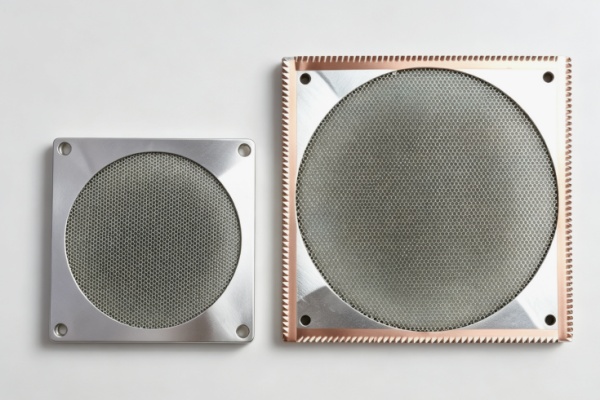
An RF shielding honeycomb window is a block of metal honeycomb – aluminum, steel, or copper – brazed or soldered into a rigid frame. The cells are deep, typically 1/2 inch or more. It's a solid, fixed panel.
A wire mesh shield window is exactly what it sounds like – woven wire, usually copper or Monel, stretched across a frame or laminated between layers of transparent material. It's flexible. It conforms. You can cut it to fit irregular shapes.
One is rigid. One is flexible. That's the first big difference.
How They Shield RF – Different Physics
An RF shielding honeycomb window works on waveguide below cutoff. Each cell is a metal tube. If the tube is small enough and deep enough, RF can't propagate through it. It bounces off the walls and dies. Shielding effectiveness is a function of cell size and depth. A standard steel honeycomb with 1/8‑inch cells and 1/2‑inch depth gives 45‑57 dB from 0.1 MHz to 2.2 GHz.
A wire mesh shield window works differently. It relies on the conductive grid reflecting RF. The shielding performance depends on the wire spacing and how well it's bonded to the enclosure. At low frequencies, coarse mesh can give 50‑60 dB. But at high frequencies, the gaps between wires act like little antennas.
One is geometry. One is conductivity. One works better at high frequencies. One doesn't.
Airflow – The Honeycomb Advantage
If you need to move air, honeycomb wins. Period.
An RF shielding honeycomb window has 80‑90% open area. The straight cells create smooth, laminar airflow with low pressure drop. Air flows almost like an open hole.
Wire mesh? 50‑60% open area at best. The woven wires disrupt airflow. Turbulence. Higher pressure drop.
Same shielding requirement, honeycomb flows more air. Fans work less. Equipment runs cooler.
Durability – Rigid vs. Flexible
Honeycomb is tough. Brazed construction. Rigid frame. Handles vibration and heat. Doesn't tear. Doesn't compress.
Wire mesh is fragile. Snags, tears, compresses. A maintenance guy leaning on it can bend it out of shape. Once it's bent, shielding is compromised.
But that flexibility is also an advantage. Mesh conforms to uneven surfaces. Honeycomb needs a flat, rigid mounting surface.
Sealing and Installation
An RF shielding honeycomb window needs a conductive gasket between the frame and the cabinet – silver‑filled silicone or beryllium copper. The mounting surface has to be bare metal. No paint. No anodize.
Wire mesh is easier to seal in irregular openings. It conforms to gaps. Works with conductive gaskets and seals.
Shielding Performance at High Frequencies
At 1 GHz, a piece of wire mesh might give you 10‑20 dB. At 5 GHz, almost nothing.
An RF shielding honeycomb window with 1/8‑inch honeycomb, 1/2‑inch depth gives 40‑60 dB at 1 GHz. At 5 GHz, 35‑55 dB. Some designs hit 80‑120 dB at microwave frequencies.
That's the gap. Honeycomb works at high frequencies. Mesh doesn't.
MIL-HDBK-419A confirms it: honeycomb ventilation panels allow higher attenuation than mesh screening over a specified frequency range.
Cost
Wire mesh is cheap. Buy it by the roll.
Honeycomb costs more. The manufacturing – corrugating, stacking, brazing – takes work.
But you buy honeycomb once. You might replace mesh multiple times.
When to Use Wire Mesh
Wire mesh is the right choice when:
The opening is an irregular shape
You need flexibility and conformability
You're on a tight budget
Frequency is low (below 1 GHz)
Shielding requirements are modest
You need a see‑through window (mesh laminated in glass)
It's a bug screen, not a shield. Good for fan guards and low‑EMI environments.
When to Use an RF Shielding Honeycomb Window
Honeycomb is the right choice when:
Frequency is above 1 GHz
You need real shielding (40+ dB)
Airflow is critical
The cabinet sees vibration or heat
EMI compliance is mandatory
The mounting surface is flat and rigid
It's a shield. If your equipment matters, use it.
Bottom Line
Wire mesh is cheap, flexible, and easy to install. But it doesn't shield at high frequencies. It's a screen, not a shield.
An RF shielding honeycomb window costs more. It's rigid. But it gives you real shielding at high frequencies, better airflow, and longer life.