To be a valuable global supplier
for metallic honeycombs and turbine parts


Contact number
0555-2813555

To be a valuable global supplier
for metallic honeycombs and turbine parts

Technological Innovation
Process Management
Continuous Improvement
Customer Satisfaction

Knowledge
Dedication
Diligence
Loyalty
Responsibility
Confidence
Tenacity
Respect

To be a valuable global supplier
for metallic honeycombs and turbine parts
Release time:2026-08-04
They're both called windows. Both go on shielded enclosures. Both keep RF where it belongs.
But they're not the same thing. Not even close.
One is for looking through. The other is for moving air. One uses glass with wire mesh. The other uses metal honeycomb.
Here's what separates an electromagnetic window from a waveguide vent window – and why you can't use one in place of the other.
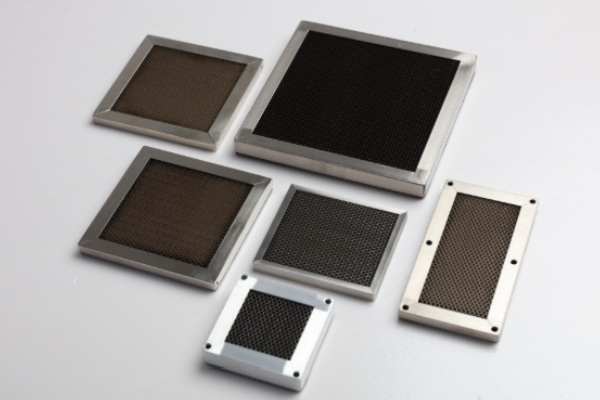
Electromagnetic Window – For Looking
An electromagnetic window is a viewing port. You put it on a shielded room or a cabinet door so you can see what's inside without opening the door.
It's glass or acrylic with a conductive mesh embedded in it. The mesh stops RF. You can still see through it.
Shielding is decent – 40‑60 dB for wire mesh, up to 80‑100 dB for optical mesh. Light transmission is 50‑80%. That's the spec that matters.
It's a solid panel. No air gets through.
Waveguide Vent Window – For Breathing
A waveguide vent window is a vent. You put it over a fan opening or an HVAC duct so air can move in and out.
It's metal honeycomb – aluminum, steel, or copper – in a rigid frame. The cells are waveguides. Small enough and deep enough, and RF can't get through.
Shielding is higher – 80‑120 dB at 1 GHz. Open area is 85‑95%. Airflow is the spec that matters.
It's a block of metal. You can't see through it.
The Core Difference
One is for light. One is for air.
You can't look through a honeycomb vent. You can't blow air through a glass window. They're not interchangeable.
How They Work
Electromagnetic window uses a conductive mesh. The mesh reflects RF. The holes in the mesh are smaller than the wavelength.
Waveguide vent window uses waveguide below cutoff. Each cell is a tube. If the tube is small enough, RF can't propagate. Bounces off the walls and dies.
One relies on surface conductivity. The other relies on geometry.
Where You Use Them
Electromagnetic window: viewing ports on shielded rooms, displays on EMI‑sensitive gear, control panels in military or medical equipment.
Waveguide vent window: cooling fans on cabinets, HVAC ducts on shelters, ventilation openings on anything that needs airflow.
Need to see? Use an electromagnetic window. Need to breathe? Use a waveguide vent window.
Side by Side
Electromagnetic window: light transmission 50‑80%, airflow zero, shielding 40‑100 dB.
Waveguide vent window: light transmission zero, airflow 80‑95%, shielding 80‑120 dB.
They're tested to the same standards – MIL‑STD‑285, IEEE 299. But they do completely different jobs.
Why You Can't Swap Them
An electromagnetic window is a solid panel. No airflow. If you put it over a fan opening, the fan does nothing.
A waveguide vent window is a metal block. No transparency. If you put it over a viewing port, you see nothing.
They solve the same problem – getting something through a shielded wall without leaking RF – but for completely different things.
Light goes through one. Air goes through the other.
Bottom Line
Electromagnetic window = seeing. Glass, mesh, optical clarity. Viewing ports, displays.
Waveguide vent window = breathing. Honeycomb, deep cells, open area. Cooling fans, HVAC.
Both shield RF. Both have their place. But they do different jobs.
We make both. We'll tell you which one fits – not which one we want to sell.