To be a valuable global supplier
for metallic honeycombs and turbine parts


Contact number
0555-2813555
To be a valuable global supplier
for metallic honeycombs and turbine parts
Technological Innovation
Process Management
Continuous Improvement
Customer Satisfaction

Knowledge
Dedication
Diligence
Loyalty
Responsibility
Confidence
Tenacity
Respect

To be a valuable global supplier
for metallic honeycombs and turbine parts
Release time:2026-08-01
Air that hasn't been straightened is a mess. Swirls, eddies, turbulence – the velocity profile is all over the place. That's a problem if you need consistent airflow for testing, combustion, or thermal management.
A honeycomb flow straightener for air fixes this. It takes that chaotic mess and turns it into smooth, straight, laminar flow.
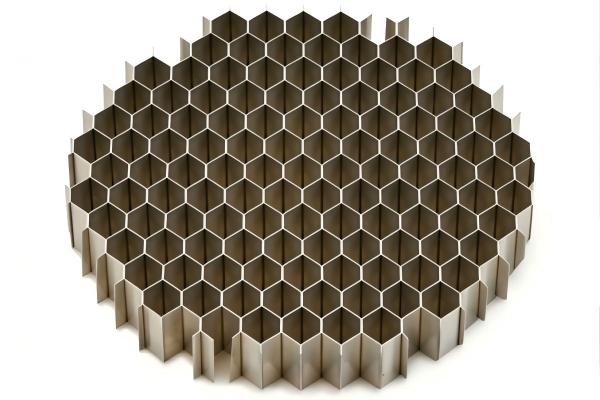
The Core Principle – Split, Constrain, Straighten
A honeycomb flow straightener for air is exactly what it sounds like – a block of honeycomb-shaped channels. Usually metal or plastic. Thousands of small parallel tubes, side by side.
When turbulent air enters these tubes, two things happen.
First, lateral motion gets killed. The tube walls physically block cross-flow. Swirl and eddies can't keep spinning – they hit the walls and die.
Second, flow gets forced straight. Every air molecule that enters a tube has to travel along the tube's axis. Any component of velocity that isn't parallel to the tube gets redirected.
The result: turbulent, swirling air enters the honeycomb. Smooth, straight, laminar air comes out the other side.
The Numbers That Matter – L/D Ratio
The most important parameter for a honeycomb flow straightener for air is the length-to-diameter ratio – how long the tubes are relative to their width.
If the tubes are too short, the air doesn't have enough time to straighten out. It exits still swirling.
If the tubes are long enough, the flow becomes fully straightened.
For effective straightening, you want an L/D ratio of at least 6 to 8. That's the sweet spot. Longer gives you even straighter flow, but it also increases pressure drop.
Open Area – The Tradeoff
The honeycomb structure has high open area – typically 80% or more. That's good because it means low pressure drop. Air flows through without much resistance.
But if you need very straight flow, you might need to increase the L/D ratio. That means longer tubes. Longer tubes mean more friction. More friction means higher pressure drop.
So there's always a tradeoff: more straightening costs more pressure. You pick the balance that fits your application.
What It Looks Like in Practice
A classic use: wind tunnels. The honeycomb flow straightener for air sits downstream of a fan or a turning vane, smoothing out the turbulence before the air enters the test section.
Another use: flow meters. To get accurate readings, the air has to be straight and uniform before it hits the sensor. A honeycomb straightener does that.
And in HVAC systems: duct turns create swirl. A honeycomb straightener after a turn helps the air settle down before it reaches the diffuser or outlet.
Some designs combine a honeycomb with a damping screen – a fine mesh that further reduces turbulence. The honeycomb straightens the direction. The screen evens out the velocity profile.
Why It Works Better Than Just Perforated Sheet
Perforated sheet has holes, but they're short. No depth. Air goes through, but the swirl doesn't get killed. It just gets chopped up – not straightened.
Honeycomb flow straightener for air has depth. The tubes give the air room to settle, redirect, and straighten. That's the difference between a simple screen and a real flow straightener.
In wind tunnels, a honeycomb is often used in combination with screens to achieve a turbulence intensity below 0.01%. That's the kind of performance you need for serious aerodynamic testing.
What to Look For
If you're buying a honeycomb flow straightener for air, check:
Cell size. Smaller cells mean more channels, better straightening, but higher pressure drop. Choose based on your flow rate and space.
Depth. Longer tubes = straighter flow. But more pressure drop. Most applications use an L/D ratio of 6:1 to 8:1.
Material. Aluminum is standard. Stainless for high temperatures or corrosive environments. Plastic for light-duty or non-conductive applications.
Open area. 80% or higher is typical. Less than that, and pressure drop climbs fast.
Bottom Line
A honeycomb flow straightener for air works by splitting turbulent airflow into thousands of tiny parallel channels. The tube walls kill swirl and force the flow straight. The result is smooth, laminar airflow that you can actually count on.
Cell size and L/D ratio control the straightening effect. Open area controls pressure drop. Choose the balance that fits your airflow and your tolerance for backpressure.
We make honeycomb flow straighteners for air – for wind tunnels, HVAC, flow meters, and anything else that needs straight air. That's what we do.