To be a valuable global supplier
for metallic honeycombs and turbine parts


Contact number
0555-2813555
To be a valuable global supplier
for metallic honeycombs and turbine parts

Technological Innovation
Process Management
Continuous Improvement
Customer Satisfaction

Knowledge
Dedication
Diligence
Loyalty
Responsibility
Confidence
Tenacity
Respect

To be a valuable global supplier
for metallic honeycombs and turbine parts
Release time:2026-07-31
Energy storage inverter cabinets are a pain. High power, high heat, high EMI. The inverter itself is a noise machine – IGBTs switching on and off at high frequencies, throwing RF everywhere. And all that power dissipation means heat. Lots of it.
So you need two things. You need airflow – a lot of it. And you need to keep RF inside the cabinet. Those two things fight each other. Cut a hole for cooling, and you open a door for EMI. Seal it tight, and your inverter cooks.
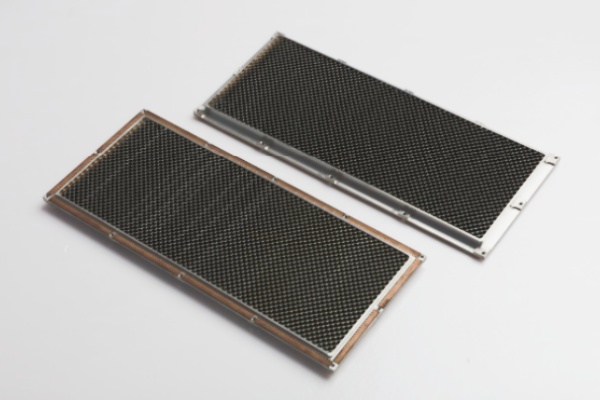
An integrated aluminum honeycomb vent solves both problems in one panel. Here's how it works – and what to look for.
Heat and EMI Fight Each Other
Energy storage inverters are power‑dense. A typical PCS cabinet might dissipate 5‑10 kW of heat or more. Forced air cooling is the standard – fans pulling air through the cabinet.
But every ventilation opening is a leakage path for EMI. The inverter's high‑frequency switching produces broadband noise that radiates through any gap. A plain vent with punched holes? That's an antenna.
So you need a vent that blocks RF without blocking airflow. That's where the honeycomb comes in.
How an Aluminum Honeycomb Vent Works
The vent is a piece of aluminum honeycomb – thin foil formed into hexagonal cells – mounted in a rigid frame. Each cell acts as a waveguide below cutoff. If the tube is small enough relative to the wavelength, the wave can't propagate. It hits the walls, bounces around, and loses energy.
A standard 3.2 mm cell with 12.7 mm depth has a cutoff around 48 GHz. That means the vent gives you solid shielding from DC up to roughly 48 GHz. Air molecules don't care – they flow right through. The honeycomb has high open area – typically 85‑95% – so airflow is nearly unrestricted.
Cell size sets the cutoff. Smaller cells block higher frequencies. Depth sets attenuation. Deeper cells give more shielding. A typical 3.2 mm cell, 12.7 mm deep gives about 110 dB shielding below cutoff.
What to Look For
Cell size. Match it to your highest frequency. For most energy storage inverters, the main EMI is in the 1‑30 MHz range, with harmonics reaching hundreds of MHz. Standard 1/8‑inch (3.2 mm) cells are usually sufficient. If you have higher frequency concerns – 5G nearby, radar – consider 1/16‑inch cells. Smaller cells shield better but hurt airflow.
Depth. 1/2 inch (12.7 mm) is standard and gives plenty of shielding for most jobs. Deeper vents give more attenuation but add pressure drop.
Material. Aluminum is the default. Light, cost‑effective, shields well. For outdoor or corrosive environments, use nickel‑plated aluminum or stainless steel.
Open area. Look for 85% or higher. Below that, fans struggle. Some designs hit 95%.
Cross‑cell. Two layers of honeycomb offset at 90 degrees can bump up shielding with only a small airflow hit.
Installation – Don't Screw It Up
You can spec the perfect vent and ruin it with bad installation.
Conductive gasket. The frame needs a conductive gasket between itself and the cabinet – knitted wire mesh, beryllium copper, or conductive elastomer. No gasket, no seal. RF leaks around the edges.
Bare metal surface. Paint is an insulator. Scrape it off where the gasket sits. The vent needs direct metal‑to‑metal contact.
Screw torque. Too loose, gaps. Too tight, frame warps. Warped frame means uneven gasket compression – more gaps.
Screw spacing. Every 50 mm or less. Too far apart, the gasket lifts in the middle.
Clean regularly. Dust blocks cells, reduces airflow, and can affect shielding.
Where to Put the Vent
Location matters. Put ventilation openings on the sides or bottom of the cabinet – lower field areas. Shielded fans with conductive blades and frames also help.
Bottom Line
Energy storage inverter cabinets need cooling and shielding. A plain vent solves one problem and makes the other worse. A solid panel solves one and kills the other.
An integrated aluminum honeycomb vent does both. Air flows through with minimal pressure drop, while the waveguide‑below‑cutoff effect blocks RF from DC to 48 GHz and beyond.
Cell size for frequency. Depth for attenuation. Gasket for sealing. Get those right, and you've got a vent that keeps your inverter cool and your EMI inside.
We make aluminum honeycomb vents for energy storage cabinets. That's what we do.