To be a valuable global supplier
for metallic honeycombs and turbine parts


Contact number
0555-2813555
To be a valuable global supplier
for metallic honeycombs and turbine parts
Technological Innovation
Process Management
Continuous Improvement
Customer Satisfaction
Knowledge
Dedication
Diligence
Loyalty
Responsibility
Confidence
Tenacity
Respect

To be a valuable global supplier
for metallic honeycombs and turbine parts
Release time:2026-07-28
High-speed rail onboard cabinets are not the same as ground‑based server rooms. Ground‑based gear sits still. A train car keeps moving. Vibration, shock, temperature swings, and EMI—all four hit the cabinet at the same time. A standard EMI vent panel from a server room? Six months later the screws are loose, the honeycomb is cracked, and the gasket has peeled off.
Rail transit onboard equipment has its own set of standards. EN 50155 covers the general requirements for electronic equipment used on rolling stock. IEC 61373 specifically covers vibration and shock testing. Together, these standards determine what onboard cabinets have to survive.
What Onboard Cabinets Face in Vibration
When a high‑speed train runs, the entire car vibrates in three directions. Up‑and‑down, side‑to‑side, front‑to‑back. The vibration is worst near the bogies (the wheel assemblies). The car body sees less shaking, but it never stops.
IEC 61373 divides equipment into three mounting categories:
Body‑mounted – lower vibration, but it goes on for hours and hours
Bogie‑mounted – much higher vibration levels
Axle‑mounted – the worst case, with shocks up to 30g
Most onboard electronic cabinets are body‑mounted. But even at the lowest category, the vibration is continuous broadband random vibration, with peak acceleration up to 5g. That's not a lab test you run once and forget. That's the entire service life. A standard EMI vent panel wasn't designed for this.
Why Standard EMI Vent Panels Fail
Standard honeycomb EMI vents have a few weak points.
Brazed joints – Under continuous vibration, brazed joints fatigue. Micro‑cracks start, spread, and eventually the honeycomb layers come loose.
Frame mounting – A standard vent is held to the cabinet wall with screws. Vibration loosens screws over time. Loose screws mean gaps. Gaps mean RF leakage paths.
Gaskets – Elastic gaskets age, harden, and lose their seal under constant vibration and temperature change. Once the seal breaks, RF leaks around the edge.
Material strength – Standard aluminum honeycomb fatigues and cracks under high vibration. Onboard cabinets need more structural margin.
These aren't occasional production defects. They're design flaws for this environment. Standard vents weren't built for rail transit.
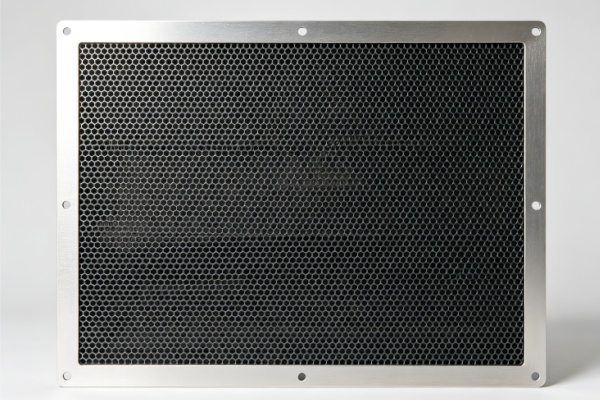
How We Build High Vibration Resistant EMI Vents for Onboard Cabinets
The EMI ventilation panels we send to high‑speed rail onboard cabinets are different from the standard ones in several ways.
Honeycomb: stainless steel, not aluminum. Stainless has much higher fatigue strength than aluminum. Under the same vibration, aluminum honeycomb might crack in a few years. Stainless holds up longer. Stainless tensile strength is more than double that of aluminum, and its fatigue performance is significantly better.
Brazing: vacuum brazed, not glued. Vacuum brazing fuses the metal itself at high temperature, forming a metallurgical bond. No adhesive to age, no glue to get brittle. Some designs use multi‑layer offset honeycomb to further improve vibration resistance.
Frame: welded stainless steel, not bolted aluminum extrusions. A welded frame has much higher rigidity than a bolted assembly. No bolted connections means nothing to loosen. Welded frames can meet EN 15085 CL2 welding standard.
Gasket: beryllium copper fingers, not conductive rubber. Beryllium copper is a metal spring. No rubber to age, no elasticity to lose. It maintains contact pressure under vibration. Conductive rubber loses its spring over time under continuous vibration and thermal cycling.
Mounting: reinforced, not standard screws. Standard screws loosen under vibration. We use locking washers, thread‑locking compound, or double nuts. Some designs use through‑bolts with vibration‑damping bushings.
Design Details to Watch
Honeycomb depth. Depth gives the electromagnetic wave more wall bounces – more attenuation. But deeper honeycomb also restricts airflow. Onboard cabinets need a balance between shielding effectiveness and cooling. High‑speed rail environments often have wide frequency ranges, so you need good margin on attenuation.
High open area. Onboard cabinets generate a lot of heat. The ventilation panel needs 85% open area or more. Lower open area means less fan efficiency and higher internal temperatures.
Reliable grounding. The EMI vent's shielding effect depends on proper grounding. Paint and oxide layers must be scraped off the mounting surface to expose bare metal. The ground path must be continuous with no breaks. Poor grounding ruins even the best honeycomb.
Actual Testing
IEC 61373 Category 1 Class B vibration testing is done in two stages. First, simulated long‑life vibration testing – applied in all three axes. This simulates the cumulative vibration fatigue over the equipment's entire service life. Then, functional random vibration testing – simulating the continuous random vibration the equipment sees during normal operation.
A product that passes both tests must show no cracks, no loose fasteners, and no drop in shielding effectiveness after testing. EMI vent shielding effectiveness is measured before and after vibration testing to make sure vibration hasn't degraded performance.
Bottom Line
A high vibration resistant EMI shielding ventilation board for high‑speed rail onboard cabinets isn't just a thicker version of a standard vent. It needs stainless steel honeycomb, vacuum brazing, a welded frame, beryllium copper finger gaskets, and locking fasteners – every design choice aimed at surviving continuous vibration.
EN 50155 sets the requirements. IEC 61373 sets the test methods. A product that passes both is what goes on the train.
We make these ventilation boards. Not just any honeycomb panel goes on a high‑speed train. It has to take vibration, block RF, and move heat – all three, no exceptions.
That's what we do.