To be a valuable global supplier
for metallic honeycombs and turbine parts


Contact number
0555-2813555
To be a valuable global supplier
for metallic honeycombs and turbine parts

Technological Innovation
Process Management
Continuous Improvement
Customer Satisfaction

Knowledge
Dedication
Diligence
Loyalty
Responsibility
Confidence
Tenacity
Respect

To be a valuable global supplier
for metallic honeycombs and turbine parts
Release time:2026-07-27
Subway and railway signal cabinets aren't the same as ordinary server room cabinets.
A regular server cabinet leaking a bit of RF might just cause a computer to stutter. A signal cabinet leaking? That could mean a switch doesn't throw. A train doesn't get the command. That's not something you fix with a reboot.
That's why rail transit signal equipment has its own EMC standards. In China, there's GB/T 24338.5. Internationally, there's EN 50121-4 and IEC 62236-4. These standards specify how much interference signal equipment can radiate, and how much external interference it has to withstand. The signal cabinet itself is the first line of defense.
Signal Cabinets – Cooling and Shielding Fight Each Other
Signal cabinets are packed with gear. They generate heat. No ventilation, and the equipment cooks. Cut ventilation holes, and EMI leaks out through the openings – or sneaks in from outside. A row of cooling slots is basically an open door for electromagnetic waves.
Ordinary server rooms can get away with wire mesh or perforated sheet. Railway signal cabinets can't. Traction power radiation, electromagnetic pulses from passing trains, interference from nearby high‑power equipment – the energy levels are in a different league. Ordinary mesh won't stop it.
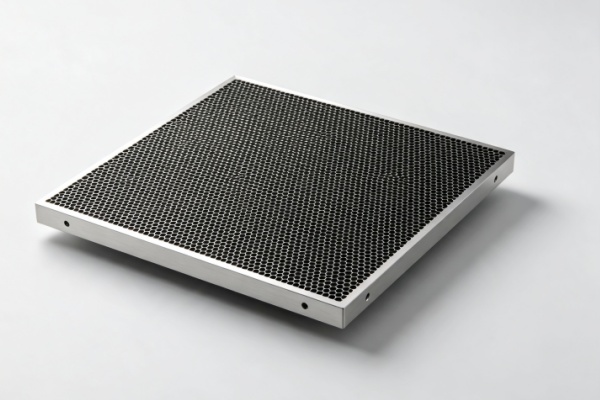
So signal cabinet ventilation openings need something specific – waveguide vent panels.
How a Waveguide Vent Panel Works
Inside a waveguide vent panel is metal honeycomb. Each little cell is a waveguide channel. The cell size and depth are calculated – the electromagnetic wavelength is larger than the cell opening, so it can't get through. It bounces around inside the cell walls and loses energy. Air molecules are much smaller than EM waves, so they pass right through unaffected.
That's the waveguide below cutoff principle. Air passes. RF doesn't.
A properly designed waveguide vent panel can deliver 40‑80 dB of shielding effectiveness across the frequency range signal cabinets care about (tens of MHz to several GHz). The exact number depends on cell size and depth – smaller cells block higher frequencies but increase airflow resistance. Deeper cells give more attenuation but also reduce airflow.
Sizing the Vent Panel for Signal Cabinets
Frequency. Figure out what frequency band the signal cabinet operates in, and what interference sources are nearby (traction power, wireless comms, radar, etc.). The cell size needs to block those frequencies.
Airflow. The cabinet's heat load determines how much ventilation area you need. Open area needs to be above 85%, otherwise the fans are just spinning their wheels.
Material. Rail signal cabinets have environmental requirements – temperature, humidity, vibration, shock. Aluminum is light but not as strong. Stainless steel resists corrosion and vibration better – a better fit for rail environments.
Sealing. The vent frame needs a conductive gasket between itself and the cabinet. No gasket, and all that shielding work is wasted. RF leaks around the edges.
Grounding. The shielding effect of a waveguide vent panel depends on proper grounding. The frame must make good electrical contact with the cabinet. Paint and oxide layers have to be scraped off.
Things That Go Wrong During Installation
Mounting surface not stripped. The vent relies on electrical contact between the frame and the cabinet to complete the shielding loop. Paint is an insulator. Leave it on, and you might as well not have installed the vent.
Wrong screw torque. Too loose, and the gasket doesn't compress – gaps. Too tight, and the frame warps – the gasket lifts. Follow the spec.
Screw spacing too wide. More than 50 mm apart, and the gasket bulges in the middle. No seal.
Wrong gasket. Rail signal cabinet EMC vent solutions use proper conductive EMC gaskets – not ordinary foam strips. Foam doesn't conduct. It doesn't shield.
Where These Go
Subway and railway signal control cabinets, comms cabinets, computer‑based interlocking cabinets, train control center cabinets – all of them need anti-EMI vent panels. The structural design of railway signal equipment cabinets has to account for EMC, including ventilation opening shielding. Some signal rooms use an integrated steel enclosure to form a single equipotential bonding plane, but the cabinet's own ventilation openings are still the weak link – that's where waveguide vent panels come in.
Rail transit signal equipment has tighter EMC requirements than ordinary industrial gear. Using ordinary punch plate or wire mesh to cut corners means failing EMC testing, and possibly failing in operation too.
Bottom Line
Anti‑EMI vent panels for subway and railway signal cabinets aren't anything exotic. They're waveguide honeycomb panels – cell size and depth calculated so air passes through and RF doesn't.
When selecting, look at frequency, airflow, material, sealing, and grounding. During installation, strip the paint, torque to spec, and use the right gasket.
Ordinary server rooms can cut corners. Signal cabinets can't. A signal cabinet leak isn't a reboot problem. It's a safety problem.
We make these vent panels. That's what we do.