To be a valuable global supplier
for metallic honeycombs and turbine parts


Contact number
0555-2813555
To be a valuable global supplier
for metallic honeycombs and turbine parts
Technological Innovation
Process Management
Continuous Improvement
Customer Satisfaction

Knowledge
Dedication
Diligence
Loyalty
Responsibility
Confidence
Tenacity
Respect

To be a valuable global supplier
for metallic honeycombs and turbine parts
Release time:2026-07-24
If you've ever looked at ventilation panels, you've seen three types. Punch plate. Metal mesh. AndEMI honeycomb vents. They all look like they do the same thing – let air through. But they're completely different. Here's what actually separates them.
A punched metal sheet. Round holes, usually. Nothing fancy.
How it works: Air goes through the holes. That's it.
Shielding: At 1 GHz, maybe 10‑15 dB. At 2 GHz, you're lucky to get 10 dB. At 5 GHz, it's basically zero. The holes act like slot antennas. RF leaks out like water through a screen door.
Airflow: 30‑50% open area. Not great. Fans work harder.
Durability: Fine indoors. Dents if you hit it.
Cost: Cheap. Buy it by the sheet.
Where to use: Low‑frequency, no‑EMI environments. Old gear that doesn't need EMC testing.
Bottom line: It's a screen, not a shield.
Woven wires. Like a heavy window screen.
How it works: Air goes through the gaps. Looks like it might block RF. It doesn't.
Shielding: At 1 GHz, maybe 15‑20 dB. At 5 GHz, almost nothing. The irregular gaps between wires act like little antennas. RF walks right through.
Airflow: 50‑60% open area. Better than punch plate, but still restrictive.
Durability: Fragile. Snags, tears, compresses. A maintenance guy leaning on it bends it out of shape.
Cost: Cheap.
Where to use: Bug screens, fan guards. Not for serious EMI.
Bottom line: Better than punch plate, but still not shielding.
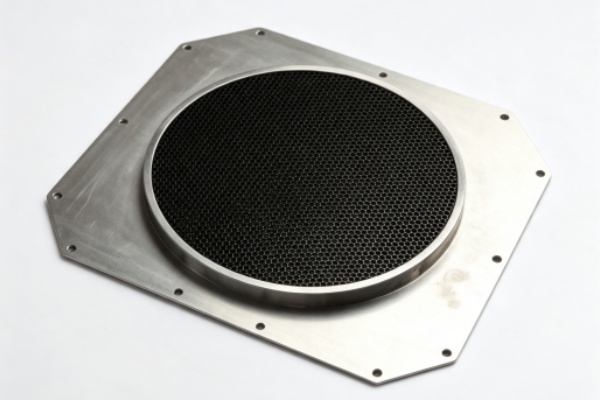
Metal honeycomb in a rigid frame. Each cell is a waveguide. The cell size and depth are designed to create a waveguide‑below‑cutoff effect. RF goes in, bounces off the walls, and dies.
How it works: The cells are deep enough and small enough that RF can't propagate through. Air molecules don't care – they flow right through.
Shielding: 40‑60 dB at 1 GHz. 35‑50 dB at 5 GHz. Some designs hit 80‑120 dB at microwave frequencies. The cells force RF to bounce and attenuate.
Airflow: 80‑95% open area. Straight cells create laminar flow with low pressure drop. Better airflow than mesh or punch plate.
Durability: Rigid frame, brazed construction. Handles vibration, heat, and repeated handling.
Cost: Higher than mesh or punch plate. But you buy it once.
Where to use: Any cabinet with sensitive electronics, EMC compliance, or high frequencies. 5G, telecom, military, medical, industrial control.
Bottom line: This is a shield.
Punch plate: moves air. No depth. Holes leak RF. 30‑50% open area. Cheap. Use it where EMI doesn't matter.
Wire mesh: moves air. Irregular gaps. Slightly better than punch plate, still useless at high frequencies. Fragile. Cheap. Use it for bug screens.
Honeycomb vent: moves air and blocks RF. Waveguide cutoff. 80‑95% open area. Rigid frame, conductive gasket, brazed construction. Costs more. Use it when equipment matters.
A customer had a cabinet with mesh vents. Failed EMC at 2 GHz. Swapped to honeycomb – same size, same airflow. Shielding went from 15 dB to 50 dB. Passed the test. The mesh saved them $50. It cost them weeks of troubleshooting.
Punch plate and mesh vents move air. They don't shield. Honeycomb moves air and shields. That's the difference.
If your equipment matters, use honeycomb. That's what we do.