To be a valuable global supplier
for metallic honeycombs and turbine parts


Contact number
0555-2813555
To be a valuable global supplier
for metallic honeycombs and turbine parts

Technological Innovation
Process Management
Continuous Improvement
Customer Satisfaction

Knowledge
Dedication
Diligence
Loyalty
Responsibility
Confidence
Tenacity
Respect

To be a valuable global supplier
for metallic honeycombs and turbine parts
Release time:2026-07-06
If you've ever looked at a cabinet ventilation opening, you've seen two types of panels. One looks like a piece of metal with holes punched in it. The other looks like a honeycomb in a frame.
They both let air through. The difference is everything else.
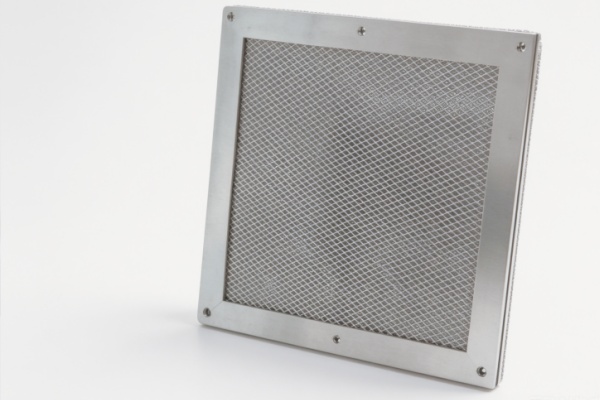
A high screen efficiency ventilation window is an engineered waveguide honeycomb panel. Thin metal walls, lots of small cells, deep channels. The cell size and depth are calculated to create a waveguide‑below‑cutoff effect. RF above a certain frequency can't propagate through the cells.
An ordinary shield vent board is perforated sheet or wire mesh in a frame. The holes are sized for airflow, not shielding. There's no depth, no waveguide effect.
One is engineered. The other is metal with holes.
Shielding Performance – Where the Gap Shows
A standard perforated vent panel at 1 GHz might give you 10-20 dB. At 5 GHz, almost nothing. The holes act like little slot antennas. RF goes right through. At high frequencies, it's worse than a screen door.
A high screen efficiency ventilation window with 1/8‑inch honeycomb, 1/2‑inch depth gives you 40-60 dB at 1 GHz. At 5 GHz, 35-55 dB depending on depth. The waveguide cells force RF to bounce off the walls and die.
The gap at 2 GHz? The honeycomb is blocking 10,000 to 100,000 times more signal than a perforated plate.
Airflow – The Surprise
People assume the perforated plate flows better because it's thinner. Not necessarily.
A high screen efficiency ventilation window has 80-90% open area. The straight cells create laminar airflow with low pressure drop.
Perforated sheet? 30-40% open area. Sharp edges create turbulence. Higher pressure drop.
Wire mesh? 50-60% open area. Irregular holes. Worse airflow than honeycomb.
One customer had a server rack overheating with perforated sheet vents – 40% open area. Fans maxed out. Swapped to a high screen efficiency ventilation window – 1/8‑inch honeycomb, 85% open area. Temperature dropped 12°C. Same fans, same cabinet.
The Physics Behind Each One
An ordinary vent panel is just holes. Air goes through. RF goes through. At high frequencies, it's completely ineffective.
A high screen efficiency ventilation window uses waveguide cutoff. The cells are deep enough and small enough that RF above cutoff can't propagate. It bounces off the walls and dies. Air molecules don't care – they flow right through.
That's the whole trick.
Sealing and Installation
An ordinary vent panel bolts on and you're done. No electrical bonding needed. But if you need shielding, it doesn't provide it.
A high screen efficiency ventilation window needs a conductive gasket between the frame and the cabinet – silver‑filled silicone or beryllium copper. The mounting surface must be bare metal. No paint. No anodize. Torque to spec.
We've fixed more "bad vents" by scraping paint off the cabinet than by replacing the honeycomb.
Cell Size – Matching the Frequency
The cell size of a high screen efficiency ventilation window determines what frequencies it blocks.
Quarter‑inch cells give you a cutoff around 600 MHz, open area around 90% – good for low frequencies and maximum airflow.
1/8‑inch cells give you a cutoff around 1.5 GHz, open area around 85% – the workhorse for telecom, 4G, and Wi‑Fi.
1/16‑inch cells give you a cutoff around 3 GHz, open area around 75-80% – for 5G, radar, and satellite applications.
Don't overspec. 1/8‑inch is the workhorse. 1/16‑inch only if you really need it – it hurts airflow.
Depth – The Underrated Knob
Most people look at cell size and stop. Depth matters just as much.
At 5 GHz, a 1/8‑inch cell, 1/2‑inch deep vent might give you 35 dB. Same cell size at 1‑inch depth might give you 55 dB.
But depth kills airflow. Pressure drop roughly doubles.
Durability and Maintenance
An ordinary vent panel is simple to maintain. But it offers no EMI protection.
A high screen efficiency ventilation window requires inspection over time. Corrosion, deformation, or contamination can reduce shielding performance.
In dusty or humid environments, waveguide plates with narrow channels can trap dust more easily. Honeycomb vents are often easier to clean and less prone to complete blockage.
Which One Should You Use?
Use an ordinary vent panel when EMI is not a concern, systems are non‑sensitive, and cooling is the only requirement.
Use a high screen efficiency ventilation window when shielding continuity must be maintained, EMC compliance is mandatory, or system stability depends on EMI control.
Bottom Line
An ordinary shield vent board moves air. It's cheap, simple, and provides no shielding at high frequencies.
A high screen efficiency ventilation window moves air and stops RF. Waveguide honeycomb. 80-90% open area. 40-60 dB shielding at 1 GHz. Requires proper gasket and grounding.
The perforated plate isn't a deal – it's a compromise. At high frequencies, it's not even that.
We make high screen efficiency ventilation windows. We've tested them against ordinary vent panels. We know the difference.