To be a valuable global supplier
for metallic honeycombs and turbine parts


Contact number
0555-2813555
To be a valuable global supplier
for metallic honeycombs and turbine parts

Technological Innovation
Process Management
Continuous Improvement
Customer Satisfaction

Knowledge
Dedication
Diligence
Loyalty
Responsibility
Confidence
Tenacity
Respect

To be a valuable global supplier
for metallic honeycombs and turbine parts
Release time:2026-07-02
If you work with industrial enclosures or electronic system design, you probably don’t think about shielding vents all that often. They’re one of those quiet, set-it-and-forget-it components that do two jobs at once: pull hot air out to keep circuits from overheating, and block EMI/RFI noise from messing with sensitive internal electronics. Stick them in a dry, temperature-controlled server room or factory floor, and they’ll chug along for years with barely any attention.
Throw humidity into the mix, though, and things get messy fast. Any field tech who’s dealt with outdoor enclosures or coastal facilities knows the drill. A brand new vent tests great on day one — airflow is solid, shielding numbers hit spec, everything looks good. Then six months, a year, two years down the line, EMI performance starts slipping. Weird part? Air still flows through just fine. Humidity doesn’t snap things overnight. It works slow, eating away at performance little by little until you’ve got a vent that looks fine but doesn’t shield like it should.
Below we’ll walk through the actual ways humidity breaks down shielding vents over time, and what you can do about it.
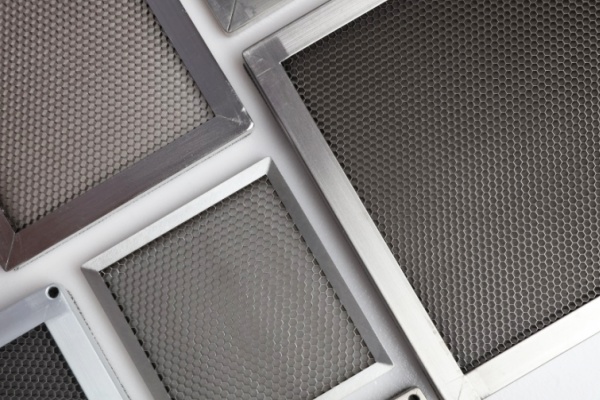
Let’s get the basics out of the way: EMI shielding works because metal conducts. Whether it’s a honeycomb grid or a woven mesh, the whole principle relies on a continuous, low-resistance metal surface to reflect and absorb electromagnetic energy. Clean metal = good shielding. That’s the whole game.
Constant humidity puts a stop to that. Moisture in the air condenses into an ultra-thin film across every surface of the vent — inside the honeycomb cells, along the mesh strands, around the mounting flange, everywhere. That film acts like a weak electrolyte, kicking off slow electrochemical oxidation. Even plated surfaces aren’t safe forever. It doesn’t show up as big rust patches at first. It starts microscopically, thin oxide layers spreading across the metal, month after month.
Once those oxide layers form, conductivity drops. The continuous conductive shield gets patchy, full of high-resistance spots. EMI doesn’t even have to work hard to leak through. In really harsh environments — near the ocean, inside steam-heavy production areas — corrosion eventually eats through plating, pits the surface, and can even deform the cell structure. At that point, shielding effectiveness falls off a cliff.
Here’s one a lot of people miss. A shielding vent doesn’t shield by itself. It only works when it’s electrically bonded tight to the enclosure wall, so the whole housing acts as one continuous Faraday cage. Break that bond, and you’ve got a leak — no matter how good the vent itself is.
Most installations put two different metals together. Vents are usually steel, nickel-plated steel, or copper alloy. Enclosures are almost always aluminum. In dry air, that’s fine. Add moisture, and you’ve got a galvanic cell right there at the contact surface. Humidity creeps into the tiny gaps between vent flange and enclosure wall, and corrosion starts eating away at the connection points. Non-conductive corrosion products build up in the joint, pushing resistance higher and higher.
You’ll stare right at it during an inspection and never notice. The vent looks intact, the screws are tight, everything appears normal. But underneath, the electrical bond is gone. Shielding fails from the edges in, not from the center out. It’s one of the most common — and most overlooked — failure modes in humid installations.
Humid air is rarely just moist. It also carries dust, lint, salt particles, and whatever else is floating around the facility. When that moisture condenses on the vent, it traps all those particles like glue. They stick inside the honeycomb cells, build up on mesh wires, and accumulate slowly, layer by layer.
At first you won’t notice. Airflow barely changes. But shielding vents are engineered to exact dimensions — cell size, channel depth, open area ratio — all tuned for specific frequency bands. Fill those channels halfway with dust and gunk, and the geometry changes. The carefully calibrated EMI attenuation falls apart.
It gets worse from there. The trapped gunk holds moisture against the metal, speeding up corrosion from the inside out. Corrosion roughens the surfaces, which catches more dust, which holds more moisture. It’s a feedback loop. Left alone long enough, performance degrades faster and faster each year.
Every shielding vent install uses some kind of seal — conductive gaskets, foam strips, edge trim. They fill small gaps, ensure even contact, and stop EMI from leaking around the edges. They’re also usually the first thing to go in a humid environment.
Polymer-based seals and gaskets hate constant moisture. Over time they harden, lose their spring, and develop tiny cracks you can’t see. The conductive fillers inside them oxidize, too, so even if the gasket still feels somewhat soft, it’s no longer electrically consistent.
Once a gasket goes bad, gaps open up around the perimeter of the vent. Those gaps become EMI highways. More than a few field service calls end the same way: pull the vent off, replace the gasket, and shielding numbers jump right back to spec. The metal vent was fine — the seal was the actual failure point.
None of this is inevitable. Humidity-related failure is slow and cumulative, which means you can head most of it off with a few smart choices up front and basic upkeep on the back end.
Pick the right materials first. If you’re installing in coastal areas, washdown zones, or permanently humid facilities, skip standard carbon steel vents. Go with passivated stainless steel or high-grade nickel-plated units built for corrosion resistance. The upfront cost is higher, but the service life difference is enormous.
Handle the dissimilar metal issue. Use corrosion-resistant conductive gaskets between vent and enclosure to break the galvanic path. Make sure mounting surfaces are flat and seated fully — gaps are where moisture gets trapped and corrosion starts.
Clean them periodically. Blow out dust and residue with compressed air, or gently brush the surfaces on a regular schedule. It’s low-effort, low-cost maintenance that stops the clog-and-corrosion cycle before it gains momentum.
Manage enclosure humidity. Breathable, waterproof pressure relief valves help equalize pressure and cut down on internal condensation. Less moisture inside the cabinet means less stress on the vents and seals.
Shielding vents don’t usually fail in humid environments from one big event. They fail from a thousand small, quiet ones: tiny oxidation spots, creeping contact resistance, slow buildup inside the cells, gaskets losing their bounce. All of it adds up, silently, until the shielding performance is noticeably gone.
For anyone specifying or maintaining enclosures in damp climates, the takeaway is simple: don’t treat vents as a fire-and-forget part. Pick appropriately for the environment, budget for light routine care, and you’ll get far more reliable — and far longer — performance out of them.