To be a valuable global supplier
for metallic honeycombs and turbine parts


Contact number
0555-2813555
To be a valuable global supplier
for metallic honeycombs and turbine parts

Technological Innovation
Process Management
Continuous Improvement
Customer Satisfaction

Knowledge
Dedication
Diligence
Loyalty
Responsibility
Confidence
Tenacity
Respect

To be a valuable global supplier
for metallic honeycombs and turbine parts
Release time:2026-06-22
Large shielded rooms are a pain. You build a Faraday cage to keep RF out. Then you cut a hole for air conditioning. And that hole becomes the weakest link – especially at low frequencies.
Low‑frequency magnetic fields are the hardest to block. They laugh at thin metal screens. They slip through gaps that would stop high‑frequency RF cold. If your shielded room has a vent that wasn't designed for low frequencies, you're leaking. Maybe a lot.
Here's how we fix that.
Why Low Frequency Is Different
High‑frequency RF hits a conductive surface and reflects. Low‑frequency magnetic fields? They go right through. They need different treatment.
At low frequencies, you can't rely on simple conductivity. You need two things: geometry and permeability.
Geometry – the vent needs to be a waveguide. Deep cells, small openings. The wave has to travel through a long, narrow path before it gets out.
Permeability – the material matters more than conductivity. High‑permeability materials like steel or permalloy redirect magnetic flux lines instead of just blocking them. Aluminum works for RF. For low‑frequency magnetic fields, steel is better.
The Problem with Standard Honeycomb Vents
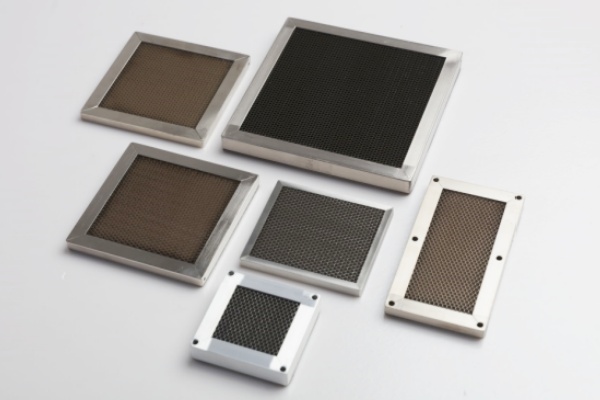
Standard EMI vents use aluminum honeycomb. 3.2 mm cells, 12.7 mm deep. That's fine for RF above 1 GHz.
At 50 Hz or 100 Hz? That aluminum honeycomb is nearly transparent. The waveguide cutoff is way too high. Magnetic fields walk right through.
We tested a standard aluminum vent at 100 Hz. Shielding was maybe 5 dB. That's nothing. A 2 mm steel plate would do better.
So if your shielded room needs low‑frequency shielding, you can't use off‑the‑shelf EMI vents. You need something designed for the job.
What We Do Differently
Material. Steel. Not aluminum. For low‑frequency magnetic fields, steel has permeability. Aluminum doesn't. We use cold‑rolled steel – it gives up to 60 dB+ shielding at low frequencies. For really demanding applications, we use permalloy or mu‑metal.
Deeper cells. Standard vents are 12.7 mm deep. For low frequency, we go deeper – 25 mm, 38 mm, sometimes 50 mm. The depth‑to‑opening ratio is critical. A deeper vent forces the magnetic field to travel further through the attenuating structure.
Smaller openings. Standard cells are 3.2 mm. We go down to 1.6 mm or 2.0 mm. The rule of thumb: aperture ≤ 3 mm, depth ≥ 3× aperture. For low frequencies, we aim for depth at least 5× the opening.
Solid construction. Some EMP ventilation panels are made from solid metal with drilled holes – no transitions between materials, which gives much higher shielding performance.
Dual‑layer. For really high shielding, we stack two vent panels. Two layers of steel honeycomb, offset. That gives 80‑100 dB at low frequencies.
Installation – Where Leaks Hide
You can build the perfect vent. If you install it wrong, it leaks.
Grounding. The vent frame must bond to the shielded room wall. No paint, no oxide, no gap. We use conductive gaskets – beryllium copper fingers or silver‑filled silicone. Contact pressure should be 80‑100 N/m.
Screw spacing. Screws every 50 mm or less. Too far apart, the gasket lifts in the middle. Gap = leak.
Torque. Too loose, no contact. Too tight, frame warps. Follow the spec.
Duct connection. The vent isn't the only leak point. The duct attached to it can act like an antenna. We use a transition piece – steel, at least 2 mm thick – that extends 300 mm from the vent. That gives the magnetic field more distance to attenuate.
Real Example – MRI Shielded Room
A hospital had an MRI room. The room was shielded with copper and mu‑metal. But the ventilation duct had a standard aluminum honeycomb vent. At 50 Hz, the MRI was picking up noise from a nearby power line.
We replaced the aluminum vent with a steel vent – 2.0 mm openings, 50 mm deep, dual‑layer. Grounded the frame with beryllium copper fingers. Also added a steel duct extension.
The noise dropped from 30 nT to under 1 nT. The MRI images cleaned up.
Real Example – Military Comms Shelter
A military shelter needed 100 dB shielding from 10 kHz to 18 GHz. The standard vent was aluminum – passed the RF test, failed the low‑frequency magnetic test.
We used a steel honeycomb vent with 1.6 mm openings, 38 mm deep, nickel‑plated for corrosion resistance. Also added a permalloy layer on the inside of the duct.
Passed the full frequency sweep. No leaks.
Testing – How We Know It Works
We test every vent in a real shielded room setup. Transmitting coil on one side, receiving coil on the other. Sweep from 10 Hz to 1 MHz.
At 50 Hz, a good steel vent gives 40‑60 dB. A standard aluminum vent gives 5‑10 dB.
We also test with the vent installed. A near‑field probe around the edges. If we see spikes, we fix the grounding.
When Aluminum Is Still Fine
If your shielded room only needs RF shielding (above 1 MHz), aluminum honeycomb works. It's cheaper, lighter, and easier to install.
But if you have power lines nearby, transformers, or any low‑frequency magnetic field source, you need steel. Or permalloy. Or both.
Don't guess. Measure the ambient magnetic field. If it's above 1 µT at 50 Hz, you need low‑frequency treatment.
Cost vs. Performance
Steel vents cost more than aluminum. Permalloy costs a lot more. Deeper vents cost more.
But a shielded room that leaks at low frequencies is useless for sensitive equipment. You can't "fix" a leaky vent with a bigger fan or a better filter.
We tell customers: spend the money on the vent. It's a small part of the room cost, but it's the part that fails most often.
Bottom Line
Large shielded rooms need low‑frequency magnetic leakage vent improvements.
Aluminum honeycomb doesn't work at low frequencies. Use steel or permalloy. Deeper cells. Smaller openings. Solid grounding. Proper duct transition.
We make these vents. We test them. We know what works.
If your shielded room leaks at 50 Hz, start with the vent. That's usually the problem. And it's usually fixable without rebuilding the whole room.
Send us your frequency requirement and your space constraints. We'll build the right vent. That's what we do.