To be a valuable global supplier
for metallic honeycombs and turbine parts


Contact number
0555-2813555
To be a valuable global supplier
for metallic honeycombs and turbine parts
Technological Innovation
Process Management
Continuous Improvement
Customer Satisfaction

Knowledge
Dedication
Diligence
Loyalty
Responsibility
Confidence
Tenacity
Respect

To be a valuable global supplier
for metallic honeycombs and turbine parts
Release time:2026-06-21
If you've been around shielding vents, you've seen both. Cheap wire mesh. Fancy honeycomb. They look similar from across the room. But the performance gap is massive.
We test both in our shop. Here's what we've measured – and what it means for your equipment.
Shielding Effectiveness – The Big Gap
This is where honeycomb leaves mesh in the dust.
A metal mesh vent might give you 10‑20 dB at 1 GHz. At 5 GHz? Almost nothing [4†L21-L24]. The gaps between the wires act like little slot antennas. RF goes right through.
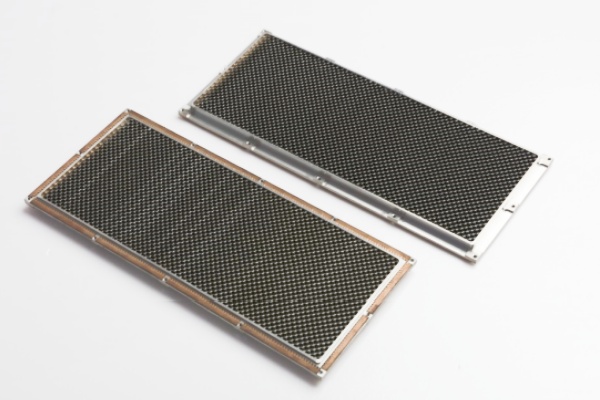
Honeycomb works on a different principle – waveguide cutoff. Each cell is a little tube. RF above the cutoff frequency bounces off the walls and dies [7†L15-L20]. A good aluminum honeycomb with conductive plating gives you 60‑90 dB at 1 GHz [9†L32-L33]. Some designs hit 80‑120 dB across wide frequency bands [7†L20-L21].
So at 5 GHz, the gap is about 40 dB or more. That means the honeycomb is blocking 10,000 times more signal than the mesh.
What that means: If you're near a cell tower, a radar, or any strong transmitter, mesh won't cut it. Honeycomb will.
Airflow – The Surprise
People assume mesh flows better because it's thinner. Not really.
A good honeycomb vent has 80‑95% open area [10†L16-L17][7†L24-L25]. The straight cells create laminar airflow with low pressure drop [7†L25-L26].
Wire mesh? The woven wires disrupt airflow. Turbulence. Higher pressure drop [7†L27]. And if you use a fine mesh to get better shielding, you choke the airflow even more [4†L23-L24].
What that means: For the same shielding performance, honeycomb often flows more air than mesh. Fans work less. Equipment runs cooler.
Structural Integrity – Mesh Is Fragile
Honeycomb is a monolithic metal block. Aluminum or steel. It resists vibration, shock, and dents [7†L30-L32]. You can mount it in a cabinet door that gets opened every day. It won't tear.
Wire mesh? It snags. It tears. It compresses under pressure [7†L33-L34]. A maintenance guy leaning on it can bend it out of shape. Once it's bent, the shielding is compromised.
What that means: For equipment that gets handled, moved, or vibrated, honeycomb lasts. Mesh is a maintenance headache.
Corrosion and Environment
Honeycomb can be plated – nickel, tin, silver – for corrosion resistance [9†L25-L27]. Stainless steel honeycomb handles salt spray. Aluminum honeycomb with chem film or nickel plating survives humidity.
Wire mesh? It corrodes at the wire intersections. Dissimilar metals in the weave can create galvanic corrosion. And if the mesh is plated, the plating wears off at the contact points [7†L34-L35].
What that means: In coastal or industrial environments, honeycomb lasts years. Mesh might need replacement in months.
Cost – The One Place Mesh Wins
Wire mesh is cheap. Really cheap. You can buy it by the roll.
Honeycomb costs more. The manufacturing is more complex – stacking, brazing, plating, framing.
What that means: If you're building a low‑cost consumer product with no serious EMI threat, mesh might be fine. If you're protecting critical equipment, honeycomb is worth the extra money.
Installation – Both Need Care
Mesh is flexible. You can cut it with scissors. But it's hard to seal around the edges. RF leaks through the gaps between the mesh and the frame.
Honeycomb comes in a rigid frame with a conductive gasket. You bolt it on. It seals. Less room for installer error.
What that means: A poorly installed mesh vent leaks. A honeycomb vent with a good gasket seals.
When Mesh Might Be Okay
If your equipment is indoors, away from strong transmitters, and you only need basic shielding below 1 GHz, mesh can work.
If you're on a tight budget and EMI isn't a safety or compliance issue, mesh is cheaper.
But if you have a cell tower nearby, a radar in the area, or any sensitive receivers, mesh is a gamble.
When You Need Honeycomb
Frequency above 1 GHz
Shielding requirement above 40 dB
Outdoor or harsh environment
Vibration or frequent handling
Critical equipment – medical, military, telecom
Honeycomb shielding vent outperform metal mesh by a wide margin. Better shielding at high frequencies. Better airflow. Better durability. Better sealing.
The only thing mesh does better is price.
If your equipment matters, spend the money on honeycomb. The performance gap isn't small. At 5 GHz, it's about 40 dB. That's the difference between passing EMC and failing. Between reliable operation and random glitches.
We make honeycomb vents. We've tested them against mesh. We know what works.
If you're not sure, send us your frequency and your environment. We'll tell you what you need. That's what we do.