To be a valuable global supplier
for metallic honeycombs and turbine parts


Contact number
0555-2813555
To be a valuable global supplier
for metallic honeycombs and turbine parts
Technological Innovation
Process Management
Continuous Improvement
Customer Satisfaction

Knowledge
Dedication
Diligence
Loyalty
Responsibility
Confidence
Tenacity
Respect

To be a valuable global supplier
for metallic honeycombs and turbine parts
Release time:2026-06-16
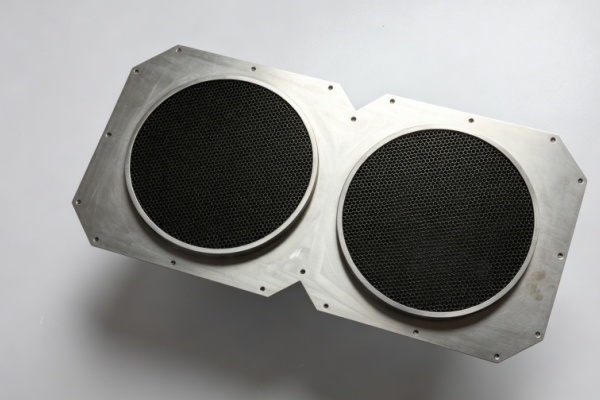
If you've ever opened a cabinet with a high screen efficiency ventilation board, you saw a piece of metal honeycomb. Looks simple. Punch some holes, bolt it on, right?
Wrong.
That honeycomb is doing a neat physics trick. It lets air flow like a window screen, but blocks RF like a solid wall. And the secret isn't the metal. It's the holes.
The Problem – Heat vs. RF
Every electronic cabinet has two problems.
First, heat. Fans push air through. You need holes.
Second, interference. Your own gear radiates RF. Outside signals want to get in. You need a shield.
A plain hole solves the first problem. It makes the second worse. A solid metal plate solves the second, but chokes airflow.
A high screen efficiency ventilation board solves both at once.
How the Honeycomb Trick Works
The honeycomb is a bunch of little tubes. Each tube is a waveguide.
If you send a radio wave down a tube that's too small for its wavelength, the wave can't make it. It bounces off the walls and dies. That's called waveguide cutoff.
Air molecules don't care. They just flow through.
So the same holes that let air pass stop RF cold. That's why a high screen efficiency ventilation board outperforms perforated sheet or wire mesh.
Cell Size – The Main Knob
The size of the honeycomb cells determines what frequencies get blocked.
Smaller cells block higher frequencies. Bigger cells block lower ones.
1/4‑inch cells – cutoff around 600 MHz. Good for low bands. Airflow is great.
1/8‑inch cells – cutoff around 1.5 GHz. The workhorse. Good for most telecom, Wi‑Fi, 4G.
1/16‑inch cells – cutoff around 3 GHz. For 5G, radar, satellite. Airflow takes a hit.
If your problem is at 2.4 GHz, 1/8‑inch cells are fine. You don't need 1/16‑inch. Over‑speccing kills airflow for no reason.
Depth – The Second Knob
Depth is how thick the honeycomb is. Standard is 1/2 inch. You can go 1 inch or more.
Deeper cells give more attenuation. A 1/8‑inch cell vent at 5 GHz might give 35 dB at 1/2‑inch depth, and 55 dB at 1‑inch depth.
But depth kills airflow. Pressure drop roughly doubles when you double the depth.
So you pick. More shielding = less air. More air = less shielding.
A true high screen efficiency ventilation board balances both.
Why Mesh and Perforated Sheet Fail
Wire mesh has maybe 50‑60% open area. Perforated sheet is 30‑50%. They block airflow more than honeycomb.
And at high frequencies, they don't shield. A piece of mesh at 2 GHz might give 10‑15 dB. That's nothing.
Honeycomb gives 40‑60 dB at the same frequency. That's the difference between passing EMC and failing.
So if you're serious about shielding, you use a high screen efficiency ventilation board. Not cheap mesh.
What to Look For
When you're buying one, check:
Open area. Should be 80‑90%. Less than 80%, fans struggle.
Cell size. Match to your frequency. Don't overspec.
Depth. 1/2 inch for most. 1 inch for high shielding.
Material. Aluminum for indoor. Stainless for outdoor, especially near salt.
Gasket. Conductive seal around the frame. No gasket, no seal.
Test data. Far‑field data, not near‑field probe numbers.
Real Example – Cell Tower Cabinet
A base station cabinet near a cell tower had a cheap mesh vent. Leaked like a sieve. They swapped to a 1/8‑inch honeycomb, 1/2‑inch depth. Shielding went from 15 dB to 45 dB at 2 GHz. Interference stopped.
Same airflow, because the open area was almost the same.
Real Example – Data Center Rack
A server rack with high heat load used perforated sheet vents. Fans maxed out, still hot. Switched to honeycomb with 85% open area. Fans slowed down, temp dropped. Shielding wasn't even the goal – but they got it for free.
That's the beauty of a high screen efficiency ventilation board.
A high screen efficiency ventilation board is not just a piece of metal with holes. It's a waveguide array that stops RF while letting air flow.
Cell size for frequency. Depth for attenuation. Open area for airflow.
Get those right, and you get both. Cooling and shielding. No compromise.
We make these boards. We test them. We ship them to cell sites, data centers, military shelters, medical labs.
If you need a vent that breathes and blocks, tell us your frequency and your airflow. We'll build the right one.
That's what we do.