To be a valuable global supplier
for metallic honeycombs and turbine parts


Contact number
0555-2813555
To be a valuable global supplier
for metallic honeycombs and turbine parts
Technological Innovation
Process Management
Continuous Improvement
Customer Satisfaction
Knowledge
Dedication
Diligence
Loyalty
Responsibility
Confidence
Tenacity
Respect

To be a valuable global supplier
for metallic honeycombs and turbine parts
Release time:2026-06-15
We braze a lot of metal honeycomb in our factory. Big parts, small parts, round, square, stainless, aluminum. If the layers don't stay together in a hot exhaust, it's our fault. So we don't mess around.
Over the years we've set up a brazing shop with rules. Not a fancy plaque – just things we hammer into every new guy. Here's how we do it.
Before the Furnace Even Starts
Cleanliness. If the foil has oil, grease, or even a fingerprint, the braze won't stick. Our operators wear clean gloves. They wipe every stack with acetone. No skipping.
Foil inspection. We look for wrinkles, scratches, oxidation. If the foil looks funky, it doesn't go in the furnace. We've lost batches because someone thought "it's probably fine." It's never fine.
Brazing filler. For stainless we use nickel‑based paste. For aluminum, aluminum‑silicon. We keep it in the fridge. Let it warm up before use – cold paste doesn't spread.
We mix small batches. Don't make a gallon if you need a cup. Leftover paste dries out, then you're guessing.
Stacking – Get It Right
Stacking the foil layers with filler between them is tedious. It's also where most defects start.
We use stacking fixtures – metal boxes with guide pins. The fixture keeps the layers from shifting. Shifted layers mean crooked cells, and crooked cells mean bad flow.
We apply the filler evenly. For sheets, cut to size. For paste, use a roller. Too much filler runs into the cells – clogs. Too little gives voids.
Stack a batch, put a heavy steel plate on top. Compress a little. Not too much – you don't want to squeeze the filler out.
Each stack gets an ID tag. Foil coil number, operator, date. If something fails, we know who to blame. Usually ourselves.
Loading the Furnace
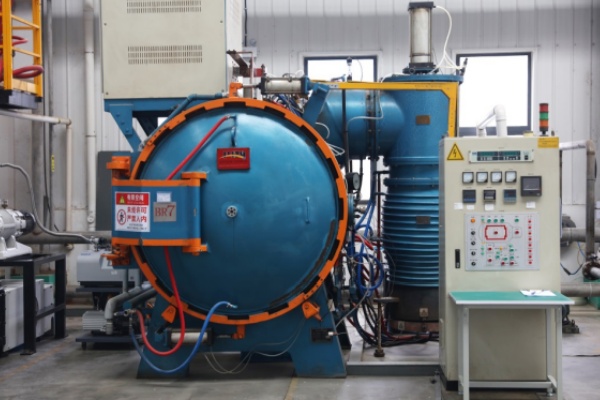
Our vacuum furnace is the heart of the shop. We treat it right.
Before loading, vacuum the chamber. Crumbs from previous runs can stick to parts. Clean rag. No solvents inside – they outgas and mess the vacuum.
Arrange stacks so hot gas can circulate. Leave gaps. Tight stacks mean the middle ones don't heat even.
We put thermocouples on a sample stack at the center. That's our witness. If the thermocouple says 500°C and the furnace says 550, we trust the thermocouple.
Close the door. Start the pump. Wait for vacuum to hit 10⁻⁵ torr or lower. If it doesn't, check the seals. Leaks ruin brazes.
The Braze Cycle – Slow and Steady
We use a programmable cycle. Ramp up slow – 10°C per minute. Too fast, the filler melts before the whole stack is hot. Then it runs to the edges and leaves the center dry.
Soak at brazing temperature. For stainless, 1040°C. For aluminum, 600°C. Soak time depends on size. Small part, 10 minutes. Big one, 30 minutes.
During soak, you can watch through the window. Filler melts and flows. Looks like a wet edge. Pooling on the bottom? Too much filler.
Then cool down. Slow. 5°C per minute down to about 500°C, then faster. Too fast, the metal shrinks uneven and cracks. We learned that the hard way.
Whole cycle takes 6‑8 hours. Don't rush it. We tried a fast cycle once. Scrapped the batch.
After the Braze – Inspection
Let parts cool to room temp in the furnace. Don't open the door hot. Oxygen rushes in and oxidizes everything.
Take them out. Look at the surface. Good braze has shiny, metallic color. Dull gray means oxidation – vacuum wasn't good enough.
Tap each part with a screwdriver. Solid ring means good bond. Dull thud means something's loose.
We peel test one from every batch. Sacrifice one part, pull the layers apart. The foil should tear before the braze lets go. If it separates clean, the whole batch is suspect.
Then we cut a cross‑section and look under a microscope. No voids? Good. Voids? Adjust filler or cycle.
Common Problems – What We Look For
Filler didn't flow. Too cold or not enough soak time. Check thermocouples.
Filler ran out of joint. Too hot or too much filler.
Cells clogged. Too much filler or paste too thin.
Parts warped. Cooling too fast or uneven heating.
White powder on aluminum. Oxidation. Vacuum was poor.
No bond. Foil dirty. Clean better next time.
We keep a log. Every failure, we write down what went wrong. Then we fix it.
Safety – No Shortcuts
Our furnace gets hot. Parts stay hot for hours after cycle ends. Don't touch without gloves. Had a guy grab a "cool" part. It wasn't.
Vacuum pumps make noise. Wear earplugs.
Brazing filler contains nickel and chromium. Not great to breathe. We use a fume extractor when mixing paste.
Clean up. Paste on the floor is slippery. Wipe it.
Shift Change – Write It Down
Before you leave, write down what you did. Furnace cycle parameters, which parts, any oddities. Next shift needs to know.
We have a whiteboard. "Today: 316L, 200 cpsi, 0.08 mm foil. Furnace run #342. Soak 45 min. Peel test passed."
Something weird? "Thermocouple read low" – write that too.
Our vacuum brazing shop runs on these rules. They're not fancy. They work.
No voids, no cracks, no delamination. Just solid brazes that hold up in exhaust.
If you need metal honeycomb brazed, we do it. Follow our specs, or tell us your requirements. We'll run it through our shop – clean, slow, and checked every batch.
That's what we do. No shortcuts.