To be a valuable global supplier
for metallic honeycombs and turbine parts


Contact number
0555-2813555

To be a valuable global supplier
for metallic honeycombs and turbine parts

Technological Innovation
Process Management
Continuous Improvement
Customer Satisfaction

Knowledge
Dedication
Diligence
Loyalty
Responsibility
Confidence
Tenacity
Respect

To be a valuable global supplier
for metallic honeycombs and turbine parts
Release time:2026-06-09
Some cabinets you open every day. Some you bolt shut and forget for years. For the second kind, a flange type plane wave shielding vent makes a lot of sense.
It's not fancy. It's just a vent with a lip that sits over the cutout. But that lip does some good things.
Let me explain.
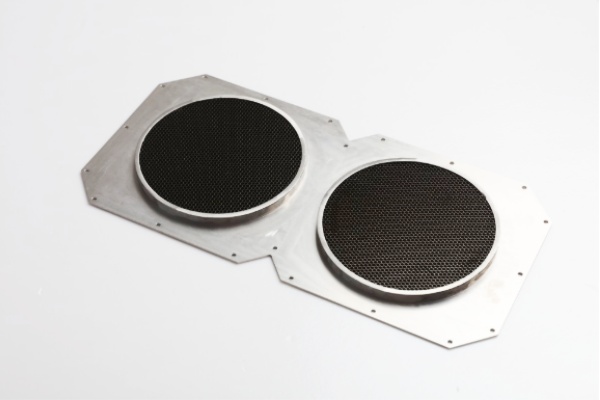
What's a Flange Vent Anyway?
Normal vent is flat. You drop it into a cutout, screw it in. The gasket seals between the frame and the cabinet wall.
A flange vent has a raised rim – a lip – that sits on the outside of the cabinet. The lip overlaps the cutout. The gasket is between the lip and the cabinet wall.
You see these on outdoor telecom boxes, industrial control panels, military shelters. Places where the cabinet doesn't get opened every day.
Why Flange for Fixed Enclosures?
Three reasons.
First, it hides a bad cutout. If your hole is a little rough or not quite square, the flange covers the mess. You don't need a perfect hole. With a flat vent, any gap around the edge is a leak. With a flange, the lip covers the gap. Sealing is easier.
Second, it seals better under vibration. The flange distributes the clamping force over a larger area. The gasket compresses more evenly. For a cabinet that sits on a vibrating floor – near a generator, on a truck – that's a big deal.
Third, it's harder to remove. A flat vent has screws on the face. Anyone with a screwdriver can take it off. A flange vent has screws on the lip, usually on the side or back. Not as easy to get to. For outdoor cabinets where theft or vandalism is a concern, flange is better.
What About Plane Wave Shielding?
Same honeycomb, same cell size, same depth. A flange doesn't change the shielding.
What it does is improve the edge seal. And for plane wave far‑field shielding, the edge seal is critical. A tiny gap at the edge can let in a lot of signal from a distant tower.
We've tested flat vents vs flange vents on the same cabinet. Same honeycomb, same gasket. The flange version measured 5‑10 dB better at frequencies above 1 GHz. Not because the honeycomb was different, but because the edge seal was more reliable.
Installation – Not Hard, But Different
You need a cutout, same as any vent. But because the flange sits on the outside, the cutout can be slightly larger than the honeycomb size. That's forgiving.
You put the gasket on the back of the flange. Then you bolt the vent to the cabinet. The bolts go through the flange, through the gasket, into the cabinet.
Torque is important. Too loose, gap. Too tight, you can warp the flange. We give torque specs. Use them.
Also, the flange can collect dust and water if it's horizontal. For outdoor, mount it with the flange facing down or on a vertical wall. Don't put a flange vent on a roof with the lip facing up – you'll get a swimming pool.
Real Example – Base Station Cabinet
A telecom customer had a base station cabinet on a tower. The flat vents were leaking RF at the edges. The cutout was rough – punched, not machined. The gasket couldn't seal.
We switched to flange vents. The flange covered the rough edges. The gasket compressed evenly. Leakage dropped 15 dB. They ordered 500 more.
Real Example – Generator Enclosure
A generator enclosure sat next to a diesel engine. Lots of vibration. Flat vents kept loosening. The screws would back off over time. Leaks would appear.
Flange vents have more screw holes and a wider clamping area. They stayed tight. No leaks after two years.
When Not to Use Flange
If your cabinet is in a tight space, the flange adds width. It sticks out maybe 1/2 inch on each side. That can be a problem if cabinets are side by side.
Also, if you open the cabinet often, a flange vent can be annoying. The lip catches on things. For a door that gets opened daily, use a flat vent.
Flange is for fixed enclosures. Things that get closed and left alone.
What to Look For in a Flange Plane Wave Shielding Vent
Same as any plane wave vent – cell size, depth, material, gasket.
But pay extra attention to:
Flange flatness. If the flange isn't flat, the gasket won't seal. We hold flatness to 0.1 mm across the flange face.
Gasket material. Closed‑cell silicone for outdoor. Silver‑filled for conductive seal.
Screw spacing. Closer is better. No more than 2 inches apart. More screws = even compression.
Corner radius. Tight corners can lift the gasket. We use a generous radius so the gasket seats properly.
Common Mistakes
Over‑tightening. People crank the bolts and warp the flange. Then the gasket is compressed only at the screw points. Leaks at the mid‑span. Use a torque wrench.
Forgetting the gasket. We've seen flange vents bolted straight to painted metal. No gasket. Big leak.
Wrong material for outdoor. Aluminum flange on a coastal site? White powder in a year. Use stainless.
Not sealing the bolt holes. Water can track through the screw threads. Use sealing washers or add a dab of silicone.
A flange type plane wave shielding vent is for fixed enclosures that don't get opened often. It seals better, hides bad cutouts, and resists vibration.
Use it outdoors, on towers, in industrial plants, on generator enclosures. Avoid it if space is tight or the door opens daily.
Same honeycomb rules apply – match cell size to frequency, depth to attenuation. Add a good gasket. Torque it right.
We make these. We've shipped them to cell sites, power plants, military shelters. They work.
If you have a fixed enclosure with a rough cutout or a vibration problem, get a flange vent. You'll sleep better. So will your equipment.