To be a valuable global supplier
for metallic honeycombs and turbine parts


Contact number
0555-2813555
To be a valuable global supplier
for metallic honeycombs and turbine parts
Technological Innovation
Process Management
Continuous Improvement
Customer Satisfaction
Knowledge
Dedication
Diligence
Loyalty
Responsibility
Confidence
Tenacity
Respect
To be a valuable global supplier
for metallic honeycombs and turbine parts
Release time:2026-06-04
You ever run an engine on cheap fuel? Off‑road diesel, high‑sulfur bunker oil, contaminated gasoline? Stuff leaves a mess. Carbon. Coke. Black gunk that sticks to everything.
A catalytic converter hates that. The coke builds up on the honeycomb, blocks the cells, kills the flow. Then the engine chokes, the light comes on, and you're swapping parts.
Ceramic substrates? They crack under the heat of decoking. Metal? It bends, it takes the abuse, it keeps going.
Here's what we've learned making metal substrates for people who can't always buy the good fuel.
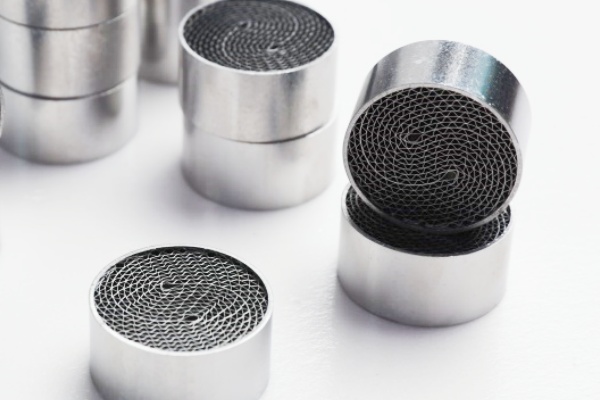
What Is Coking, and Why Should You Care?
Burn cheap fuel, you get incomplete combustion. Leaves carbon deposits. That carbon sticks to the catalyst surface. Builds up like soot in a chimney.
Eventually, the cells plug. Backpressure goes up. Engine loses power. Fuel economy drops. Check engine light pops.
To clean it, you gotta run a regeneration cycle – get the converter hot enough to burn off the carbon. That takes temperature. Sometimes 600°C or more.
Ceramic honeycomb doesn't like that. Heat it up fast, cool it down fast, it cracks. Then you have bypass, no treatment, dead converter.
Metal? Metal can take the heat. It expands, it contracts, it doesn't shatter.
Why Metal Handles Coking Better Than Ceramic
Ceramic is brittle. Good for clean gas, steady temps. But when you're burning crap fuel, you get thermal cycling. Hot regen, cool down, hot regen. Ceramic cracks.
Metal is tough. You can heat it up, cool it down, over and over. It won't crack. It'll get covered in coke, sure. But you can bake it off without killing the substrate.
Also, metal has better thermal conductivity. Spreads the heat faster. Less hot spots. Less chance of local overheating that makes the coke worse.
We've seen ceramic substrates in garbage trucks crack after six months. Metal ones last years.
What We Do to Make Metal Substrates More Coking‑Resistant
You can't stop the coke if the fuel is shit. But you can design the metal substrate to survive it.
Lower cell density. 200 cpsi instead of 400. Bigger cells, less chance of plugging. Coke has room to blow through.
Thicker foil. 0.08 to 0.1 mm. Thin foil can warp under the heat of decoking. Thick foil holds its shape.
Stainless, not aluminum. Aluminum can melt if the regen gets too hot. Stainless takes the heat.
Smooth cell walls. Rougher walls give coke a place to grab. We keep our forming tools sharp for smooth surfaces.
Coating that resists coking. Some washcoat formulations are stickier than others. We use a low‑coking formulation for bad fuel applications.
Real Example – Garbage Truck
City garbage truck. Stop‑start, idle forever, cheap diesel. The ceramic DOC kept cracking during regen. Every six months, new converter.
We switched to a metal substrate – 200 cpsi, 0.1 mm stainless, low‑coking coating. Same regen schedule. No cracks. Two years later, still running. The coke built up, but the metal didn't fail.
Real Example – Mining Hauler
Off‑road diesel, high sulfur, dirty. The catalyst kept poisoning and coking. They tried ceramic – cracked. Tried thin metal – warped.
We gave them 100 cpsi, 0.12 mm stainless, with a special high‑temperature coating. The cells were so big the coke mostly blew through. What stuck got burned off in regen. Lasted three times longer than ceramic.
How to Help Your Metal Substrate Survive Bad Fuel
You can't fix bad fuel, but you can help the catalyst.
Keep the engine tuned. Rich mixture makes more coke. Fix injectors, air filters, sensors.
Decoke regularly. Run a hot regen before the cells plug solid. Monitor pressure drop. When it climbs, bake it off.
Don't let it idle for hours. Idling doesn't get hot enough to burn coke. It just builds up.
Use additives? Some help. Some make it worse. Test first.
If you're stuck with bad fuel, use a metal substrate with low cell density and thick foil. It won't stop the coke, but it'll survive the cleaning cycles.
What We've Learned
After years of making these for garbage trucks, mining equipment, and off‑road rigs, here's the short version.
Ceramic cracks under coking conditions. Aluminum warps. Thin foil bends.
Thick stainless, low cell density, smooth walls, and a coating that doesn't grab carbon – that's the combo.
We've seen metal substrates go 5‑10 years on bad fuel. They get ugly. They get coked up. But they don't crack. And after a hot regen, they're back to work.
Poor fuel quality means coke. Coke means regen cycles. Regen cycles kill ceramic substrates.
Metal substrates handle the heat. They don't crack. They don't warp – if you use thick stainless and low cell density.
If you're running junk fuel, don't buy cheap ceramic. Don't buy thin aluminum. Get a proper metal honeycomb built for the abuse.
We make 'em. We've seen what works. Tell us your fuel, your duty cycle, your regen temps. We'll build the right one.
And if you're not sure, run a regen cycle on your current substrate. If it cracks, you need metal. That's the test. No magic.