To be a valuable global supplier
for metallic honeycombs and turbine parts


Contact number
0555-2813555
To be a valuable global supplier
for metallic honeycombs and turbine parts
Technological Innovation
Process Management
Continuous Improvement
Customer Satisfaction
Knowledge
Dedication
Diligence
Loyalty
Responsibility
Confidence
Tenacity
Respect
To be a valuable global supplier
for metallic honeycombs and turbine parts
Release time:2026-06-03
Man, oilfield gas is nasty. You know what I'm talking about. Comes up with the crude – water vapor, hydrogen sulfide (smells like rotten eggs), heavy hydrocarbons, sometimes sand. Just nasty.
For years they just flared it. Burned it off. Wasted it. But now? Flaring's bad. Regulators hate it. They want you to clean that gas and actually use it – run a generator, pump it back in the ground, send it to a pipeline.
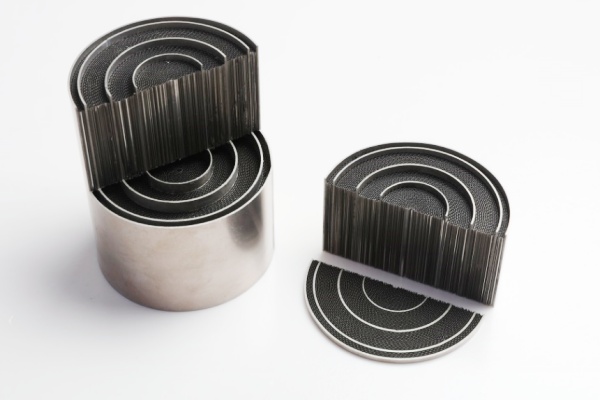
That means you need a catalytic system. And the heart of that system is a metal honeycomb substrate.
We make these for oilfield service companies. I've seen some stuff.
What's wrong with that gas
It's not clean. Not even close.
Water vapor – rusts pipes, kills engines.
Hydrogen sulfide – toxic, stinks, poisons catalysts dead.
Heavy hydrocarbons – propane, butane – condense and gum everything up.
Sand and salt – scratch up small passages, wear out parts.
You run this junk through a regular catalytic converter, it'll die fast. Plug up, poison out, game over.
So you need a whole purification train first. Knock out water, take out H2S, filter the solids. Then send it to a catalytic oxidizer to burn the rest. That's where our honeycomb comes in.
Why metal, not ceramic, for oilfield gas
Ceramic honeycomb is cheap. Works fine for pipeline gas.
But oilfield gas? Still dirty after pre‑treatment. Ceramic is brittle. One slug of water, one thermal shock – crack. Then gas bypasses, no treatment, system's dead.
Metal is tough. You can cycle it hot and cold. Water won't crack it. Sand won't shatter it. It lasts.
Metal also heats up faster. Good for start‑stop. And you can weld it into a housing – no fragile mounting mat to fail.
Downside? Metal costs more. But downtime in an oilfield costs a lot more. Pay once, forget it.
What to look for in a metal carrier for this crap
We sell these to oilfield guys. Here's what matters.
Cell density. Low. 200 cpsi or even 100. This gas is dirty – big cells don't plug as easy. Do NOT use 400 cpsi. You'll regret it.
Foil thickness. Thick – 0.1 mm or more. This gas has liquid slugs sometimes. Thin foil bends. Thick foil laughs at it.
Material. Stainless 316L. Not 304. Not aluminum. 316L handles H2S corrosion way better. If there's salt water (chlorides), you definitely need 316L or even higher alloy.
Catalyst coating. You're burning methane and VOCs. Platinum/palladium works. But sulfur kills palladium faster than platinum. So use high‑platinum formulation. Or a sulfur‑tolerant catalyst if the gas is really clean – but it's usually not.
Shape. Oilfield skids are tight. Round carriers are standard, but rectangular fits better sometimes. We do custom shapes.
How big should it be?
Space velocity again. For this gas, you want lower space velocity – more contact time. 10,000 to 20,000 per hour is typical.
If you've got heavy hydrocarbons, you might need even more volume. They take longer to burn.
Send us your flow rate, gas composition (especially H2S and heavy stuff), and required destruction. We'll size it.
Real example – flare gas recovery
A small oilfield wanted to stop flaring and run a generator instead. Their gas: 70% methane, 15% ethane, 10% propane, 5% butane, plus 500 ppm H2S, water saturated.
We gave them a 200 cpsi, 0.1 mm 316L stainless honeycomb, high‑platinum coating. Upstream they had a coalescing filter for water and an iron sponge for H2S.
System ran at 350°C. Destruction efficiency 99%. Generator ran fine. No more flare. Paid back the equipment cost in fuel savings in 14 months.
Real example – wellhead with sand
Another site had sand and salt carryover. Tried ceramic honeycomb. Sand pitted the surface, then thermal cycling cracked it. Two failures in six months.
We replaced with 100 cpsi, 0.15 mm thick 316L honeycomb. Lower cell density, thicker walls. Sand blew through without plugging. No cracking. Still running after 3 years.
What goes wrong in the field
Liquid carryover – water or liquid hydrocarbons hit the catalyst, cool it down fast, thermal shock. Fix: better separation upstream – knock‑out pot, coalescing filter.
Sulfur poisoning – H2S kills palladium. If your gas has sulfur, use high‑platinum catalyst or a sulfur‑guard bed upstream.
Plugging from heavy ends – big hydrocarbons condense and coke on the catalyst. Fix: pre‑heat the gas or use lower cell density so crap blows through.
Sand erosion – thin foil wears out. Use thicker foil, lower cell density, maybe a stainless mesh screen upstream.
Thermal cycling – oilfield systems start and stop. Metal handles it. Ceramic doesn't.
Maintenance tips
Check pressure drop regular. Up = plugging. Down = bypass or crack.
Monitor temperature across the catalyst. Delta T means it's working. No delta T means catalyst might be dead.
Test H2S upstream. If it spikes, your sulfur‑guard bed is saturated.
Inspect the carrier during shutdowns. Look for dents, cracks, erosion. Replace if needed.
When to replace
Metal honeycomb substrate lasts a long time. We've seen 5‑10 years in oilfield service. But nothing's forever.
Erosion from sand – cells get bigger, less surface area, efficiency drops.
Poisoning from H2S – no recovery, replace.
Thermal fatigue after thousands of cycles – cracks at welds.
If destruction efficiency drops below your target and upstream pre‑treatment is working, time for a new carrier.
Oilfield associated gas is a bitch. Dirty, wet, corrosive, full of surprises.Ceramic can't handle it. Metal can.
Low cell density – 200 or 100 cpsi. Thick foil – 0.1 mm or more. 316L stainless. High‑platinum catalyst.
Size it for low space velocity. Watch for liquid carryover. Replace when efficiency drops.
We make these carriers. Shipped them to Texas, North Dakota, Alberta, the Middle East. Every site is a little different. Tell us your gas, your flow, your space. We'll build the right one.