To be a valuable global supplier
for metallic honeycombs and turbine parts


Contact number
0555-2813555

To be a valuable global supplier
for metallic honeycombs and turbine parts

Technological Innovation
Process Management
Continuous Improvement
Customer Satisfaction

Knowledge
Dedication
Diligence
Loyalty
Responsibility
Confidence
Tenacity
Respect

To be a valuable global supplier
for metallic honeycombs and turbine parts
Release time:2026-05-29
Walk through any factory with a lot of VFDs. Open a control cabinet door. The first thing you notice? The heat. And if you put a spectrum analyzer near it, the noise.
Industrial control cabinets are a mess of electromagnetic interference. Variable frequency drives scream across a wide band. PLCs chatter. Relays click. All that noise wants to get out. And outside noise – welders, radios, other drives – wants to get in.
You need to cool the cabinet. So you cut a hole. But a plain hole is an antenna. You need a high screen efficiency vent that lets air through and keeps RF where it belongs.
Here's what we've learned from supplying hundreds of these to factories.
The Problem with Control Cabinets
A typical control cabinet has maybe 5-10 kW of heat. Fans push air through. But the cabinet also has to meet EMC regulations. If it doesn't, nearby equipment glitches. The production line stops. The maintenance guy starts swapping parts randomly.
We've seen it happen. A VFD cabinet radiating so much noise that the PLC in the next cabinet faults every time the drive ramps up. They replaced the PLC, replaced the VFD, even rewired the building. The fix was a high screen efficiency vent on the cabinet door.
The old vent was just a perforated grille. At the frequencies the VFD was putting out (10-30 MHz, plus harmonics into hundreds of MHz), the grille did nothing. The new vent had 1/8‑inch honeycomb, 1/2‑inch deep, with a conductive gasket. Noise dropped 40 dB. The PLC stopped faulting.
Why Perforated and Mesh Don't Work
Perforated sheet has maybe 30-40% open area. That chokes airflow. Fans run full speed. And at any frequency above a few hundred MHz, it's useless.
Wire mesh has better open area (50-60%), but the holes are irregular. RF leaks through. Plus it's fragile. A maintenance guy leaning on it can tear it.
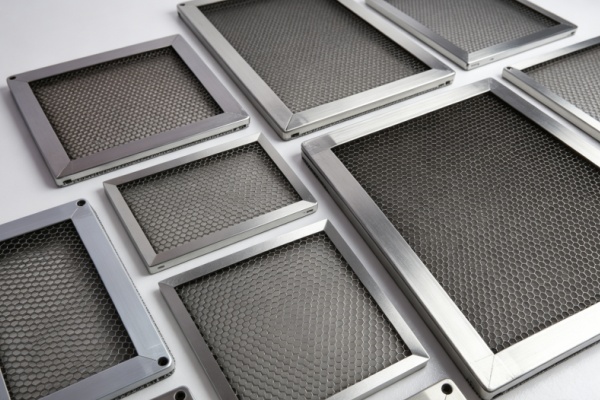
A high screen efficiency vent uses waveguide honeycomb – straight cells, 80-90% open area, real shielding. That's the difference.
What to Look For in a Control Cabinet Vent
We ask customers a few things.
First, what's the worst frequency? VFDs produce a broad hash from switching. But the biggest trouble is often in the 1-30 MHz range and harmonics up to a few hundred MHz. For that, 1/8‑inch honeycomb is fine. The cutoff is around 1.5 GHz, so at lower frequencies, the waveguide effect is even stronger.
Second, how much heat? If the cabinet has a lot of drives, you need high open area – 85% or more. That means 1/8‑inch cells, not 1/16‑inch. Don't overspec on cell size.
Third, is the cabinet outdoors? Industrial control cabinets are often in dusty factory floors, not always climate controlled. But outdoor? If it's outdoors, you need stainless and maybe a louver cover. Indoors, aluminum is fine.
Fourth, what about the gasket? Industrial cabinets are often painted. If you bolt a vent directly to paint, no seal. You need to scrape the paint where the gasket sits, or use a gasket with sharp teeth (beryllium copper) that bites through.
Installation Tips for Factory Floors
We've seen some rough installations. Wrenches instead of torque wrenches. Screws missing. Gaskets installed crooked.
Here's what works.
Clean the mounting surface. Remove paint on the gasket footprint. Use a conductive gasket – silver‑filled silicone is forgiving. Torque the screws to spec – not too loose, not too tight. Space screws every 50-75 mm.
If the cabinet door is flimsy, the frame can warp when you tighten. We recommend a thicker frame or a support stiffener on the inside.
One customer had a cabinet door that was 1 mm steel. When they tightened the vent, the door flexed. The gasket didn't seal. We sent a thicker frame and backing plate. Problem solved.
Real Example – Water Treatment Plant
A water treatment plant had multiple VFD cabinets controlling pumps. The SCADA system kept losing communication with one pump. Randomly. The operator would reset and it would work for a while.
They tried new cables, new radios, even a new PLC. Nothing.
We looked at the cabinet. It had a standard perforated vent – big holes, 40% open. The VFD inside was radiating like crazy. The SCADA radio – mounted 10 feet away – was getting swamped.
We replaced the vent with a high screen efficiency waveguide vent – 1/8‑inch cells, 1/2‑inch depth, aluminum frame, conductive gasket. We also scraped the paint off the mounting flange.
The SCADA radio stopped glitching. The plant manager called us two weeks later to say it was the cheapest fix they'd ever seen.
Real Example – Automotive Assembly Line
An automotive assembly line had a panel with 20 VFDs. The heat was so bad they had to leave the door open. That made the RF problem worse.
They tried adding fans. Still hot. They tried a bigger vent – still not enough airflow.
We sized a custom vent with 1/8‑inch cells but increased the size from 12x12 to 12x18. Open area went from 122 sq in to 183 sq in. Pressure drop dropped by a third. Airflow increased. They also added a second vent on the other side of the cabinet for cross‑flow.
Temperature dropped 15°C. RF still contained. The door stays closed now.
Maintenance
Industrial cabinets get dirty. Dust collects on the vent. Dust blocks cells. Airflow drops. Fans run harder.
We recommend cleaning the vent face with compressed air every month. Use a soft brush. Don't use a pressure washer – water gets inside.
If the vent has a pre‑filter, wash it with soapy water. Dry it before reinstalling.
Also check the gasket annually. If it's cracked or hard, replace it. Cheap insurance.
Industrial control cabinets need high screen efficiency vent solutions that balance airflow and shielding.
1/8‑inch honeycomb, 1/2‑inch depth, 85% open area is the sweet spot for most VFD panels. Conductive gasket. Bare metal mounting surface. Proper torque.
Don't use perforated sheet. Don't use wire mesh. They don't shield enough and they choke airflow.
We make these vents. We've supplied them to factories, water plants, assembly lines, and power stations. The problems are all the same – heat, noise, and EMC. The solution is the same – a vent that breathes and blocks.
If your control cabinet is running hot or causing interference, give us a call. We'll help you size the right vent. No upsell. Just what works. That's what we do.