To be a valuable global supplier
for metallic honeycombs and turbine parts


Contact number
0555-2813555
To be a valuable global supplier
for metallic honeycombs and turbine parts
Technological Innovation
Process Management
Continuous Improvement
Customer Satisfaction
Knowledge
Dedication
Diligence
Loyalty
Responsibility
Confidence
Tenacity
Respect

To be a valuable global supplier
for metallic honeycombs and turbine parts
Release time:2026-04-15
In our factory, we make the metal honeycomb that goes inside catalytic converter. We see a lot of substrates come back from the field – some good, some bad. The bad ones? They don't always die from poisoning or melting. A lot of them just break.
Cracked. Delaminated. Worn down from rattling around inside the can. The coating might still be active. The precious metals might still be there. But the substrate itself fell apart, and that's the end of the story.
So yeah, we worry about strength. Not just how much crush force it takes to deform a part on a test bench. But how it holds up after years of vibration, heat cycles, and exhaust pulses. Here's what we do to make sure our substrates don't come back in pieces.
What Breaks a Substrate? We've Seen It All
After you've been in this business a while, you learn where the weak points are.
Vibration is the slow killer. The engine shakes, the road shakes, the whole exhaust shakes. Over time, that works on the brazed joints. Small cracks start, then grow.
Thermal shock is the sudden killer. The converter gets red hot, then you shut off the engine and cold air rushes in. That rapid cooling can crack a substrate like a hot glass under cold water.
Backfires are the hammer. One good pop from a misfire sends a pressure wave down the pipe. I've seen substrates with a perfect circular crack right in the center – that's from a backfire.
Loose mounting is the slow grind. If the substrate isn't held tight in the can, it moves. The edges rub against the metal. The foil wears down. Then it cracks.
We build our substrates to survive all of these. But we can't control what happens after they leave the dock. That's why we make them tough from the start.
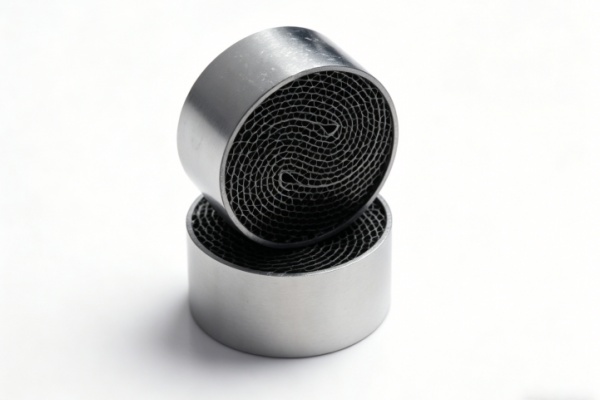
The Foil – We Don't Skimp Here
The substrate starts with metal foil. Thin stuff – about as thick as a couple sheets of paper. But the alloy and thickness make all the difference.
For most cars, we use aluminum. It's light, it's cheap, and it's strong enough for normal driving. But aluminum work‑hardens. The constant vibration makes it brittle over time. That's why we don't use aluminum for heavy‑duty applications.
For trucks, off‑road vehicles, or anything that sees rough roads, we use stainless steel. It's tougher. It flexes more without cracking. Costs more, but it lasts.
We also offer different thicknesses. Standard is 0.05 mm. That's fine for most passenger cars. But if a customer tells us the substrate is going into a diesel that runs rough or a delivery van that hits potholes every day, we'll recommend 0.08 mm or thicker.
We check every coil of foil when it comes in. Thickness. Surface condition. We even run a test braze on a sample. If the foil has oil or oxidation, the braze won't stick. That coil goes back.
I remember one time a supplier changed their rolling process without telling us. The foil looked fine, but the brazing failed on three batches. We scrapped everything and went back to our old supplier. Cost us a lot of money. Now we test every coil like we don't trust anyone.
Brazing – The Part You Can't See
The foil layers are held together by brazing. It's like soldering, but at high temperature. The filler metal melts, flows into the joints, and solidifies. If it's done right, the bond is stronger than the foil itself.
If it's done wrong, the substrate delaminates – the layers peel apart.
We run a controlled‑atmosphere furnace. Temperature is monitored constantly. We have thermocouples inside the furnace, not just on the controller. And we pull a sample from every batch to peel test.
Peel test is simple. Clamp one layer of foil in a vise, pull. If the foil tears before the braze lets go, it's good. If the braze separates clean, it's bad. No argument.
One night shift, the furnace drifted cold. Nobody caught it until morning. We pulled samples from the batch – all of them failed the peel test. We scrapped the whole run. Twenty substrates, right into the scrap bin. The operator was upset. But shipping bad parts would have been worse. Those substrates would have come apart in someone's car.
The Mounting Mat – More Important Than You Think
The substrate doesn't touch the metal can directly. We wrap it in a fiber mat that expands when it gets hot. That mat holds the substrate in place and cushions it from vibration.
If the mat loses tension, the substrate moves. Movement leads to fretting – the edges of the honeycomb grind against the can. The foil wears down. Then it cracks.
We've seen converters where the mat had turned to dust. The substrate was just bouncing around inside. The owner heard a rattle. When we cut it open, the edges of the honeycomb were worn down by a couple millimeters.
So we're picky about mats. Different applications get different mats. Gasoline cars run cooler than diesels. Industrial engines run longer. Off‑road vehicles see more vibration. We match the mat to the job.
We also control the gap between the substrate and the can to within a few tenths of a millimeter. Too tight and we stress the substrate during installation. Too loose and the mat can't hold it. We've learned that sweet spot over years of trial and error.
Canning – It Has to Fit Just Right
Some of our customers can the substrates themselves. Others send us the cans and we do it. Either way, the fit has to be perfect.
We've had customers complain about cracking during installation. We go visit their plant. Sometimes their press is pushing too fast. Sometimes the can is out of round. Sometimes they're using the wrong mat.
One customer kept crushing substrates on their assembly line. We watched them for an hour. Their press operator was slamming the foot pedal – bang, bang, bang. No guide cone, no slow approach. We showed them how to use a tapered guide and a slower press cycle. Cracking stopped.
We also give customers torque specs for the bolts if they're bolting the converter together. Too tight and you warp the flange. Too loose and it leaks. We've seen both.
Testing – We Break Our Own Parts on Purpose
We don't just trust our process. We test.
Crush test. Put a substrate in a hydraulic press and squeeze. We know how many pounds it should take before it starts to deform. If it crushes too easy, something's wrong.
Peel test. Every batch, we sacrifice one substrate and peel it apart. That's a part we can't sell. But it's worth it to know the brazing is solid.
Vibration table. We mount a substrate in a can, put it on a shaker, run it at engine frequencies for hours. Then we check for movement, cracks, or fretting.
Thermal shock. Heat a substrate to 700 degrees, then blast it with cold air. Look for cracks. Some substrates survive one cycle. We want them to survive dozens.
Pressure pulse. We simulate backfires – hit the front face with repetitive pressure spikes. If the substrate cracks, we go back to the drawing board.
We don't do all of these on every batch. They take too long. But we do them on every new design and every time we change a material or process. And we keep records. When a customer has a failure in the field, we can look back and see what that batch went through.
What We Tell Our Customers
When someone asks us how to know if a substrate is strong enough, here's what we say.
Listen to it. Tap the converter with a wrench. A solid substrate rings like a bell. A cracked one sounds dull.
Feel the weight. A quality substrate feels solid. Cheap ones with thin foil feel light and flimsy.
Ask about testing. If the manufacturer can't tell you how they test for strength, find another one.
Don't drop it. Sounds obvious, but we've seen substrates get cracked in shipping or on the shop floor. Handle them like they're fragile – because before they're canned, they kind of are.
Match the substrate to the application. A standard aluminum substrate is fine for a sedan that drives on smooth roads. A diesel truck that runs on gravel needs stainless and thicker foil.
Stories From the Shop Floor
We had a fleet customer once – delivery vans, lots of stop‑and‑go, rough city streets. They kept cracking substrates after about 60,000 miles. We cut one open. The foil had work‑hardened and cracked along the cell walls. They were using standard aluminum. We switched them to a stainless substrate with slightly thicker foil. The next set went 150,000 miles with no cracks.
Another customer – a guy with a classic muscle car – kept breaking substrates from backfires. His engine was tuned rich, and it would pop through the exhaust on deceleration. We put in a substrate with thicker foil and a stiffer mounting mat. It survived. He eventually fixed the tune, but the substrate held up in the meantime.
And then there was the shop that kept getting converters with rattles. They thought we were shipping bad parts. We had them send one back. When we cut it open, the mounting mat was missing. They had forgotten to put it in during canning. That was on them, not us. We sent them a box of mats and showed them how to install them.
Bottom Line
At our factory, we make substrates that are meant to last. Good foil, solid brazing, the right mounting mat, proper canning pressure, and testing to prove it works.
We've seen what happens when any of those things are wrong. Cracked substrates. Loose cores. Failed emissions. Angry customers.
We don't cut corners because we know that a substrate that breaks in the field is a substrate that comes back to us. And we'd rather spend the time and money upfront than explain why a part failed.
Strength isn't the only thing that matters. But it's the thing that holds everything else together. And we take that seriously.