To be a valuable global supplier
for metallic honeycombs and turbine parts


Contact number
0555-2813555
To be a valuable global supplier
for metallic honeycombs and turbine parts
Technological Innovation
Process Management
Continuous Improvement
Customer Satisfaction

Knowledge
Dedication
Diligence
Loyalty
Responsibility
Confidence
Tenacity
Respect

To be a valuable global supplier
for metallic honeycombs and turbine parts
Release time:2026-04-14
Most people think a catalytic converter is just for emissions. That's it. Clean up the exhaust, pass the test, move on.
But I've been under enough cars to notice something else. A car with a good converter – not just any converter, but one with a well‑designed substrate – sounds different. Smoother. Quieter. Less of that raspy edge that makes you think something's loose.
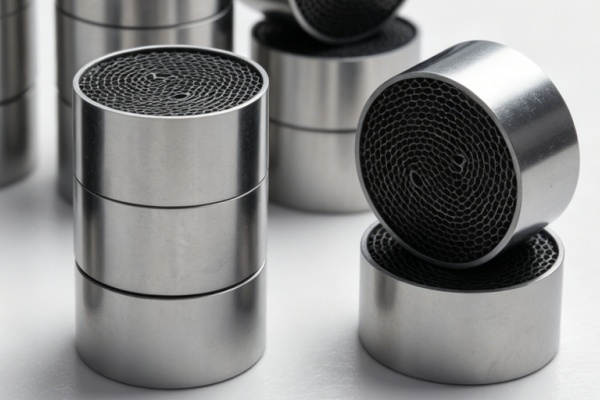
Turns out, the honeycomb substrate inside a catalytic converter does more than just host the catalyst. It also knocks down noise. The same cells that convert CO and hydrocarbons also break up sound waves.
If you're designing an exhaust system for low emissions and low noise, the substrate is doing double duty. Here's what I've learned about making that work.
The Noise Problem Nobody Talks About
Exhaust noise comes from pressure waves. The engine fires, a slug of hot gas slams into the exhaust pipe, and that pressure wave travels down to the tailpipe. When it hits open air, you hear it.
Mufflers exist to break up those waves. Baffles, chambers, fiberglass packing – they all do the same thing. Give the pressure wave something to bounce off of until it loses energy.
But here's the thing. The catalytic converter is already in the exhaust stream. And the honeycomb inside is a bunch of tiny little tubes. Those tubes are great at breaking up sound waves. The gas has to go through thousands of small channels, each one a dead end for pressure waves.
I've seen cars where you could hear the difference before and after a converter swap. Same engine, same muffler. The only thing that changed was the converter. The car with the good substrate was noticeably quieter.
How the Honeycomb Muffles
It's not magic. It's physics.
A sound wave is just a pressure wave. When it hits a small tube, part of it reflects back. Part of it keeps going. The rest turns into heat. The smaller the tube, the more reflection.
A catalytic converter has thousands of tiny tubes – the cells. The wave splits up into each cell, bounces around, and loses energy. By the time all those little waves recombine at the outlet, they're weaker. Less noise.
This works best when the cells are uniform and straight. If the cells are crooked or misaligned, the wave finds a straight path through. That's why cheap substrates with sloppy cell geometry don't seem to quiet things down as much.
I had a customer once who complained that his new converter was louder than the old one. Same size, same cell count, same everything. We cut the old one open. The substrate had collapsed in one corner – the cells were crushed. But the new one was perfect. The old one was actually blocking flow and muffling noise by accident. The new one flowed better, so the engine breathed easier, but the exhaust note changed. He didn't like it. We ended up adding a resonator. Not the converter's fault, but it taught me that people notice the sound.
Low Emissions and Low Noise – Same Cells
Here's the good part. The things that make a substrate good at emissions also make it good at noise.
Small cells. More cells per square inch means more surface area for the catalyst. Also means more tiny tubes to break up sound waves.
Straight cells. Uniform channels mean even flow for the catalyst. Also mean the sound waves hit the walls at consistent angles, which helps with attenuation.
Long substrate. A longer substrate gives more time for the reactions to happen. Also gives sound waves more distance to bounce around and lose energy.
Good mounting. A tight fit in the can keeps the substrate from vibrating. Vibration is its own kind of noise. A loose substrate rattles.
So if you design a substrate for high conversion efficiency, you're already most of the way to a quiet exhaust.
Where It Matters Most
Some applications really need both low emissions and low noise.
Generator sets. Especially for hospitals or data centers. They need to be clean and quiet. Nobody wants a generator that sounds like a tractor and smells like a diesel.
Marine. Boat exhaust is right at the waterline. Noise travels across the water. Emissions get into the air and water. A good substrate helps with both.
RV and camper vans. People sleep in these things. They don't want to hear the exhaust or smell it.
Urban delivery trucks. Early morning routes, residential neighborhoods. Quiet matters. Clean matters.
Police and emergency vehicles. They need to be clean, but they also don't want to announce themselves with a loud exhaust.
I worked with a generator manufacturer a few years back. They needed to meet strict noise ordinances for a hospital installation. They tried adding bigger mufflers – helped, but added backpressure. The generator lost efficiency. We spec'd a longer substrate with 600 cpsi instead of 400. The emissions got cleaner, the noise dropped, and the backpressure stayed the same. That was the sweet spot.
What Goes Wrong
Not every substrate is good at noise reduction. Here's what hurts acoustic performance.
Low cell density. 200 cpsi flows well, but the cells are bigger. Bigger cells don't break up sound waves as effectively. It's like shouting through a pipe versus shouting through a drinking straw.
Cracked substrate. A crack gives the sound wave a straight shot through. The converter might still pass emissions – the catalyst still works – but the noise goes right through the crack.
Loose mounting mat. If the substrate can move inside the can, it rattles. That's a different kind of noise, but it's still noise.
Thin walls. Thin foil cells are great for fast light‑off. But they don't reflect sound as well as thicker walls. There's a trade‑off.
I saw a cheap aftermarket converter once that was supposed to be 400 cpsi. When we cut it open, the cell walls were so thin they were almost translucent. The converter flowed great. Emissions were okay. But the car was noticeably louder than stock. The owner complained. We swapped in a quality substrate with normal wall thickness. Noise went back to normal.
Testing for Noise
We don't usually test substrates for noise. That's the muffler's job. But we've done it enough times to know what works.
We put a microphone at the tailpipe, run the engine at steady RPM, and measure the sound level. Swap the substrate – same can, same muffler – and measure again.
A good substrate might drop the noise by 2 or 3 decibels. That doesn't sound like much, but decibels are logarithmic. 3 dB is about a 30% reduction in perceived loudness.
A bad substrate – cheap, thin walls, low cell density – might actually make the noise worse. The sound waves go straight through without bouncing.
I remember testing two different substrates in the same car. One was 400 cpsi, standard wall. The other was 300 cpsi, thin wall. The 300 cpsi flowed better – lower backpressure – but the car was louder at highway speeds. The 400 cpsi was quieter but had a little more backpressure. The customer chose quiet over power.
Designing for Both
If you're designing an exhaust system and you need low emissions and low noise, here's what I'd think about.
Cell density. 400 cpsi is a good starting point. If noise is critical, go higher – 600 cpsi. If flow is critical, go lower – 300 cpsi. But know that you're trading off.
Substrate length. Longer is better for both emissions and noise. But longer means more backpressure. Find the balance.
Wall thickness. Standard thickness is fine. Thin walls are for fast light‑off, but they hurt noise. Only go thin if you really need it.
Mounting. Make sure the substrate is tight in the can. A loose substrate rattles and also lets noise bypass through the gap.
Muffler integration. Don't rely on the converter alone for noise control. It's a helper, not a replacement for a muffler.
I've seen exhaust systems where the engineer spec'd a high‑cell‑density converter and then deleted the muffler. Lightweight, compact, clean. Worked fine for emissions. The noise was borderline. The driver thought it was too loud. They ended up adding a small resonator.
Real‑World Examples
A friend of mine built a custom motorcycle. Big twin, loud pipes. He wanted to keep the noise down and pass emissions. He put on a 600 cpsi substrate – high cell density – and a small muffler. The bike passed the sound test and the emissions test. The exhaust note was deep but not obnoxious. He said it sounded like a stock bike but with more torque.
Another customer – a delivery van fleet – switched from 300 cpsi to 400 cpsi substrates. They didn't change the mufflers. The drivers said the vans sounded quieter at idle. Less diesel clatter. The fleet manager didn't care about noise, but he liked the lower emissions.
A generator installer I know uses 600 cpsi substrates for hospital backup units. The generators run at 1800 RPM constant. The high cell density knocks down the high‑frequency whine. The neighbors don't complain.
Bottom Line
A catalytic converter substrate does more than clean exhaust. It also breaks up sound waves. The same cells that convert CO and hydrocarbons also reflect and absorb noise.
If you need a low‑emission, low‑noise exhaust system, don't just think about the muffler. Think about the converter. Higher cell density helps. Longer substrate helps. Straight, uniform cells help.
A cheap substrate with thin walls and sloppy geometry might pass emissions – barely – but it won't do much for noise. A quality substrate helps with both.
I've seen cars that passed the sniffer test but sounded terrible. The owner thought something was wrong with the exhaust. Nothing was wrong – just a cheap converter that didn't muffle.
You don't have to spend a fortune. But pay attention to the substrate. It's doing more work than you think.