To be a valuable global supplier
for metallic honeycombs and turbine parts


Contact number
0555-2813555
To be a valuable global supplier
for metallic honeycombs and turbine parts
Technological Innovation
Process Management
Continuous Improvement
Customer Satisfaction

Knowledge
Dedication
Diligence
Loyalty
Responsibility
Confidence
Tenacity
Respect
To be a valuable global supplier
for metallic honeycombs and turbine parts
Release time:2026-01-30
In small spacecraft propulsion systems, exhaust treatment is rarely treated as a standalone topic. It sits somewhere between propulsion performance, thermal control, and hardware lifetime. For reaction control systems and small thrusters, this interaction is hard to separate.
Most of these systems rely on catalytic decomposition. The propellant enters a reactor, decomposes on contact with the catalyst, and exits as hot gas. Thrust is produced. Control is achieved. On paper, the process is straightforward.
In hardware, it is not.
Small thrusters operate in limited volume. Flow paths are short. Heat release is concentrated. There is little space for gradients to smooth out naturally.
If decomposition starts unevenly, the system reacts immediately. Local temperatures rise. Flow shifts. Reaction zones move. In larger engines this might average out. In small systems it does not.
This is often observed during early testing. Temperature sensors show asymmetry. Exhaust behavior changes between firings. None of this is caused by the chemistry itself. It is structural.
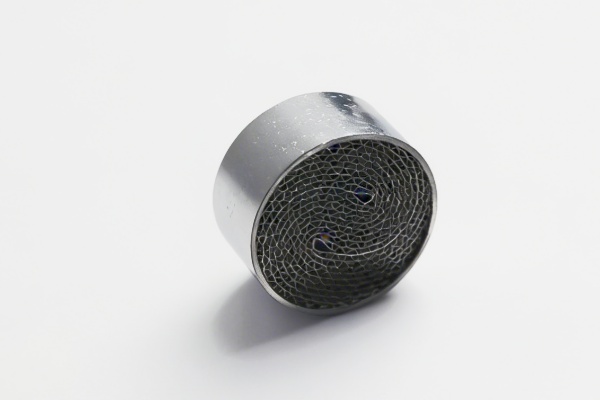
The Catalyst Substrate defines how the reaction develops.
It controls how the propellant enters the reaction zone. It defines residence time. It shapes how heat spreads through the reactor. The catalyst material alone cannot do this.
If flow distribution is uneven at the substrate inlet, decomposition follows that pattern. Channels with higher flow rates see stronger reactions. Adjacent channels may underperform. Temperature gradients appear quickly.
These gradients introduce stress. Over time, they lead to coating loss or microcracking in the substrate. Performance drift follows.
Catalytic decomposition depends on surface contact, but also on how repeatable that contact is.
Substrate geometry determines repeatability. Channel size, length, and spacing matter more than often assumed. Small differences become visible over repeated cycles.
Honeycomb-type catalyst substrates are commonly selected because they reduce variability. Each channel behaves similarly. Flow paths are defined. This limits extreme local behavior.
For propulsion systems, consistency is often more important than absolute efficiency.
Once geometry is set, coating becomes the next constraint.
Uniform catalyst coating across the substrate is critical. Not for peak reaction rate, but for reaction balance. Thick regions react faster and run hotter. Thin regions lag behind.
This imbalance shifts decomposition downstream or upstream over time. It also changes how the exhaust gas forms. For RCS systems, this can show up as small but measurable thrust variation.
Over many firings, uneven coating accelerates degradation. Hot zones lose catalyst faster. Cold zones never fully activate. The system drifts away from its original behavior.
From a propulsion standpoint, this is a reliability issue, not a manufacturing one.
The catalyst substrate does not operate alone.
Upstream, propellant delivery affects how evenly flow enters the substrate. Any asymmetry at the inlet is amplified downstream. Downstream, exhaust flow interacts with the nozzle and nearby structure.
A stable substrate design helps isolate these effects. It reduces sensitivity to small upstream variations and smooths downstream behavior.
In this sense, the Catalyst Substrate acts as a buffer inside the propulsion system.
Small thrusters are rarely single-use. They fire repeatedly over long missions. Each firing introduces thermal cycling. Expansion and contraction occur at the channel level.
If reaction distribution is uneven, cycling is uneven. Cracks initiate earlier. Coating adhesion weakens faster.
Once degradation starts, it is difficult to stop. There is no opportunity for adjustment in orbit. This is why early design choices around substrate geometry and coating quality have long-term consequences.
From a design perspective, the substrate is not just a holder for catalyst. It is a flow control element. A thermal management element. A reliability driver.
Propulsion engineers treat it accordingly. Geometry is reviewed early. Coating processes are qualified carefully. Variability is minimized, even at the cost of higher manufacturing effort.
In small spacecraft propulsion systems, margins are limited. The exhaust treatment system must behave predictably from the first firing to the last.
In catalytic propulsion systems, exhaust behavior reflects internal structure. The Catalyst Substrate shapes how decomposition occurs, how heat is distributed, and how the system ages.
For small thrusters and RCS units, where volume is tight and repetition is high, substrate design and coating uniformity are central to stable operation. They are not secondary details. They are part of the propulsion system definition.