To be a valuable global supplier
for metallic honeycombs and turbine parts


Contact number
0555-2813555
To be a valuable global supplier
for metallic honeycombs and turbine parts

Technological Innovation
Process Management
Continuous Improvement
Customer Satisfaction

Knowledge
Dedication
Diligence
Loyalty
Responsibility
Confidence
Tenacity
Respect

To be a valuable global supplier
for metallic honeycombs and turbine parts
Release time:2026-01-14
Waveguide plates and honeycomb vents are often grouped together under the same category of shielding ventilation components. On drawings, they may even look interchangeable. In real enclosures, however, they behave quite differently.
Choosing between them is rarely a matter of which one has “better shielding.” It is about how each structure interacts with airflow, frequency range, installation conditions, and long-term use.
A waveguide plate is based on controlled channel geometry.
Each opening is designed to behave as a waveguide, pushing the cutoff frequency above the operating range of the system. Shielding performance depends heavily on channel depth, width, and consistency.
A honeycomb vent, by contrast, relies on a dense array of thin-walled cells. The shielding effect comes from the combined behavior of many small passages rather than a small number of precisely defined waveguides.
This difference alone leads to very different practical outcomes.
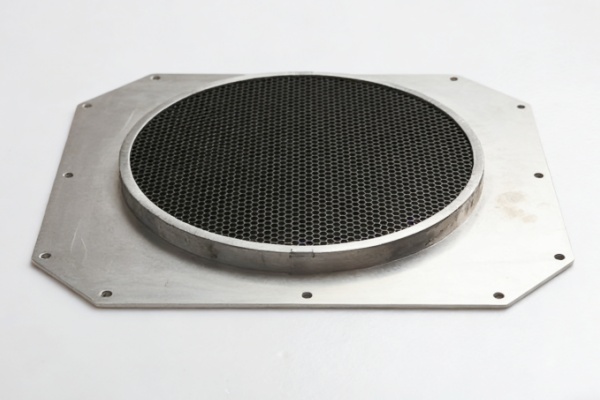
Waveguide plates are typically more predictable at specific frequency ranges. When geometry is well controlled, cutoff behavior is stable and repeatable. This makes waveguide plates attractive for applications where the critical frequency band is clearly defined.
Honeycomb vents tend to provide broader but less sharply defined attenuation. They are often more forgiving across a wider frequency range but may not achieve the same level of control at a specific cutoff point.
In practice, waveguide plates favor precision. Honeycomb vents favor coverage.
Airflow is one of the most noticeable differences once systems are running.
Waveguide plates usually create higher pressure drop, especially when shielding requirements push designers toward deeper or narrower channels. This can stress fans and create localized hot spots if airflow paths are not carefully planned.
Honeycomb vents generally allow smoother airflow due to thinner walls and shorter flow paths. For systems with tight thermal margins, this difference becomes obvious quickly.
Many overshielding problems start when waveguide plates are selected without fully accounting for airflow impact.
Waveguide plates are sensitive to geometry changes.
Small deformations, uneven mounting surfaces, or manufacturing variation can shift cutoff behavior enough to affect EMI performance.
Honeycomb vents are usually more tolerant of minor deformation. Individual cell damage does not always translate into immediate shielding failure, especially in large vent areas.
From a handling and installation perspective, honeycomb structures are often more forgiving.
In dusty or humid environments, dense structures behave differently.
Waveguide plates with narrow channels can trap dust and debris more easily, gradually reducing airflow and affecting thermal performance. Corrosion at contact points can also become an issue if coatings are not well controlled.
Honeycomb vents, while not immune, are often easier to clean and less prone to complete blockage. Long-term performance depends heavily on material choice and surface treatment for both designs.
In practice, waveguide plates are often chosen when:
The operating frequency range is well defined
High, targeted shielding is required
Mechanical rigidity is important
Honeycomb vents are more common when:
Airflow demand is high
Frequency coverage needs to be broad
Installation conditions are less controlled
Neither solution is universally better. Problems usually arise when one is used outside its practical strengths.
The choice between a waveguide plate and a honeycomb vent should start with how the enclosure will actually be used, not just what the shielding numbers look like on paper.
Many EMI issues attributed to “poor vent performance” are really the result of mismatched expectations — selecting a structure that does not align with airflow, installation, or environmental realities.
Understanding these practical differences early prevents costly changes later, when vent openings become the hardest part of the enclosure to fix.