To be a valuable global supplier
for metallic honeycombs and turbine parts


Contact number
0555-2813555
To be a valuable global supplier
for metallic honeycombs and turbine parts
Technological Innovation
Process Management
Continuous Improvement
Customer Satisfaction

Knowledge
Dedication
Diligence
Loyalty
Responsibility
Confidence
Tenacity
Respect

To be a valuable global supplier
for metallic honeycombs and turbine parts
Release time:2026-01-12
In many electronic enclosures, EMI shielding vents are treated as accessories.
In reality, they are often the first point of failure.
From an acceptance perspective, shielding vents deserve the same level of scrutiny as the enclosure itself. Once installed, correcting a vent-related EMI issue is usually difficult, expensive, and disruptive to the system.
This article focuses on how EMI shielding vents are commonly accepted in real engineering projects, and what criteria truly matter beyond datasheets.
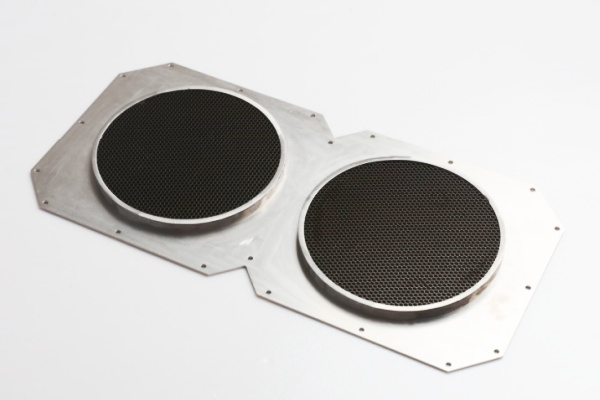
A common mistake is to jump directly to shielding effectiveness numbers.
In practice, many EMI issues originate from basic mechanical or material problems that appear long before any lab test.
Dimensional accuracy is the first filter.
If a vent frame does not sit flat against the enclosure surface, electrical continuity becomes unreliable. Even minor warping can introduce micro-gaps that compromise shielding performance at higher frequencies.
No amount of gasket pressure can fully compensate for poor flatness.
Waveguide-based vents rely on consistent channel geometry.
Deformation, partial blockage, or collapsed cells are not cosmetic defects — they directly affect cutoff frequency behavior.
In acceptance inspections, engineers typically check:
Uniformity of vent channels
Absence of crushed or bent sections
Frame rigidity under light manual pressure
If the structure is unstable before installation, it will only get worse once exposed to vibration or thermal cycling.
Material consistency is often underestimated.
Two vents with the same nominal specification can behave very differently if raw material quality varies. Conductivity, surface roughness, and oxidation resistance all influence contact performance.
Acceptance inspections usually focus on:
Oxidation or corrosion on conductive surfaces
Coating consistency
Clean bonding interfaces
Shielding vents are allowed to be protected, but not insulated.
Any coating that interferes with metal-to-metal contact creates risk.
In real projects, EMI shielding failures often trace back to grounding.
A vent can meet lab attenuation requirements and still fail in-system if electrical continuity is poor. For this reason, continuity checks are often part of acceptance, especially for critical enclosures.
Engineers look for:
Low resistance between vent core and frame
Reliable contact between frame and enclosure
No insulating layers on contact surfaces
If continuity cannot be confirmed, shielding performance becomes theoretical.
Not all vents are tested the same way.
However, one rule applies universally:
If shielding performance fails at required frequencies, airflow performance does not compensate for it.
Cooling and shielding are not interchangeable requirements.
Both must be met.
Overly aggressive shielding designs can restrict airflow beyond acceptable limits. This often shows up only after installation, when thermal performance degrades.
Acceptance criteria typically include:
No blocked channels
Pressure drop within design limits
Consistent airflow across the vent area
A vent that solves EMI problems but creates thermal risk is not truly acceptable.
Acceptance does not end when the vent leaves the factory.
In field inspections, engineers frequently find that well-designed vents fail due to poor installation. Common issues include uneven torque, misalignment, and incomplete grounding.
As a result, acceptance often includes post-installation checks:
Visual confirmation of full contact
Ground continuity verification
Absence of visible gaps
A shielding vent should be judged as part of the enclosure, not as a standalone component.
For outdoor or industrial systems, acceptance must consider long-term exposure.
Dust accumulation, moisture, and corrosion slowly degrade shielding performance. A vent that performs well at installation but degrades within a year does not meet practical acceptance standards.
This is why material selection and surface treatment decisions often reappear during acceptance reviews.
In real engineering environments, EMI shielding vents are accepted when they:
Fit correctly without adjustment
Maintain structural integrity
Provide reliable electrical continuity
Meet shielding requirements at operating frequencies
Support required airflow
Remain stable after installation
Acceptance is cumulative.
Passing one criterion does not offset failure in another.
This is how EMI leakage at ventilation openings is actually controlled — not by a single test result, but by consistent engineering discipline across design, manufacturing, and installation.