To be a valuable global supplier
for metallic honeycombs and turbine parts


Contact number
0555-2813555

To be a valuable global supplier
for metallic honeycombs and turbine parts

Technological Innovation
Process Management
Continuous Improvement
Customer Satisfaction

Knowledge
Dedication
Diligence
Loyalty
Responsibility
Confidence
Tenacity
Respect

To be a valuable global supplier
for metallic honeycombs and turbine parts
Release time:2025-12-10
Keeping electronic equipment cool is one thing. Keeping it cool while still blocking unwanted electromagnetic interference (EMI) is a different challenge. That’s exactly what a Waveguide window ventilation board is built for—letting air move through an enclosure without opening a door for RF leakage.
At first glance, the idea sounds contradictory: how can air pass through, yet high-frequency signals don’t? The explanation sits in the geometry of the honeycomb structure and the waveguide cutoff behavior behind it.
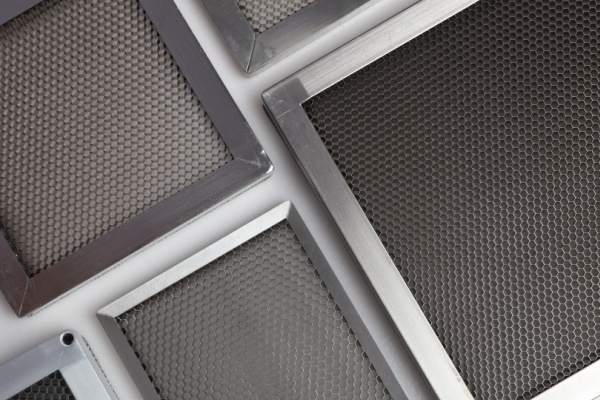
Every hexagonal channel inside a waveguide window ventilation board acts as a miniature waveguide filter.
Each one has a specific cutoff frequency, meaning RF waves below that point simply cannot propagate through the cell.
Performance is tuned through:
Cell diameter
Cell depth (panel thickness)
The conductivity of the metal used
Air flows freely, but electromagnetic energy gets trapped and attenuated within the long, narrow passages.
Most waveguide window ventilation boards are made from aluminum or stainless steel.
The conductive walls of each cell force RF energy into repeated reflections, stripping away strength as the waves bounce inside.
By the time they exit the honeycomb—if they exit at all—the EMI level is already significantly reduced.
Traditional mesh or punched vents often become weak points in an enclosure.
A honeycomb-style waveguide window avoids this problem because its open area is not truly “open” from an RF perspective.
Even though air passes through, the geometry does not allow RF fields to maintain the modes required for transmission.
In practical terms, the Waveguide window ventilation board behaves much closer to a solid metal plate than to a vent.
Different systems demand different levels of airflow and shielding.
Engineers usually adjust variables like:
Honeycomb depth for stronger EMI suppression
Cell size for air volume
Material choice for corrosion or weight considerations
Frame structure for sealing quality and mounting
Because of this flexibility, a Waveguide window ventilation board can suit everything from light-duty telecom cabinets to defense-grade enclosures.
You will often find this kind of ventilation board in:
RF-shielded boxes and racks
Military communication shelters
Radar and navigation systems
5G/6G base station equipment
EMC testing rooms and shielded chambers
High-power microwave devices
Anywhere cooling is needed but RF leakage is not acceptable, a waveguide-style ventilation system becomes the go-to solution.
A Waveguide window ventilation board may look like a simple piece of metal honeycomb, but the design is doing far more than letting air pass.
By combining waveguide cutoff physics with conductive materials, it delivers a rare combination: strong EMI shielding with efficient airflow—something traditional vents simply cannot achieve.