To be a valuable global supplier
for metallic honeycombs and turbine parts


Contact number
0555-2813555
To be a valuable global supplier
for metallic honeycombs and turbine parts
Technological Innovation
Process Management
Continuous Improvement
Customer Satisfaction
Knowledge
Dedication
Diligence
Loyalty
Responsibility
Confidence
Tenacity
Respect

To be a valuable global supplier
for metallic honeycombs and turbine parts
Release time:2025-12-09
In modern diesel aftertreatment systems, the close-coupled DOC has become a standard layout. Placing the Diesel Oxidation Catalyst as close as possible to the turbo outlet helps with faster light-off, better CO/HC control, and more stable downstream temperatures. But this position also exposes the catalyst brick to the harshest part of the exhaust environment.
That’s where metal substrates—especially Fe-Cr-Al based DOC metal substrates—offer clear advantages.
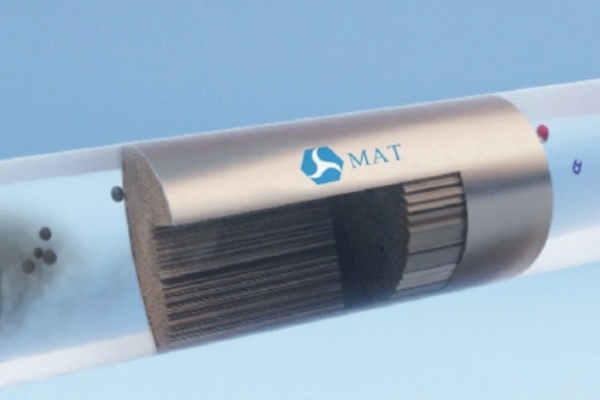
A close-coupled DOC sits where exhaust temperatures fluctuate the most. It needs to deal with:
sudden spikes during load changes
continuous high-temperature operation
rapid heating from cold start
Metal substrates warm up quickly thanks to their thin foil walls and high thermal conductivity. The faster the substrate reaches light-off, the sooner the DOC can convert CO and HC.
Ceramic substrates take longer to absorb heat and don’t tolerate sharp thermal swings nearly as well.
The first few seconds after startup decide whether a diesel engine can meet emission limits. Because a metal substrate has lower thermal mass, it needs less energy to reach catalytic activation temperature.
This makes a big difference in:
cold climates
stop-and-go machinery
small displacement industrial engines
For close-coupled DOC placement, metal substrates simply react faster.
The zone right after the turbo is not only hot—it vibrates heavily. Construction machinery, marine engines, gensets, and agricultural machines can generate constant mechanical stress.
Metal substrates use:
Fe-Cr-Al alloy foil
flexible corrugation geometry
brazed reinforcement points
This internal structure absorbs vibration and minimizes the chance of cracks, foil collapse, or washcoat damage. Ceramic bricks in the same location are more vulnerable to shock.
Close-coupled DOCs often need to fit into tight engine bays. Metal substrates can be wound in various shapes:
round
oval
tear-drop
custom pack-fit designs
Because the foil can be formed more freely, engineers can optimize the balance between:
flow uniformity
backpressure
catalytic area
This is very useful when the DOC shares a housing with DPF or SCR components.
One of the less talked-about advantages is the aluminum oxide layer that naturally forms on Fe-Cr-Al metal substrates.
This layer provides:
excellent washcoat adhesion
greater thermal-stability of noble metal coating
long-term resistance against exhaust gas corrosion
For DOC use—where repetitive heating cycles are normal—this oxide layer significantly extends service life.
Close-coupled DOC placement demands a substrate that can heat up quickly, survive extreme temperatures, handle vibration, and fit into compact housings.
The DOC metal substrate checks all these boxes. With its strong Fe-Cr-Al structure, fast thermal response, and flexible geometry, it remains the most reliable choice for modern diesel engines designed to meet tighter emission rules.