To be a valuable global supplier
for metallic honeycombs and turbine parts


Contact number
0555-2813555
To be a valuable global supplier
for metallic honeycombs and turbine parts
Technological Innovation
Process Management
Continuous Improvement
Customer Satisfaction
Knowledge
Dedication
Diligence
Loyalty
Responsibility
Confidence
Tenacity
Respect
To be a valuable global supplier
for metallic honeycombs and turbine parts
Release time:2025-12-08
Industrial engines are built for one thing: to work hard, often in tough conditions. Whether it’s a generator that runs all day, a mining truck operating underground, or a marine engine crossing open waters, emissions are always part of the equation. And that’s exactly where a metallic catalytic converter comes in.
It’s not just about ticking boxes for regulations anymore. It’s about keeping environments safer for people on site and making sure machines can continue to run efficiently over the long term.
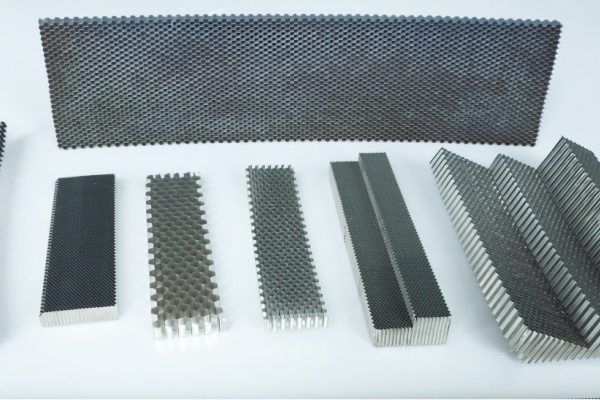
At its core, a metallic catalytic converter does the same basic job as any other — it reduces harmful emissions in the exhaust. But the key difference lies in the substrate.
Instead of a ceramic core, it uses a thin metal foil structure, usually made from FeCrAl alloy. This metal substrate is formed into a honeycomb shape and coated with catalytic materials. As exhaust gases pass through, chemical reactions take place, turning harmful gases like CO and HC into less harmful substances.
Because it’s made of metal, it handles heat and vibration far better than ceramic. That’s a big advantage in industrial settings where temperature swings and mechanical stress are unavoidable.
Industrial engines are rarely used in gentle, predictable environments. They’re exposed to dust, vibration, load changes and long working hours. Ceramic substrates can crack or degrade under those conditions. Metallic ones are far more forgiving.
Another big advantage is faster light-off. A metallic catalytic converter heats up more quickly after start-up, so it begins converting emissions sooner. Over time, this adds up to a noticeable reduction in total emissions, especially for equipment that runs in cycles rather than continuously.
Lower back pressure is another benefit. With thinner walls and a more open structure, metallic substrates allow exhaust gases to flow more freely, which helps maintain engine performance.
Metallic catalytic converters are widely used across many types of industrial equipment, including:
Power generation systems and backup generators
Construction machinery such as cranes and excavators
Mining trucks and underground vehicles
Commercial marine engines and port equipment
Agricultural machines used in large-scale farming
In places like tunnels, mines, ports, and enclosed facilities, reducing emissions is not only a legal requirement — it directly affects worker safety and comfort.
Beyond compliance, metallic catalytic converters also support system longevity. Better heat management means less stress on surrounding components. Their durability means longer service intervals and fewer unexpected failures.
For operators, that means less downtime, lower maintenance costs and more predictable performance. Over time, the system pays for itself not just in compliance, but in reliability.
Industrial sectors are under real pressure to cut emissions without compromising output. The metallic catalytic converter has proven to be one of the most practical tools to achieve this balance.
As technologies continue to evolve, we’re seeing even more advanced coatings and substrate designs, further improving efficiency and lifespan. For many industries, this isn’t a future solution — it’s already becoming the standard.