To be a valuable global supplier
for metallic honeycombs and turbine parts


Contact number
0555-2813555
To be a valuable global supplier
for metallic honeycombs and turbine parts
Technological Innovation
Process Management
Continuous Improvement
Customer Satisfaction
Knowledge
Dedication
Diligence
Loyalty
Responsibility
Confidence
Tenacity
Respect
To be a valuable global supplier
for metallic honeycombs and turbine parts
Release time:2025-11-21
If you’ve ever worked around excavators, bulldozers, or loaders, you know these machines don’t exactly have a smooth ride. The engines and exhaust systems take a beating from vibrations, sudden shocks, and constant load changes. For a Diesel Oxidation Catalyst (DOC), this is a real test. The DOC Metal Substrate inside is the backbone—it has to stay intact while still doing its job of cleaning exhaust gases.
Off-road engines rarely run steady. One minute you’re idling; the next, full load as the machine moves over uneven ground. That means the DOC sees:
Constant vibration from engine and chassis movement.
Sudden shocks when the equipment hits bumps or rocks.
Thermal cycles, where heat expansion combines with mechanical stress.
Ceramic substrates just can’t handle this. They crack, break, or lose their coating. Metal honeycomb substrates, on the other hand, are much more forgiving.
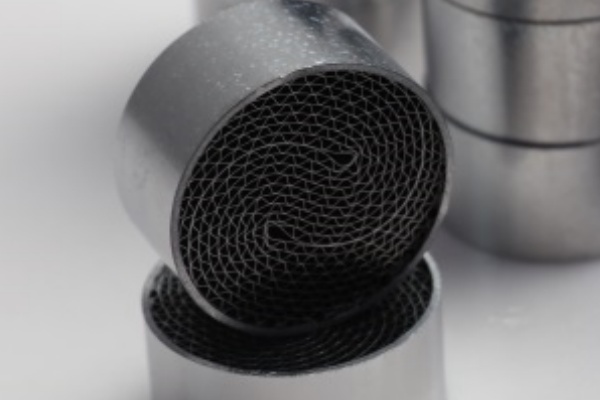
A DOC Metal Substrate is basically stainless steel or FeCrAl foil rolled and corrugated into a honeycomb. This design makes it flexible yet strong:
Absorbs shocks: The honeycomb structure bends slightly under stress instead of cracking.
Handles vibration: Metal flexes without losing structural integrity.
Heats quickly: Metals reach operating temperature faster, which is critical for conversion during engine load changes.
Not every metal substrate is built the same. Here’s what engineers focus on:
Foil thickness: Thicker foils are tougher, but too thick slows heating. Engineers pick a balance so the substrate survives vibration but still lights off fast.
Cell density (CPSI): Too many small channels can make the substrate brittle under stress. Off-road designs usually favor medium CPSI for a mix of surface area and durability.
Corrugation geometry: The angle and depth of corrugations help spread stress evenly and maintain gas flow.
Mounting and canning: How the substrate sits in its housing matters. Proper mats and canning pressure let the substrate flex slightly, which prevents cracking under heavy vibration.
Material choice: FeCrAl forms a stable oxide layer that sticks to the coating, while stainless steel provides corrosion resistance. Choosing the right metal is key for long-term performance.
We don’t just rely on theory. Substrates are put through:
Vibration tables to mimic engine and chassis motion.
Shock simulations to test impact resistance.
Thermal cycling to combine heat and mechanical stress.
The results? A well-designed DOC Metal Substrate can survive thousands of hours in off-road machines without structural issues and maintains consistent backpressure and conversion efficiency.
Even the best metal substrate needs correct installation:
Mats should not be over-compressed.
Canning must hold the substrate securely but not too tightly.
Exhaust connections should avoid transmitting direct vibration.
Monitor the machine’s operation—constant overloads or extreme vibrations can still wear the substrate faster.
For off-road machines, the DOC Metal Substrate isn’t just a catalyst carrier—it’s a mechanical workhorse. Its honeycomb structure, foil thickness, corrugation pattern, and material all combine to handle vibration and shock while keeping emissions under control. Unlike ceramic substrates, metal handles the rough reality of construction sites, farms, and industrial work without losing performance.
If you’re designing or maintaining off-road equipment, investing in quality metal substrates and proper installation is key. They’re built to survive real-world stress and keep your DOC working reliably for years.