To be a valuable global supplier
for metallic honeycombs and turbine parts


Contact number
0555-2813555
To be a valuable global supplier
for metallic honeycombs and turbine parts
Technological Innovation
Process Management
Continuous Improvement
Customer Satisfaction
Knowledge
Dedication
Diligence
Loyalty
Responsibility
Confidence
Tenacity
Respect
To be a valuable global supplier
for metallic honeycombs and turbine parts
Release time:2025-11-22
When you work around marine diesel engines long enough—tugs, fishing vessels, small cargo ships, offshore supply boats—you start to see a pattern: anything mounted near the exhaust must deal with problems that don’t show up in on-road systems. The fuel is different, the vibration is different, and the entire thermal profile is far less predictable.
This is exactly why DOC metal substrate have become the preferred option for marine applications. Ceramic carriers may work in controlled environments, but once you put them in a ship’s engine room, their weaknesses show up fast. After a few retrofit projects and plenty of field inspections, it’s clear why a DOC metal substrate handles the job better.
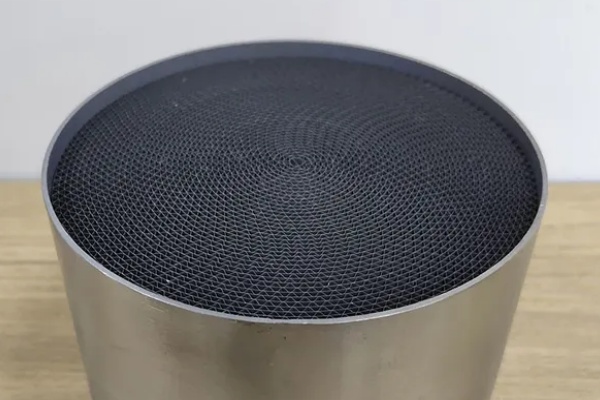
Most marine engines still run on fuels that are nothing like automotive diesel. Even with IMO sulfur limits tightening, the fuel quality offshore remains inconsistent. High sulfur, variable aromatics, and unstable combustion all influence the exhaust chemistry.
Here’s what that means for the DOC:
higher SOF (soluble organic fraction)
more soot residue
more corrosive exhaust moisture
A metal DOC substrate, especially one built from FeCrAl alloy, stands up to sulfur-related corrosion far better than ceramic honeycombs. With ceramic bricks, we used to see micro-cracking and coating spalling after long exposure to humid, sulfur-rich exhaust. Metal substrates form a stable oxide layer, so the coating stays bonded much longer.
Vehicle engines cycle quickly and predictably. Marine engines don’t.
A ship may idle for hours in port, then surge to high load when leaving the harbor, then settle at a mid-load cruise for most of the day. These long, uneven temperature swings are tough on any DOC.
What we see with DOC metal substrates:
They heat up faster after long low-load periods.
They tolerate long hot holds without deforming.
They survive sudden temperature spikes from rapid load changes.
Metal’s thermal conductivity helps the catalyst reach light-off earlier. On vessels that burn lower-grade fuel—where hydrocarbon slip is more obvious—this makes a noticeable difference in both smoke and odor.
Ceramic substrates, by comparison, don’t enjoy this thermal cycling. Repeated uneven heating leads to internal stress that eventually cracks the brick.
Anyone who has worked inside an engine room during rough weather knows this: everything shakes. Marine engines deliver strong, low-frequency vibration through the engine mounts and the hull. Accessories bolted to the exhaust line take that vibration directly.
A DOC metal substrate handles this better than ceramics for a simple reason: the structure flexes slightly instead of cracking.
Key advantages:
Metal foils absorb vibration without fracturing.
The brazed honeycomb maintains channel alignment even under heavy movement.
The cartridge resists chipping and impact damage during installation or service.
We’ve pulled out marine ceramic substrates with corner cracks, broken cells, and coating detachment—usually long before their intended service life. Metal units rarely show the same failure modes.
Marine exhaust systems see hot exhaust on one side and ocean humidity on the other. When the engine cools, condensation collects in the casing. On steel-hull ships, salt mist is unavoidable.
DOC metal substrates—especially FeCrAl—handle this environment far better:
They resist oxidation from moisture and salt cycling.
They maintain structural integrity even after repeated wet/dry cycles.
Their oxide layer protects the catalyst coating from corrosion.
Ceramic substrates simply aren’t built for that kind of exposure. Once moisture penetrates the brick, long-term strength drops.
Ship engines operate near constant torque for long periods. If backpressure creeps up due to soot, ash, or early substrate degradation, fuel consumption rises noticeably and the engine struggles to maintain load.
DOC metal substrates offer:
lower initial backpressure,
more stable flow after long operation,
less risk of channel plugging,
higher tolerance to uneven soot distribution.
Marine operators often care less about emissions and more about keeping engines reliable and fuel cost predictable. Lower backpressure helps with both.
Marine vessels run long hours and usually prefer minimal downtime. When accessing the exhaust system takes removing insulation blankets, service platforms, or duct sections, nobody wants to do it twice.
In real fleets, we keep seeing:
metal substrates still structurally sound after 8,000+ hours,
coatings intact after multiple thermal cycles,
stable conversion performance even with fuel variation.
That kind of predictable durability is why shipowners are switching to metal DOC solutions, especially when retrofitting older vessels to meet port emission standards.
Marine exhaust conditions are messy—high sulfur, drifting temperatures, heavy vibration, and constant exposure to moisture. In that environment, a DOC metal substrate simply outperforms ceramic carriers.
It heats up faster, handles vibration better, resists corrosion, and delivers stable oxidation performance across long operating hours. For ship operators trying to meet emission limits without sacrificing reliability, metal substrates aren’t just a better choice—they’re the only practical one.