To be a valuable global supplier
for metallic honeycombs and turbine parts


Contact number
0555-2813555
To be a valuable global supplier
for metallic honeycombs and turbine parts
Technological Innovation
Process Management
Continuous Improvement
Customer Satisfaction

Knowledge
Dedication
Diligence
Loyalty
Responsibility
Confidence
Tenacity
Respect

To be a valuable global supplier
for metallic honeycombs and turbine parts
Release time:2025-07-31
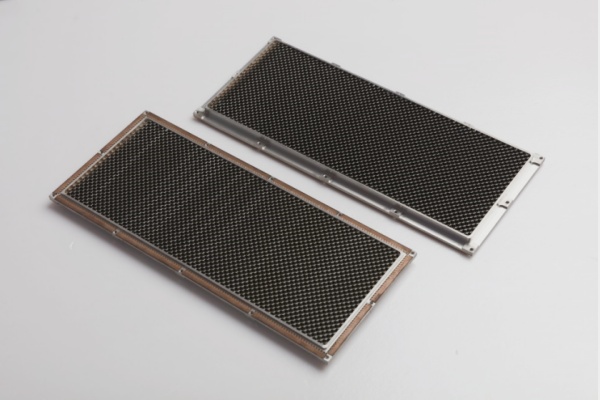
Modern ventilation windows represent a critical convergence point between environmental control and electromagnetic compatibility requirements. As wireless technologies proliferate across industrial and residential spaces, the demand for effective electromagnetic interference testing has grown exponentially. This technical guide examines standardized evaluation protocols for assessing ventilation window performance in shielding against electromagnetic disturbances while maintaining optimal airflow characteristics.
Core Testing Methodologies,Frequency Domain Analysis forms the backbone of electromagnetic interference testing for ventilation structures:
Large Loop Injection (30Hz-100kHz): Deploys precisely calibrated current loops to simulate low-frequency magnetic fields, with loop diameter exceeding half the window's smallest dimension for accurate near-field measurements.
Antenna Radiation Method (10MHz-40GHz): Utilizes directional antennas to generate standardized electromagnetic waves, requiring independent vertical/horizontal polarization tests to account for structural anisotropy.
Flanged Coaxial Technique: Specifically designed for planar materials per ASTM D4935, ideal for evaluating metallic mesh and honeycomb configurations common in ventilation window designs.
Time Domain Diagnostics provide complementary insights:
Pulse excitation techniques (e.g., Electrical Fast Transient) identify localized shielding failures at joints and waveguide interfaces through transient response analysis.
Standardized Testing Framework
Global certification protocols mandate compliance with tiered standards:
Military Specifications: MIL-STD-285 and GJB 6190-2008 define rigorous thresholds for mission-critical applications.
Civilian Standards: GB/T 12190 (shielding rooms) and GB/T 30142-2013 (planar materials) establish baseline requirements for commercial installations.
Industry Benchmarks: IEEE 299.1 Level 4 certification (≥80dB@10MHz-18GHz) addresses emerging 5G and millimeter-wave challenges.
Advanced Testing Scenarios
Millimeter-Wave Evaluation (24.25-52.6GHz):
Incorporates focused horn antennas in anechoic chambers to minimize diffraction artifacts.
Employs spatial averaging techniques to account for wavelength-scale structural variations.
Large-Area Assessment:
Grid-based segmentation (300mm×300mm units) enables localized performance mapping.
Robotic scanning systems generate 3D shielding effectiveness profiles.
Long-Term Performance Monitoring:
Surface transfer impedance measurements track material degradation.
Predictive modeling correlates environmental exposure with shielding performance decay.
Certification and Reporting
Third-party validation requires:
Calibration certificates traceable to ISO 17025 standards.
Frequency response curves with 1/3-octave resolution.
Measurement uncertainty analysis (±2dB tolerance).
Explicit compliance statements against applicable standards.
The systematic application of electromagnetic interference testing methodologies ensures ventilation windows meet dual requirements of environmental control and electromagnetic protection. As wireless technology evolves toward higher frequencies and denser deployments, continuous refinement of testing protocols will remain essential for maintaining electromagnetic compatibility in built environments.