To be a valuable global supplier
for metallic honeycombs and turbine parts


Contact number
0555-2813555
To be a valuable global supplier
for metallic honeycombs and turbine parts
Technological Innovation
Process Management
Continuous Improvement
Customer Satisfaction
Knowledge
Dedication
Diligence
Loyalty
Responsibility
Confidence
Tenacity
Respect

To be a valuable global supplier
for metallic honeycombs and turbine parts
Release time:2026-08-19
Most people look at a finished metallic honeycomb catalyst substrate and see a block of metal with holes. Looks simple.
It's not.
You start with a roll of flat foil. 0.05 mm thick. Sometimes thinner. That foil has to become a structure with thousands of cells. All uniform. All bonded together. Able to survive 800°C exhaust and years of vibration.
Two steps make or break it: corrugating and welding. Get either wrong, and the substrate doesn't last.
Here's what happens in our shop.
The Foil
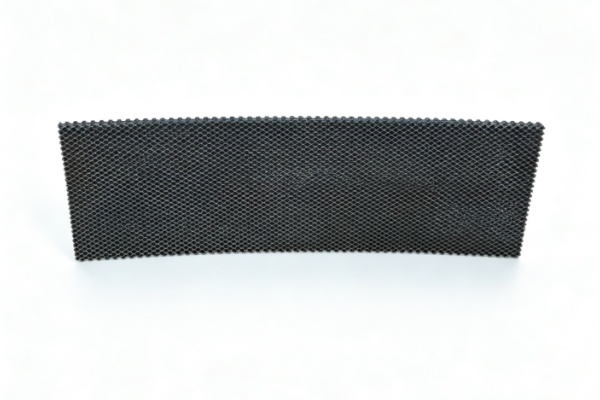
Metallic honeycomb starts with thin stainless foil. Fe-Cr-Al alloys are common – they handle high-temperature oxidation. Foil thickness is usually 0.05 mm, sometimes down to 0.02 mm for high-density stuff.
The foil comes in coils. Every coil gets checked before it hits the line. Thickness, surface, oxidation. Oil or scale on the foil? The weld won't take. Thickness varies? Cells come out uneven.
One bad roll can ruin a whole batch. So we check everything.
Corrugating
The flat foil has to become wavy. That's corrugating.
The foil goes through forming rolls – gears that press flat metal into a wavy shape. The wave pattern sets the cell size. Tighter waves = smaller cells. Wider waves = larger cells.
The rolls have to be precise. Worn rolls make uneven corrugations. Uneven corrugations mean uneven cells. Uneven cells mean bad flow and weak spots.
Some methods use progressive corrugation – the foil gets shaped gradually as it moves through. The profile can be trapezoidal, sinusoidal, whatever the application needs.
We change rolls on a schedule, not when they break. If the corrugations are off by a few microns, the cells won't line up when stacked.
The corrugated foil becomes the cell walls. The flat foil becomes the walls between rows of cells.
Stacking or Winding
Once the foil is corrugated, it has to become honeycomb.
Round substrates are wound. Two strips – one corrugated, one flat – wound together around a mandrel. Like rolling up a sleeping bag. Corrugated strip makes the cells. Flat strip closes them off.
The winding has to be tight. Too loose, layers shift and cells don't line up. Too tight, foil stretches and cells deform. Back tension is critical – around 10 kgf during winding.
Some substrates are stacked instead of wound. Slower, but works for non-round shapes.
Either way, you get a core with hundreds or thousands of cells. At this point, nothing holds the layers together except tension and friction.
Welding – Brazing
The core has to be bonded. If the layers aren't joined, the substrate comes apart in the exhaust. Vibration, heat, exhaust pulses – they'll separate the layers.
Brazing is the most common method. A filler metal with a lower melting point goes between the layers. It melts, flows into the gaps by capillary action, and solidifies. No pressure needed – important for thin foils.
The brazing happens in a furnace – vacuum or hydrogen atmosphere. Temperatures can hit 1200°C. The atmosphere matters – aluminum oxide on the foil surface can stop the filler from wetting. Ni-base filler metals are common for heat resistance.
Some methods use laser welding instead. A laser beam hits the end surface of the core, welding the corrugated and flat plates together at the contact points.
The challenge with laser is coverage. A laser spot is small – about 0.2 mm diameter. To cover a large end surface, the beam has to move in a pattern, oscillating as it goes.
Diffusion bonding is for high-performance stuff. The foils get heated under pressure in a vacuum. Metal atoms diffuse across the joint interface. No filler. The layers become one piece of metal.
Each method has its place. Brazing is the workhorse – reliable, proven, cost-effective. Laser is faster for some jobs. Diffusion bonding is for when you need the strongest joint possible.
End Welding – Preventing "Film Out"
When a substrate is wound or stacked, the layers can shift. Exhaust flow can push inner layers out – called "film out."
To stop it, the ends of the core get welded after formation. The laser or braze bonds the layers at the end faces, locking them in place.
The welding has to be uniform across the whole end surface. Some areas welded, others not? The substrate can still shift or delaminate.
The Can
After the core is formed and welded, it goes into a metal can. The can protects the core and mounts it in the exhaust system.
Some methods form the can around the core. A strip of sheet metal roll-formed into a concave shape. Foil layers laid onto it. Sheet metal formed into a tube around the layers. Seam welded along the length.
Other methods insert the core into a pre-formed can and braze it in place.
Either way, the core has to be held secure. Movement leads to fretting and failure.
What Goes Wrong
Uneven corrugations – worn rolls. Uneven cells. Bad flow.
Poor brazing – filler doesn't flow. Layers not bonded. Delamination.
Laser burn-through – too much power on thin foil. Holes.
Oxidation during brazing – atmosphere off, foil surface oxidizes. Filler won't wet. Bond fails.
Winding tension wrong – too loose layers shift, too tight foil stretches.
Incomplete end welding – end faces not fully welded. Layers protrude or separate.
Testing
Every batch gets tested.
Peel test – sacrifice one, peel layers apart. Foil should tear before the joint gives.
Tap test – tap with a screwdriver. Solid bond rings. Weak bond thuds.
Light test – shine a light through. Even pattern = straight cells. Dark spots = crushed or misaligned cells.
Dimensions – diameter, length, cell density. Out of spec = no ship.
Bottom Line
A metallic honeycomb catalyst substrate isn't just a block with holes. Flat foil gets corrugated, stacked or wound, bonded – by brazing, laser welding, or diffusion bonding.
Corrugation has to be precise. Winding has to be tight. Brazing or welding has to be complete. End faces have to be locked.
Get any of these wrong, and the substrate fails. Maybe not today. Maybe not tomorrow. But eventually.
We make metallic honeycomb catalyst substrates. That's what we do.