To be a valuable global supplier
for metallic honeycombs and turbine parts


Contact number
0555-2813555

To be a valuable global supplier
for metallic honeycombs and turbine parts

Technological Innovation
Process Management
Continuous Improvement
Customer Satisfaction

Knowledge
Dedication
Diligence
Loyalty
Responsibility
Confidence
Tenacity
Respect

To be a valuable global supplier
for metallic honeycombs and turbine parts
Release time:2026-08-11
Before you buy an EMI shielding vent, you need to know one thing: are you buying a vent that actually shields, or something that just looks like one? The price difference isn't huge. The EMC test results are.
We evaluate eight things at our factory before we ship a vent. Miss any of them, and you might end up with a vent that doesn't work.
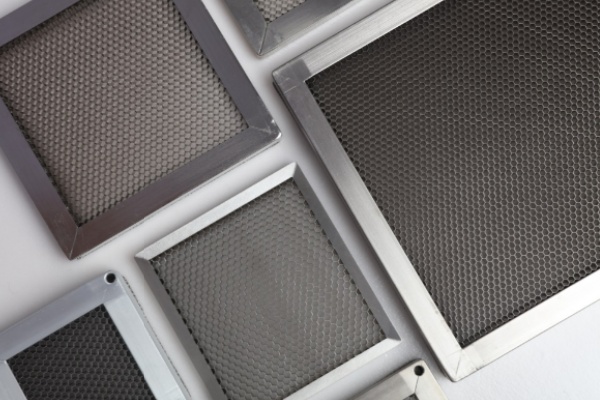
1. Frequency – What Band Do You Need to Block
This is the most overlooked parameter and the one that trips people up the most.
First figure out your equipment's highest operating frequency and what interference sources might be nearby. 1/8‑inch (3.2 mm) honeycomb has a cutoff around 1.5 GHz. 1/16‑inch (1.6 mm) cuts off around 3 GHz. Higher frequencies need smaller cells.
What to ask: What's the shielding effectiveness at my specific frequency? One data point at 1 GHz isn't enough.
2. Shielding Effectiveness Data – Real Test Reports, Not Marketing
Don't trust "nominal values." Shielding effectiveness has to be measured, not estimated.
40‑50 dB is basic shielding – enough for commercial EMC. 60‑70 dB is the workhorse level – telecom and industrial. 80‑100 dB is high shielding – military, medical, critical. 100+ dB is extreme – shielded rooms, TEMPEST.
What to ask: For a test report, not a spec sheet. The report should include frequency range, test method (IEEE 299 or MIL‑STD‑285), and batch number of the tested sample.
3. Cell Size and Depth – One Sets Cutoff, One Sets Attenuation
Cell size determines cutoff frequency. Depth determines how much attenuation you get. Both are essential.
Pick too large a cell, and high‑frequency signals pass right through. Pick too shallow a depth, and attenuation isn't enough.
Rule of thumb: Standard is 1/8‑inch cells + 1/2‑inch depth. High‑frequency applications use 1/16‑inch + 1/2‑inch. Low‑frequency plus high airflow use 1/4‑inch + 1/2‑inch. Depth beyond 1 inch is for high‑shielding requirements, but pressure drop increases significantly – check your fan margin.
4. Open Area – Can Air Actually Get Through
Open area is the percentage of the vent face that's empty space. Below 80%, fan efficiency drops noticeably. Good vents hit 85‑95%. 85% is the baseline.
What to ask: What's the open area percentage? If they can't answer, they haven't done flow testing.
5. Pressure Drop Curve – Don't Find Out After Installation That Airflow Is Too Low
Open area gives you a theoretical number. Pressure drop curve tells you whether air can actually pass through at your operating flow.
Same 85% open area, 1/2‑inch depth versus 1‑inch depth – pressure drop roughly doubles.
What to ask: For a pressure drop curve, not a single number. The curve needs to cover your operating airflow range. If they have a curve, they've done flow testing. If they don't, they haven't.
6. Material and Surface Finish – How Long It Lasts
Indoor, normal environment: aluminum honeycomb with chromate conversion or nickel plating. Lightweight, affordable, good enough.
Outdoor or high humidity: stainless steel (304 or 316L) or nickel‑plated aluminum. Aluminum corrodes in salt spray.
Chemical environments: 316L stainless steel or tin‑plated brass.
What to ask: What's the base material? What's the surface finish? Have you done salt spray testing?
7. Brazing Method – Glued Panels Don't Last
How the honeycomb layers are bonded determines service life. Vacuum brazing creates a metallurgical bond – no adhesive to age, stable shielding over time. Bonded (glued) panels might pass factory testing, but shielding drifts after a few years.
What to ask: Is it vacuum brazed or bonded? For brazed, they should be able to describe the temperature profile and process. Vague answers mean process control isn't solid.
8. Gasket and Installation – Edge Leaks Ruin Everything
Perfect honeycomb with a poor frame seal is a leaky vent. RF leaks around the edge. All that shielding is wasted.
Gasket types: Silver‑filled silicone (indoor standard), beryllium copper fingers (high vibration), knitted wire mesh (harsh environments). Avoid conductive foam – it's not reliable.
Mounting surface: The gasket must sit on bare metal. Paint and oxide layers must be scraped off. Screw torque needs to be right – too loose leaves gaps, too tight warps the frame. Screw spacing no more than 50 mm.
What to ask: What's the gasket material? What's the torque spec? What's the surface prep requirement? If they can give specific numbers, they've done installation validation. "Standard installation" isn't enough.
Also Ask for Test Reports and Batch Traceability
One panel tested doesn't mean the whole batch is good. You need batch‑specific records, not one sample report.
Shielding effectiveness test report (frequency range and test method included)
Material certificate
Batch number for traceability
Pressure drop curve
Bottom Line
Eight things to check before you buy an EMI shielding vent: frequency, shielding data, cell size/depth, open area, pressure drop curve, material/finish, brazing method, gasket and installation requirements. Plus batch test reports and material certs.
We make EMI shielding vents. Not sure what you need? Send us your requirements. We'll spec the right vent – not the most expensive one, the one that fits.
That's what we do.