To be a valuable global supplier
for metallic honeycombs and turbine parts


Contact number
0555-2813555

To be a valuable global supplier
for metallic honeycombs and turbine parts

Technological Innovation
Process Management
Continuous Improvement
Customer Satisfaction

Knowledge
Dedication
Diligence
Loyalty
Responsibility
Confidence
Tenacity
Respect

To be a valuable global supplier
for metallic honeycombs and turbine parts
Release time:2026-08-07
If you look at an EMI shielding vent and a regular ventilation grille side by side, they look similar. Both have openings. Both let air pass. Both bolt onto a cabinet.
But the similarity stops there.
One is for moving air. The other is for moving air and stopping RF. One is a passive opening. The other is an engineered filter. And in any environment with sensitive electronics, the difference between them is the difference between passing EMC testing and failing it.
We make EMI shielding vents. Here's why they're not the same as regular grilles – and when you actually need them.
What a Regular Ventilation Grille Actually Is
A regular grille is exactly what it looks like. A piece of metal or plastic with holes. Sometimes a louver. Sometimes a mesh. Sometimes just a stamped plate with slots.
Its job is simple: let air through. Nothing else.
In a cabinet with no EMI requirements, that's fine. The grille cools the gear. No one cares about RF leaking out or getting in because there's no sensitive electronics to protect.
But put that same grille on a cabinet with a microprocessor, a radio, or any communication port, and you have a problem. Standard ventilation grilles, perforated plates, or fan openings often behave as slot antennas, significantly reducing enclosure shielding effectiveness – especially at higher frequencies. Once the signal's wavelength gets short enough, even a small hole starts looking like an open door.
That grille becomes a leak.
How an EMI Shielding Vent Works
An EMI shielding vent solves a different problem. It doesn't just move air. It moves air while maintaining shielding continuity.
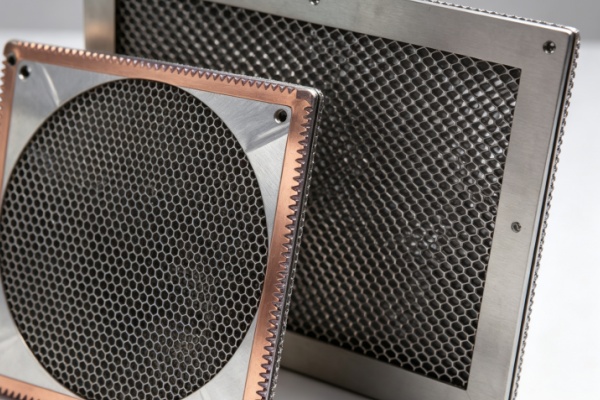
Most EMI shielded vent panels use waveguide‑below‑cutoff or honeycomb structures that allow airflow while attenuating electromagnetic energy. The honeycomb cells act as tiny waveguides. If the cell is small enough and deep enough, RF can't propagate through it. It bounces off the walls and dies.
Air molecules don't care about cutoff frequencies. They flow right through. That's the whole trick.
Instead of an open window, you get a structured path that lets air move while blocking specific frequencies. Ventilation and shielding finally stop fighting each other.
The Numbers – What You Actually Get
A regular grille gives you maybe 10‑15 dB of shielding at 1 GHz. At 2 GHz, you're lucky to get 10 dB. At 5 GHz, it's basically zero. The holes act like slot antennas. RF leaks out like water through a screen door.
An EMI shielding vent with 1/8‑inch honeycomb, 1/2‑inch depth gives you 40‑60 dB at 1 GHz. At 5 GHz, 35‑50 dB. Some designs hit 80‑120 dB at microwave frequencies.
That's the difference between a cabinet that leaks and a cabinet that passes EMC.
Airflow – The Surprise
People assume a regular grille flows better because it's thinner. Not necessarily.
A regular grille has 30‑50% open area. That's not great. Fans work harder.
An EMI shielding vent with honeycomb has 80‑95% open area. The straight cells create laminar flow with low pressure drop. Better airflow than a grille.
Same shielding requirement, honeycomb flows more air. Fans work less. Equipment runs cooler.
Durability and Longevity
A regular grille is fragile. It bends, it dents, it rusts.
An EMI shielding vent is rigid. Brazed or welded construction. Handles vibration, heat, and repeated handling.
Regular grilles have no shielding to maintain. EMI vents require inspection over time. Corrosion, deformation, or contamination can reduce shielding performance. But when maintained properly, they outlast grilles by years.
Installation – The Critical Difference
A regular grille bolts on. Done.
An EMI shielding vent requires proper installation. You can have the perfect vent. If you install it wrong, it leaks.
Bare metal contact. The frame needs a conductive gasket and bare metal mounting surface. Paint is an insulator. Break the electrical path, and the vent doesn't shield.
Screw torque. Too loose, gaps. Too tight, frame warps.
Screw spacing. Every 50 mm or less.
Grounding. The vent must be electrically bonded to the enclosure. Without proper sealing, EMI can bypass the vent entirely.
We've fixed more "bad vents" by scraping paint than by replacing honeycomb. Installation quality matters as much as the vent itself.
When to Use a Regular Grille
Regular grilles are fine when:
EMI is not a concern
Systems are non‑sensitive
Cooling is the only requirement
There's no EMC testing to pass
They're cheap. They're simple. They work in low‑frequency, no‑EMI environments.
When You Need an EMI Shielding Vent
You need an EMI vent when:
Shielding continuity must be maintained
EMC compliance is mandatory
System stability depends on EMI control
There are sensitive electronics, radios, or communication ports in the cabinet
An EMI shielded vent panel is not a universal replacement. It is an application‑driven solution.
Bottom Line
A regular grille moves air. That's it. No shielding. At high frequencies, it leaks.
An EMI shielding vent moves air and stops RF. It uses waveguide‑below‑cutoff physics. It gives you 40‑60 dB at 1 GHz. It flows more air than a grille. It lasts longer. But it requires proper installation and grounding.
Ventilation openings often define the weakest point in a shielded enclosure. Ignoring this leads to design compromises. A properly selected EMI shielding vent addresses airflow and shielding simultaneously.
If your equipment matters, use the right vent.
We make EMI shielding vents. That's what we do.