To be a valuable global supplier
for metallic honeycombs and turbine parts


Contact number
0555-2813555

To be a valuable global supplier
for metallic honeycombs and turbine parts

Technological Innovation
Process Management
Continuous Improvement
Customer Satisfaction

Knowledge
Dedication
Diligence
Loyalty
Responsibility
Confidence
Tenacity
Respect

To be a valuable global supplier
for metallic honeycombs and turbine parts
Release time:2026-07-09
Before you pick a honeycomb vent, you gotta know one thing. Your frequency. Not the one you hope you have. The real one.
Get that wrong, and the vent is useless. RF sails right through. You wasted money, and your gear still leaks.
Here's how to match honeycomb specs to your operating frequency. No theory. Just what works.
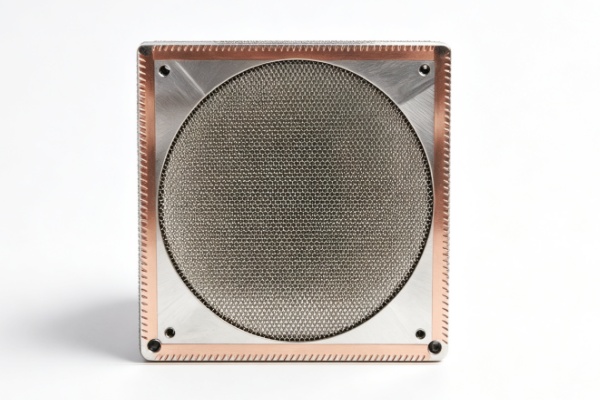
The One Rule You Can't Ignore
The cell size must be smaller than the wavelength you're trying to block.
That's it. That's the whole thing.
The honeycomb is a bunch of little tubes. Each tube is a waveguide. If the tube is too big for the frequency, RF goes straight through. If the tube is small enough, the wave bounces off the walls and dies.
The rule of thumb: the cell depth needs to be 3 to 4 times the cell diameter. A 3.18 mm cell needs at least 12.7 mm depth. That's the waveguide‑below‑cutoff effect.
Smaller cells = higher frequency blocking. Bigger cells = more airflow.
Cell Size vs. Frequency – What You Actually Need
Here's the rough map.
1/4‑inch (6.35 mm) – cutoff around 600 MHz. Good for low frequencies. Open area around 90%. Best airflow.
1/8‑inch (3.18 mm) – cutoff around 1‑2 GHz. The workhorse. 85% open area. Good for most telecom, 4G, Wi‑Fi.
1/16‑inch (1.6 mm) – cutoff around 3 GHz. For 5G, radar, millimeter wave. Open area drops to 75‑80%. Airflow takes a hit.
A 1/8‑inch cell at 1/4‑inch thickness gives you 102 dB at 100 MHz, 74 dB at 2 GHz, and 58 dB at 10 GHz. That's solid for most applications.
A 3.2 mm cell at 12.7 mm depth blocks frequencies above 20 GHz with 90 dB or more.
The rule: use the biggest cell that still covers your frequency. Don't overspec. A 1/16‑inch vent at 2.4 GHz shields great, but it chokes airflow for no reason.
Cell Depth – The Second Knob
Depth is how thick the honeycomb is. Standard is 1/2 inch (12.7 mm). You can go 1 inch or more.
Deeper cells shield better. A 1/8‑inch cell vent at 5 GHz might give 35 dB at 1/2‑inch depth, and 55 dB at 1‑inch depth.
But depth kills airflow. Pressure drop roughly doubles when you double the depth.
Single‑layer 6.35 mm thick honeycomb at 2 GHz gives 52 dB. Same cell size at 12.7 mm gives 96 dB. More depth, more shielding.
Cross‑cell honeycomb – multiple sections stacked – gives even higher shielding. 6.35 mm cross‑cell at 2 GHz gives 94 dB.
Trade‑off: more depth = better shielding = less airflow. Pick what matters more.
Real Numbers from the Bench
We tested a 1/8‑inch cell, 1/4‑inch thick vent. Here's what it gave:
At 100 MHz: 102 dB.
At 500 MHz: 85 dB.
At 2 GHz: 74 dB.
At 10 GHz: 58 dB.
A 1/8‑inch cell, 1/2‑inch deep vent at 2 GHz gives about 55‑60 dB. At 5 GHz, about 35‑40 dB. At 10 GHz, about 20‑25 dB.
For high shielding, cross‑cell honeycomb is the answer. 6.35 mm cross‑cell at 2 GHz gives 94 dB – almost as good as 12.7 mm single‑layer at 96 dB. Half the thickness, almost the same shielding.
When to Go Smaller
Need to block 5G at 3.5 GHz? 1/8‑inch works, but you're near the edge. 1/16‑inch gives you more margin.
Need to block 28 GHz mmWave? You need 1/16‑inch or smaller.
Need to block 60 GHz and above? 2.0 mm holes or smaller. Some specialist vents in this range cover up to 67 GHz with better than -70 dB attenuation.
Don't overspec. If you don't need mmWave, stick with 1/8‑inch. You'll save airflow and money.
What the Standards Say
MIL-HDBK-419A shows that a steel honeycomb vent with 1/8‑inch cells and 1/2‑inch depth gives 56‑57 dB from 100 MHz to 500 MHz. That's enough for a lot of military and industrial work.
IEEE 299 and MIL‑STD‑285 are the test standards for shielding effectiveness. If a supplier can't tell you how they tested, be suspicious.
Summary – Quick Guide
Sub‑6 GHz – 1/8‑inch cells, 1/2‑inch depth. Open area 85%. Good for most telecom, 4G, Wi‑Fi.
28 GHz mmWave – 1/16‑inch cells, 1/2‑inch depth or more. Higher shielding, less airflow.
60 GHz+ – 2.0 mm holes or smaller. Very high attenuation.
Low frequency (below 600 MHz) – 1/4‑inch cells. Best airflow.
High shielding requirement – cross‑cell honeycomb. 6.35 mm cross‑cell gives 94 dB at 2 GHz.
Bottom Line
Picking a honeycomb vent by frequency is simple once you know the rough map.
1/4‑inch for low frequencies, good air.
1/8‑inch for most telecom and Wi‑Fi.
1/16‑inch for 5G and radar.
Smaller for mmWave.
Match the cell size to your frequency. Match the depth to your shielding requirement. Don't overspec – it kills airflow.
We make honeycomb vents in all sizes. Tell us your frequency. We'll tell you what vent to buy. That's what we do.