To be a valuable global supplier
for metallic honeycombs and turbine parts


Contact number
0555-2813555
To be a valuable global supplier
for metallic honeycombs and turbine parts

Technological Innovation
Process Management
Continuous Improvement
Customer Satisfaction

Knowledge
Dedication
Diligence
Loyalty
Responsibility
Confidence
Tenacity
Respect

To be a valuable global supplier
for metallic honeycombs and turbine parts
Release time:2026-05-27
People think a high screen efficiency ventilation window is just a piece of mesh in a frame. Drill some holes, slap a screen on it, call it a day.
No. That's a bug catcher, not an EMI shield.
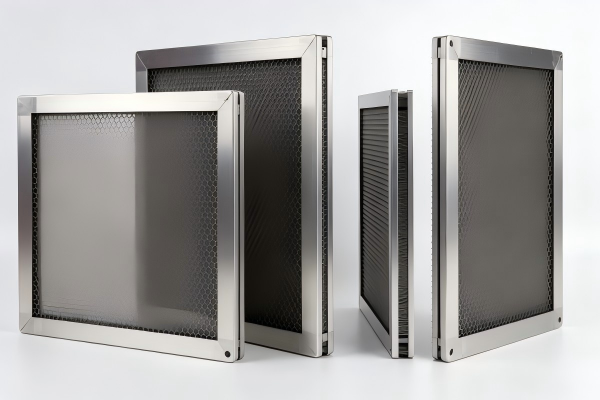
A real high screen efficiency ventilation window has to do two things at once – move a lot of air, and stop a lot of RF. Get the balance wrong, and you either cook your equipment or leak like a radio station.
Here's how we build them at our shop.
The Problem with Cheap Screens
Ordinary mesh – like window screen – has maybe 50-60% open area. That's not enough. Your fans will scream. Also, the holes are irregular. RF leaks through at high frequencies.
Perforated sheet is worse. 30-40% open area. Chokes airflow. And it's thin – no depth, so no waveguide effect.
So cheap "screens" fail on both counts. Poor ventilation. Poor shielding.
What High Screen Efficiency Means
We use waveguide honeycomb. Thin metal walls, lots of small cells. Open area is 80-90% – way better than mesh or perforated. Air flows almost like an open hole.
The cells are deep – typically 1/2 inch or more. That depth creates the waveguide cutoff. RF above a certain frequency can't get through. It bounces around and dies.
So you get both. Good airflow. Real shielding.
That's the high screen efficiency part.
Cell Size vs. Frequency
The cell size determines what frequencies get blocked.
1/4‑inch cells → cutoff around 600 MHz. Good for low frequencies, airflow is excellent.
1/8‑inch cells → cutoff around 1.5 GHz. The workhorse. 85% open area.
1/16‑inch cells → cutoff around 3 GHz. Shields 5G, radar. Open area drops to 75-80%.
Pick the cell size that matches your problem frequency. Don't overshoot – smaller cells hurt airflow more.
Airflow – The Forgotten Half
We see this all the time. Someone specs a vent with tiny cells because they want "maximum shielding." Then they bolt it on, and the fans struggle. Equipment runs hot.
They forgot about airflow.
A high screen efficiency ventilation window needs to be sized correctly. Calculate your CFM. Get the pressure drop curve from the supplier. Make sure your fans can handle it.
If not, go up a cell size or add more vent area.
Sealing – The Silent Killer
Even the best honeycomb won't shield if the frame leaks.
You need a conductive gasket between the vent and the cabinet – silver‑filled silicone or beryllium copper. The mounting surface must be bare metal. No paint. No anodize.
And torque the screws to spec. Too loose – gap. Too tight – warp the frame. Both leak.
We've fixed more "bad vents" by scraping paint off the cabinet than by replacing the honeycomb.
Real Example – Data Center Upgrade
A customer had a server rack overheating. They were using perforated sheet vents – 40% open area. Fans were maxed out. Temperature was high.
We swapped in a high screen efficiency ventilation window – 1/8‑inch honeycomb, 85% open area. Same fans, same cabinet. Temperature dropped 12°C. Fans slowed down. Noise dropped.
Shielding? They didn't even know they had an RF problem until the old vents leaked. New vents fixed that too.
Real Example – Military Shelter
A military shelter needed 60 dB shielding at 2 GHz. They tried a cheap honeycomb vent – 1/4‑inch cells. Open area was fine, but shielding was only 35 dB.
We used 1/8‑inch cells, 1/2‑inch depth, stainless frame, conductive gasket. Shielding hit 65 dB. Airflow was still fine because we increased the vent size a bit.
That's the trade‑off. Sometimes you need a bigger vent to keep airflow up.
Common Mistakes
Mistake #1 – Buying by shielding number alone, ignoring open area. Then fans choke.
Mistake #2 – Using aluminum outdoors. Corrodes. Shielding drops.
Mistake #3 – No gasket. Or paint under the gasket. Both leak.
Mistake #4 – Thinking all honeycomb is the same. Cell size and depth matter.
How to Pick the Right One
Step 1 – Know your highest frequency. Pick cell size accordingly.
Step 2 – Know your required CFM. Get pressure drop data.
Step 3 – Decide material. Indoor? Aluminum. Outdoor? Stainless.
Step 4 – Don't forget the gasket. Conductive, bare metal surface, torque spec.
Step 5 – Test one before you buy a hundred.
Bottom Line
A high screen efficiency ventilation window is not a piece of mesh. It's engineered honeycomb – right cell size, right depth, right material, right gasket.
Good airflow. High shielding. That's the whole point.
We make them. We test them. We've seen what works and what doesn't.
If you need a vent that breathes and blocks, call us. Tell us your frequency and your fan specs. We'll build the right one. No guesswork. That's what we do.