To be a valuable global supplier
for metallic honeycombs and turbine parts


Contact number
0555-2813555
To be a valuable global supplier
for metallic honeycombs and turbine parts

Technological Innovation
Process Management
Continuous Improvement
Customer Satisfaction

Knowledge
Dedication
Diligence
Loyalty
Responsibility
Confidence
Tenacity
Respect

To be a valuable global supplier
for metallic honeycombs and turbine parts
Release time:2026-05-25
We get asked this a lot at our factory. What's the difference between a regular honeycomb vent and a waveguide array ventilation plate? Don't they both have holes?
Yeah, but the holes aren't the same. And at high frequencies, it matters a lot.
Here's what we've seen on our test bench.
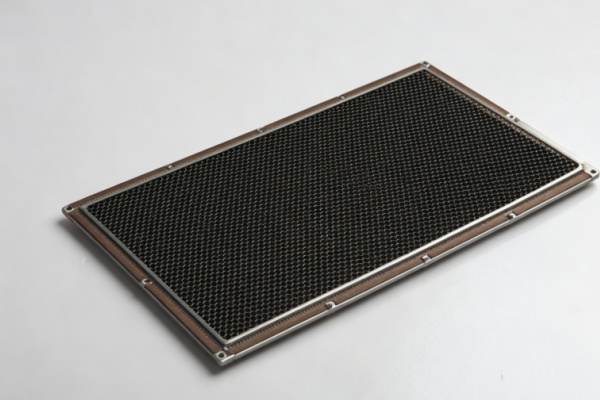
Regular honeycomb is made from thin foil, corrugated and stacked or wound. The cells are hexagons. They work fine at lower frequencies – like 1‑2 GHz. But crank it up to 5 GHz or 10 GHz, and problems show up.
The cell walls aren't perfectly straight. There are tiny curves. Also, the seams where layers are brazed together – those can have microscopic gaps. At microwave frequencies, those gaps act like little antennas. RF sneaks out.
We've tested honeycomb from several suppliers. At 1 GHz, they all did 60 dB or more. At 5 GHz, some dropped to 35 dB. At 10 GHz, many were down to 15‑20 dB – basically useless.
A waveguide array ventilation plate isn't made from foil. It's machined from a solid block of metal – usually aluminum. Holes are drilled or EDM cut straight through. No seams. No brazing. Just a solid block with precision holes.
The holes can be round, square, or hex. But they're all perfectly straight, smooth, and identical. That makes a huge difference at high frequencies. A straight hole is a real waveguide. RF can't sneak around corners or through gaps.
You can also vary the hole size across the plate – bigger holes in the middle, smaller at the edges – to tune the airflow and shielding. Can't really do that with old honeycomb.
We put a standard 1/8‑inch honeycomb vent (1/2 inch deep, aluminum) next to a waveguide array ventilation plate with the same hole size and depth.
At 1 GHz: both about 65 dB. No difference.
At 5 GHz: honeycomb 35 dB, waveguide array 55 dB. That's 20 dB better.
At 10 GHz: honeycomb 18 dB, waveguide array 42 dB. The honeycomb is junk at 10 GHz. The waveguide array still works.
Airflow? Almost the same. Same open area, same depth. Pressure drop was within 5%.
Weight? The waveguide array is a bit heavier – solid block instead of thin foil. Not a big deal for most cabinets.
Machining from solid block is expensive. Foil is cheap. A waveguide array can cost 3‑5 times more than a regular honeycomb vent.
So you don't use it everywhere. You use it when you really need high shielding at high frequencies.
A customer had a 5G base station at 3.5 GHz. They used regular honeycomb. Passed lab EMC, but in the field near other radios, they got interference.
We tested their vent – about 45 dB at 3.5 GHz. Not bad, but not enough margin.
Switched to a waveguide array ventilation plate – same hole size, same depth. At 3.5 GHz, it hit 65 dB. Interference gone. They paid 4x more, but it solved the problem.
Another customer needed to shield a radar at 9 GHz. Regular honeycomb gave them only 22 dB. They needed 50 dB.
We made a waveguide array with 1/16‑inch holes, 1 inch deep. At 9 GHz, it measured 60 dB. Worked perfectly. Cost was high, but cheaper than redesigning the whole cabinet.
If your highest frequency is under 3 GHz, regular honeycomb is fine. Most commercial EMC testing only goes to 1‑2 GHz anyway.
If you're on a tight budget, honeycomb wins.
If airflow is your main concern, both are similar – same open area, same depth.
When You Need a Waveguide Array Ventilation Plate
Frequency above 5 GHz
Need more than 40 dB shielding at those frequencies
Military, medical, aviation, or high‑reliability jobs
You already tried honeycomb and it leaked
A waveguide array ventilation plate beats old honeycomb at high frequencies. No seams, straight holes, much better shielding at 5‑10 GHz and beyond.
Costs more. Weighs a bit more. But when you need to block microwave, it's the right tool.
We make both. We'll tell you which one you need. Low frequency? Save your money. High frequency? Don't mess around. Call us. We'll build the array. That's what we do.