To be a valuable global supplier
for metallic honeycombs and turbine parts


Contact number
0555-2813555

To be a valuable global supplier
for metallic honeycombs and turbine parts

Technological Innovation
Process Management
Continuous Improvement
Customer Satisfaction

Knowledge
Dedication
Diligence
Loyalty
Responsibility
Confidence
Tenacity
Respect

To be a valuable global supplier
for metallic honeycombs and turbine parts
Release time:2026-05-22
We get this request all the time at our factory. The cabinet is tight. A standard 1/2‑inch thick vent won't fit. But the gear still gets hot and still leaks RF.
Customers ask: "Can you make it thinner?"
Yeah. But you need to know what you're giving up.
Here's what we've learned about ultra‑thin microwave barrier vent board – it's not just cutting a standard one in half.
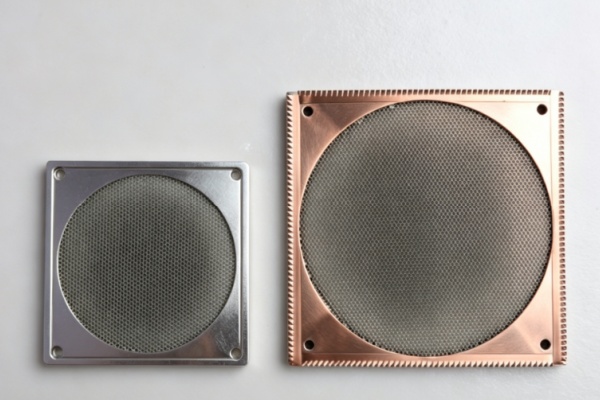
Why You Need a Thin Vent
Equipment keeps shrinking. Data center servers are packed tighter. Outdoor telecom cabinets have to be flush against walls. Medical gear has no spare room inside.
A standard microwave barrier board is 1/2‑inch thick (about 12.7 mm). Sometimes that's too much. Especially on a cabinet door – the door itself might be 1 mm thick. Stick a 12 mm vent on it, and the back side hits the components inside.
The thinnest we've made was 6 mm (about 1/4 inch). That was for a mobile medical device. The internal clearance was only 8 mm. A standard vent wouldn't even come close to fitting.
What You Lose When You Go Thin
Let's be honest. Making a vent thinner costs you two things.
First – shielding. Waveguide cutoff works better with depth. Cut the depth in half, and shielding can drop 10-20 dB. A 1/2‑inch deep vent might give you 40 dB at 10 GHz. At 1/4 inch deep, maybe 20-25 dB.
Second – mechanical strength. Thin honeycomb dents easily. A worker pushes it during installation, and now you have a dent. Dented honeycomb doesn't shield.
So you can't just slice a standard vent in half and call it good. You have to know your frequency, your power, your installation.
If your problem is below 3 GHz, thin might work fine. If you're dealing with 10 GHz, thin might not cut it.
How We Keep Shielding Up on Thin Boards
After making a bunch of these, we've figured out a few tricks.
Trick 1 – smaller cells. Standard vent uses 1/8‑inch cells with 1/2‑inch depth. When we go down to 1/4‑inch depth, we switch to 1/16‑inch cells. Smaller cells have a higher cutoff frequency, which helps make up for lost depth. A 1/16‑inch cell, 1/4‑inch deep board can perform about the same at 5 GHz as a 1/8‑inch cell, 1/2‑inch deep board.
Trick 2 – stainless instead of aluminum. Thin aluminum dents easily. Stainless is stiffer. Won't bend when someone leans on it. Costs more and weighs a bit more, but it holds up.
Trick 3 – add a backing support. For very thin boards, we sometimes bond a thin non‑metal sheet (like FR4) to the back. It stops dents without blocking airflow. Can't use metal – that would short out the vent.
Trick 4 – give up on depth, go bigger on area. Sometimes you can't increase depth, but you need more shielding. So we make the vent larger. More open area means you can tolerate a bit more pressure drop. Not ideal, but it works.
Real Numbers – Thickness vs. Shielding
From our own tests (1/8‑inch cells, aluminum):
1/2 inch depth → 60 dB at 1 GHz, 35 dB at 5 GHz, 20 dB at 10 GHz
3/8 inch depth → about halfway between
1/4 inch depth → 45 dB at 1 GHz, 20 dB at 5 GHz, 8 dB at 10 GHz
So if a customer needs 30 dB at 10 GHz, a 1/4‑inch deep vent won't get there. Need 1/16‑inch cells, or go back to 1/2 inch.
We always ask first: what frequency? what thickness can you live with? Then we give a straight answer. No lies.
Real Example – Mobile CT Scanner
A customer made a mobile CT scanner. Internal clearance was stupid tight – less than 8 mm. They needed to vent heat and keep RF inside.
We built a 6 mm thick board. 1/16‑inch cells. Stainless. Tested at 2-3 GHz – about 40 dB shielding. They needed 35 dB. Barely made it.
First unit worked. No leaks. They ordered 200 more.
Real Example – 5G Small Cell
Another customer had a 5G small cell, operating up to 4 GHz. The cabinet door was thin. Only 10 mm of space for a vent. They tried another supplier's thin vent – at 4 GHz, it did almost nothing.
We used 1/16‑inch cells, 10 mm depth, aluminum frame. Tested at 4 GHz – 55 dB. They tested it themselves and passed.
The trick was keeping the frame thin but the honeycomb deep enough. We shaved material off the frame, not the honeycomb.
Installation – Thin Vents Break Easily
Thin vents are fragile. Installers with impact drivers can warp the frame in one second. Warped frame means gasket doesn't seal. RF leaks.
We give torque specs. We put a note in the box: "This vent is thin. Be gentle."
Some people ignore it. They call us later with a leak. We tell them to check the torque. They back off the screws, re‑torque correctly, leak stops.
Also, shipping. Thin honeycomb dents if you stack heavy boxes on it. We pack them in foam, each one separated, in a sturdy box.
When Thin Vents Are a Bad Idea
Sometimes we just say no.
If the frequency is above 10 GHz, or power is hundreds of watts, a thin vent won't shield enough. Also, thin vents can heat up under high power. Less metal to absorb and spread the heat.
If the equipment is in a high vibration environment – trucks, aircraft – thin honeycomb can fatigue and crack. We recommend at least 10 mm depth, or stainless.
We tell customers straight: "Your requirement won't work with a thin vent. Either find more space or change the design." They don't always like it, but it's better than shipping a vent that fails.
How to Know If You Need Ultra‑Thin
Measure the gap behind your cabinet door. Standard 1/2 inch (12-13 mm) – if it fits, don't bother with thin.
If it doesn't fit, then check your frequency. Below 3 GHz? You can probably go down to 6-8 mm. 5-6 GHz? Try not to go below 10 mm. Above 10 GHz? Stick with standard thickness, or go to 1/16‑inch cells.
Not sure? Send us your frequency, power, and available space. We'll run the numbers. If it won't work, we'll tell you. No hard feelings.
Ultra‑thin microwave barrier vent boards are for when a standard vent won't fit in the cabinet.
Thinner means less shielding and weaker structure. You can make up some of it with smaller cells, stainless material, or backing supports.
We've made them as thin as 6 mm. We've also told customers to forget about it because their frequency was too high.
If your equipment is tight on space, send us the numbers. We'll tell you if thin can work – and if it can, we'll build it. That's what our factory does.