To be a valuable global supplier
for metallic honeycombs and turbine parts


Contact number
0555-2813555

To be a valuable global supplier
for metallic honeycombs and turbine parts

Technological Innovation
Process Management
Continuous Improvement
Customer Satisfaction

Knowledge
Dedication
Diligence
Loyalty
Responsibility
Confidence
Tenacity
Respect

To be a valuable global supplier
for metallic honeycombs and turbine parts
Release time:2026-05-20
I've been called to more than one site where the customer swears the vent is bad. "We bought your shielded vent, but our spectrum analyzer shows leakage." Sometimes they're right. Usually they're not.
The honeycomb is fine. The leakage is coming from somewhere else. Or the vent was installed wrong. Or they bought the wrong type for their frequency.
Microwave leakage in ventilation systems is almost always caused by one of a handful of common problems. Here's my list – what to check before you blame the vent.
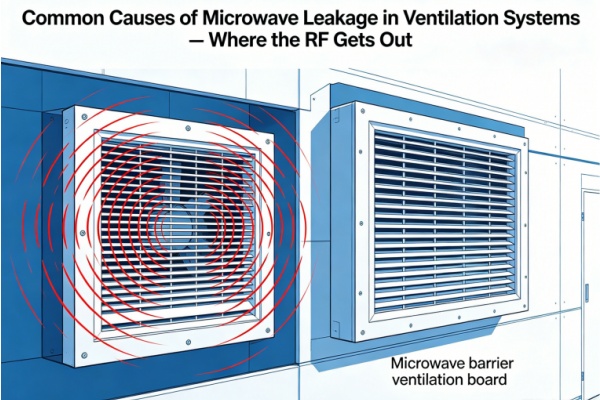
1. The Gasket – Missing, Wrong, or Dead
This is the number one cause. By a lot.
A waveguide vent needs a conductive gasket between the frame and the cabinet. No gasket? Leak. Wrong gasket? Leak. Gasket crushed or hardened? Leak.
I've seen vents bolted directly to painted metal with no gasket at all. The installer thought the metal‑to‑metal contact was enough. It's not. Paint is an insulator. Even bare metal has microscopic gaps.
I've also seen the right gasket but installed wrong – too loose, too tight, or not aligned.
And gaskets age. Silver‑filled silicone lasts years indoors. Outdoors in the sun? Maybe three years. Then it hardens, cracks, and leaks.
Fix: Use the specified gasket. Torque to spec. Replace gaskets on a schedule.
2. Paint Under the Gasket
This one is maddening. Someone spends good money on a shielded vent, then bolts it onto a painted surface. The paint is an insulator. The gasket can't make electrical contact.
We had a customer with a military shelter. The vent was installed on a freshly painted panel. Leakage was 30 dB worse than spec. We scraped the paint off the mounting flange, reinstalled the vent, and the leakage dropped to within spec.
Fix: Remove paint on the mounting surface. Bare metal only. No exceptions.
3. Wrong Cell Size for the Frequency
A waveguide vent works above its cutoff frequency. Below cutoff, it doesn't shield much.
If your interference is at 800 MHz and you buy a vent with 1/8‑inch cells (cutoff around 1.5 GHz), it won't work. You need 1/4‑inch cells.
Common mistake: Assuming smaller cells are always better. They're not. Smaller cells have higher cutoff frequency. For low frequencies, you need larger cells.
We had a customer with a 900 MHz problem. They bought 1/8‑inch cells because "smaller is better." Leakage was high. Switched to 1/4‑inch cells. Problem solved.
Fix: Match cell size to your frequency. Don't guess.
4. Not Enough Depth
Cell depth matters too. A 1/2‑inch deep vent shields less than a 1‑inch deep vent.
For microwave frequencies, you need enough depth to get the attenuation you need. At 10 GHz, a 1/2‑inch deep, 1/16‑inch cell vent might give you 40 dB. The same vent at 1‑inch depth might give you 60 dB.
Common mistake: Using the same depth for all applications. If you need high shielding at high frequencies, go deeper.
Fix: Ask for attenuation data at your frequency for different depths.
5. Warped Frame
If the frame isn't flat, the gasket won't compress evenly. You get high spots and low spots. Low spots are gaps. Gaps leak.
We measure frame flatness to 0.1 mm. Some cheap vents are 0.5 mm or more out of flat. That's a leak waiting to happen.
Also, over‑tightening screws can warp the frame. We've seen installers crank down so hard the frame bowed in the middle.
Fix: Use a flat frame. Torque to spec. Don't overdo it.
6. Gaps at the Corners
The gasket has to go around corners. If the gasket ends don't meet perfectly, or if the corner radius is too tight, you get a gap.
We use continuous gaskets on a reel – no splices. For finger stock, we overlap the ends.
Common mistake: Using a gasket that's too stiff to bend around tight corners. It lifts away from the frame, leaving a gap.
Fix: Use a gasket designed for your frame corner radius. Test with a continuity meter.
7. Corrosion – The Slow Leak
Aluminum vents in coastal or industrial environments corrode. White powder forms. The powder is non‑conductive. It lifts the gasket. It also degrades the honeycomb's shielding.
We saw a vent at a coastal telecom site. After two years, the aluminum frame was pitted and covered in white powder. Shielding had dropped 30 dB.
Fix: Use stainless 316L for coastal or corrosive environments. Or replace aluminum vents every couple of years.
8. Damaged Honeycomb
Someone drops the vent during installation. Steps on it. Drives a forklift into the cabinet.
The honeycomb gets dented. Cells collapse. Dents can create resonant cavities that actually radiate RF.
We had a customer with a vent that was leaking at one spot. We looked at it – someone had dropped a tool on it, denting the honeycomb in a 2‑inch circle. That dent was the leak.
Fix: Inspect vents before installation. Don't use damaged ones.
9. Wrong Orientation
Some vents are directional. The honeycomb should be oriented with cells vertical or horizontal depending on the polarization of the RF.
For most applications, orientation doesn't matter much. But for very high frequencies or very high shielding requirements, it can.
Common mistake: Assuming orientation doesn't matter. At 10 GHz, a 1/8‑inch cell vent has different attenuation for horizontal vs. vertical polarization.
Fix: Ask the manufacturer for orientation data. Install as specified.
10. Leakage Around the Screws
Screw holes are penetrations through the frame. If the screw is not conductive or not bonded, RF can leak through the hole.
We use conductive screws (stainless or plated steel). Some applications require a conductive washer under the screw head.
Also, if the screw threads are painted or anodized, they may not make good contact.
Fix: Use conductive screws. Ensure the mounting holes are bare metal.
How to Find the Leak
If you have a microwave leak, don't guess. Find it.
Use a near‑field probe on a spectrum analyzer. Scan around the vent edges, the frame, the gasket line, the screws.
A sharp spike in the signal when you approach a spot means that's the leak.
We've done this for customers over video calls. "Move the probe to the top left corner. Now slowly along the edge. See that spike? There's your leak. Check the gasket there."
Often it's a simple fix – tighten a screw, scrape some paint, replace a gasket.
Real Example – Radar Shelter
A military radar shelter had a microwave leak. The vent was our standard 1/8‑inch, 1/2‑inch depth, aluminum frame. The customer insisted the vent was bad.
We sent a technician with a spectrum analyzer. The leak was at the bottom edge of the vent. He removed the vent. The gasket was there, but the paint on the shelter had not been removed. The gasket was sitting on paint.
He scraped the paint, cleaned the surface, reinstalled the vent. Leak gone.
The vent was fine. The installation was wrong.
Bottom Line
Microwave leakage from a ventilation system is rarely the honeycomb's fault.
Check the gasket first. Check for paint under the gasket. Check the cell size against your frequency. Check the depth. Check frame flatness. Check for corrosion. Check for damage. Check orientation. Check the screws.
Most leaks are fixable without replacing the vent. A little cleaning, a new gasket, a few more screws.
If you have a leak and can't find it, call us. We'll walk you through the checklist. I'd rather spend twenty minutes on the phone than have you buy a new vent you don't need. That's just wastefu