To be a valuable global supplier
for metallic honeycombs and turbine parts


Contact number
0555-2813555

To be a valuable global supplier
for metallic honeycombs and turbine parts

Technological Innovation
Process Management
Continuous Improvement
Customer Satisfaction

Knowledge
Dedication
Diligence
Loyalty
Responsibility
Confidence
Tenacity
Respect

To be a valuable global supplier
for metallic honeycombs and turbine parts
Release time:2026-05-19
I've been in plenty of rooms full of high‑power microwave gear. The kind that cooks the air and makes your skin tingle. Those cabinets have two problems. They need to dump heat. And they need to keep radiation inside.
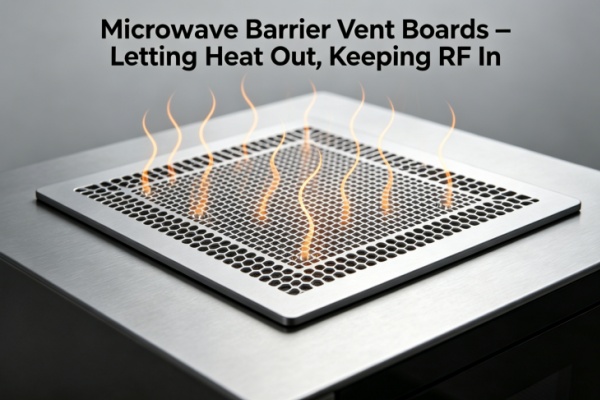
A normal vent won't work. Perforated sheet? RF pours out. Solid metal? No airflow, equipment cooks. You need a microwave barrier vent board – something that breathes and shields at the same time, at frequencies where ordinary vents give up.
Here's how they work and what makes them different.
Ordinary electronics might leak a few hundred milliwatts of RF. Annoying, but not dangerous. High‑power microwave can be tens of kilowatts. That's not just interference – that's a safety hazard. RF burns. Interference with sensitive gear. Failed compliance.
And the heat. A 10 kW transmitter might dump another 5-10 kW as heat. That heat has to go somewhere. Cabinet doesn't breathe, temperatures soar. Components fail.
So you need a vent that shields at microwave frequencies – 1 GHz, 3 GHz, 10 GHz, higher – while moving a lot of air.
A standard EMI vent with 1/8‑inch honeycomb works fine up to a few GHz. At 3 GHz, it still does something. At 6 GHz, it's getting weak. At 10 GHz, forget it. Cells are too big. RF goes right through.
You can go to smaller cells. 1/16‑inch honeycomb works at higher frequencies. But small cells mean less open area – maybe 75-80% instead of 85%. That hurts airflow. And in a high‑power cabinet, airflow is critical.
Depth matters too. Standard vent is 1/2‑inch deep. For microwave, you might need 1 inch or more. That adds even more airflow restriction.
So the problem is: how do you get high shielding at high frequencies without choking your fans?
A microwave barrier vent board isn't just honeycomb. It's engineered. There are a few approaches.
Approach 1 – Very small cells, but selective. Instead of covering the whole vent with 1/16‑inch honeycomb, you use larger cells with smaller cells only where needed. Or variable cell size – larger in the middle for airflow, smaller at the edges for shielding. Balances the trade‑off.
Approach 2 – Multilayer honeycomb. Two layers offset from each other. RF has to bounce more times. Attenuation increases without reducing cell size. Airflow is better than a single layer of very small cells.
Approach 3 – Absorptive materials. Add a thin layer of RF absorber – carbon‑loaded foam or ferrite – inside the honeycomb. Absorber soaks up RF that gets through. Boosts shielding at high frequencies without changing cell size.
Approach 4 – Plated plastic honeycomb. Lighter than metal. Walls can be very thin. Good open area. Shielding is decent, though not as good as metal.
We've used all of these depending on frequency and power. No one‑size‑fits‑all.
If you're buying a microwave barrier vent board, here's what to look for.
Frequency range. Highest frequency you need to shield? 2.4 GHz? 5.8 GHz? 10 GHz? 18 GHz? Vent has to be designed for that range.
Shielding effectiveness. How many dB? For high‑power microwave, 60 dB at operating frequency is minimum. 80 dB is better. 100 dB is military grade.
Power level. High‑power RF can heat up the vent itself. Honeycomb can act like an antenna and get hot. Vent has to handle the power without melting or arcing.
Airflow. Attenuation vs. airflow. You have to calculate CFM and pressure drop.
Material. For high power, stainless is better than aluminum. Aluminum can melt or warp. Stainless handles heat better.
Standard EMI testing goes to 18 GHz. For microwave, you need to test higher – sometimes to 40 GHz or beyond.
We use a test fixture with waveguide transitions. Vent goes between two sections of waveguide. Measure insertion loss – that's shielding effectiveness.
For high‑power testing, put the vent in front of a high‑power source and measure temperature rise. If the vent gets too hot, design fails.
One customer needed a vent for a 10 kW radar system at 9.4 GHz. Three designs. First got so hot you could smell the paint. Second had higher shielding but restricted airflow too much. Third – multilayer stainless honeycomb – passed both thermal and RF tests.
Medical linac uses high‑power microwave to accelerate electrons. Cabinet needs cooling. Shielding has to be tight – both ionizing and non‑ionizing.
We supplied a vent board with 1/16‑inch honeycomb, 1‑inch depth, stainless steel, and a layer of absorber inside. Shielding was 80 dB at 3 GHz. Airflow enough to keep the cabinet cool.
Customer measured radiation outside the cabinet. Below background. Vent worked.
Customer built industrial RF heaters for drying wood. 5 kW at 27 MHz. Lower frequency, but power was high.
They tried standard 1/8‑inch honeycomb. Shielding was fine at 27 MHz – cutoff is much higher. But RF heated the honeycomb. Aluminum got hot enough to soften.
Switched to stainless honeycomb with thicker foil. Same cell size, same shielding. Stainless didn't heat as much. Problem solved.
A microwave barrier vent board is heavier than a standard vent. Frame needs to be stronger. Mounting screws need to be stainless to avoid galvanic corrosion.
Gasket is critical. Any gap around the frame is a leak. At microwave frequencies, even a small gap can radiate significantly.
We specify silver‑filled silicone gaskets for most microwave vents. For very high frequencies, beryllium copper fingers – maintain better contact.
Also, vent should be bonded to the cabinet with multiple screws, close spacing. No more than 50 mm apart.
Using a standard EMI vent on high‑power microwave gear. Won't shield enough. Or will heat up.
Ignoring airflow. If vent is too restrictive, equipment overheats. Different problem.
Forgetting the gasket. An 80 dB vent with a bad gasket is a 20 dB vent. All that shielding wasted.
Using aluminum in high‑power applications. RF can heat the aluminum. Can even cause arcing at edges. Use stainless.
Not every RF cabinet needs a specialized microwave vent. Low power, low frequency – standard EMI vent is fine.
But if you have:
Frequencies above 3 GHz
Power levels above 100 watts
Safety or compliance requirements for high shielding
Heat that would choke a small fan
Then you need a microwave barrier vent board.
We've made them for radar, medical, industrial heating, research labs. Each one different. Each solved the same two problems – heat and radiation.
A microwave barrier vent board lets heat out and keeps radiation in. It's not a standard EMI vent. It's engineered for the specific frequency, power level, and airflow requirement.
Small cells, deeper depth, multilayer, absorptive materials, stainless – all tools we use.
If you have high‑power microwave gear that's running hot and leaking RF, don't try to solve it with an off‑the‑shelf vent. Call us. We'll design something that works for your frequency, your power, your cabinet. That's what we do.