To be a valuable global supplier
for metallic honeycombs and turbine parts


Contact number
0555-2813555

To be a valuable global supplier
for metallic honeycombs and turbine parts

Technological Innovation
Process Management
Continuous Improvement
Customer Satisfaction

Knowledge
Dedication
Diligence
Loyalty
Responsibility
Confidence
Tenacity
Respect

To be a valuable global supplier
for metallic honeycombs and turbine parts
Release time:2026-05-15
An electromagnetic shielding room is supposed to keep RF out. Or keep RF in. Depends on which side you're on. But either way, the room has to breathe. People inside need air. Equipment needs cooling.
So you cut a hole in the shield. And that hole – if you do it wrong – turns your nice shielded room into a leaky sieve.
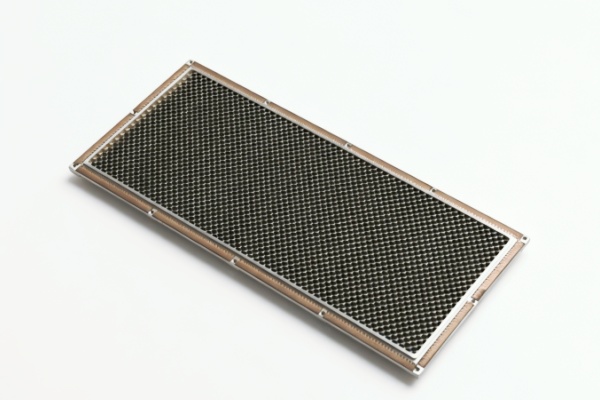
A waveguide vent plate is how you fix that. It lets air move. It stops RF. Here's what you need to know if you're building or buying a shielded enclosure.
The Problem with Holes
A solid metal room shields great. No gaps, no leaks.
But you can't seal it tight. People inside need fresh air. Equipment needs cooling. So you need ventilation openings.
A plain hole is an antenna. RF goes in, RF goes out. At certain frequencies, a hole can radiate almost as well as a dipole. Your shielding effectiveness goes from 100 dB down to maybe 20 dB.
That's a disaster for an EMC test room. You'll fail your own validation tests. Or outside interference will ruin your measurements.
You need a vent that stops RF but passes air. That's what a waveguide vent plate does.
How a Waveguide Vent Works
A waveguide vent plate is a metal honeycomb. Thin walls, lots of small cells. Usually 1/8‑inch or 1/4‑inch cells. The cells are deep – typically 1/2 inch to 2 inches.
Each cell acts as a waveguide. Below a certain frequency, the waveguide "cuts off" – RF can't propagate through. It bounces off the walls and attenuates.
Above cutoff, RF gets through. So you size the cells so that cutoff is above the highest frequency you need to shield.
For a typical EMC test room (10 kHz to 18 GHz), you use 1/8‑inch cells. Cutoff is around 1.5 GHz. That means below 1.5 GHz, the vent doesn't help much. But that's okay because solid metal walls shield low frequencies fine, and you're not putting vents on all four walls.
For higher frequencies, smaller cells. For lower frequencies, larger cells – but you may need a different approach.
We've made waveguide vents for shielded rooms that hold 100 dB of shielding at 1 GHz. That's military grade. It takes careful design.
Key Specs for a Shielded Room Vent
If you're buying a waveguide vent plate for a shielding room, here's what matters.
Cell size. 1/8‑inch for most applications. 1/4‑inch for lower frequencies. 1/16‑inch for millimeter wave.
Depth. Deeper cells shield better. 1 inch is common for shielded rooms. 2 inches for very high attenuation.
Material. Aluminum is fine for most. Stainless if you need corrosion resistance or if the room is outdoors.
Frame. Needs to be thick and flat. The vent mounts to the shield. Any gap around the frame is a leak.
Gasket. Conductive gasket between the vent frame and the shield. Silver‑filled silicone or beryllium copper fingers.
Bonding. The vent frame must bond to the shield. No paint. No anodize. Bare metal to bare metal.
We've seen shielding rooms where the vent looked fine but the installer left paint on the mounting surface. The gasket sat on paint. The RF leaked around the edges. Scraped the paint, added conductive gasket, problem fixed.
Testing a Shielding Room Vent
You don't guess with a shielded room. You measure.
We test our waveguide vent plates on a dedicated fixture. Two shielded chambers, a transmitting antenna, a receiving antenna. The vent goes in a wall between them.
We sweep from 10 MHz to 18 GHz. Measure the difference with the vent in place versus a solid metal plate.
For a good vent, we see 60-80 dB at 1 GHz. At 10 GHz, maybe 50-60 dB. At 100 MHz, less – but that's fine because the room walls shield low frequencies anyway.
We also test with the vent installed in a actual shielding room. Not just our fixture. Real conditions matter.
One customer required 100 dB at 1 GHz. We used 1/8‑inch cells, 2 inch depth, aluminum frame with double gasket. Passed with margin.
Airflow – Don't Choke the Room
A shielding room can get hot. People inside. Equipment running. The ventilation system has to move enough air.
A waveguide vent plate restricts airflow. The honeycomb cells are small. Pressure drop can be significant.
We calculate pressure drop for each vent. For a 1/8‑inch cell, 1 inch depth, 80% open area, pressure drop at typical flow rates is about 0.2 inches of water. That's fine for most HVAC systems.
But if you put a vent on the supply and return, you need double the pressure drop. Plan for it.
We had a customer who installed our vents on a large shielded room. The HVAC system couldn't move enough air. They had to add booster fans. We warned them, but they didn't believe us until they measured.
Tip: Calculate your airflow needs. Then size the vents accordingly. Or use multiple vents.
Installation – The Details Matter
You can buy the best waveguide vent plate in the world. If you install it wrong, it leaks.
Surface prep. The mounting surface on the shield has to be bare metal. No paint. No oxide. Clean with solvent.
Gasket. Use the recommended conductive gasket. Torque to spec. Too loose, gap. Too tight, gasket can split.
Screw spacing. No more than 50 mm apart. For large vents, more screws along the long edges.
Seal around the frame. Some installations add a secondary seal – conductive tape or caulk. Belt and suspenders.
We've done on‑site installations for shielded rooms. The difference between a good install and a bad one is 20 dB of shielding. That's huge.
Common Mistakes
Using a vent that's too small. Airflow suffers. Room overheats.
Using a vent that's too big. Harder to seal. Frame can warp.
Ignoring low frequencies. Waveguide vents don't shield below cutoff. If you have a low‑frequency problem, you need a different solution – like ferrite tiles.
Forgetting the return path. The vent is one hole. There are others – cable penetrations, door seals, pipe feeds. All have to be shielded.
Not testing after installation. You should test the finished room, not just the vent. We've seen rooms that passed with the vent alone, but failed when the door and other penetrations were added.
Real Example – EMC Test Lab
We supplied waveguide vents for a new EMC test lab. The room needed 80 dB of shielding from 10 kHz to 18 GHz. The HVAC contractor had already installed ductwork with 12x12 inch openings.
We made 1/8‑inch cell, 1 inch depth, aluminum frame vents with silver‑filled gasket. Each vent had 85% open area. We calculated pressure drop and confirmed their HVAC had enough capacity.
We helped with installation. Cleaned the mounting flanges. Removed paint. Torqued to spec.
The room passed its shielding validation. The lab manager said it was one of the few rooms they'd seen that passed on the first try.
A waveguide vent plate is the only practical way to get airflow into an electromagnetic shielding room without killing your shielding effectiveness.
Choose the right cell size for your frequencies. 1/8‑inch for most. Deeper cells for higher attenuation.
Don't ignore installation. The best vent is useless if the gasket is wrong or the paint is left on.
Test the finished room. One leak at a vent edge can ruin your whole shielding budget.
We've made vents for EMC labs, anechoic chambers, military shelters, and MRI rooms. Each one needed different specs. But the principle is the same – let air through, stop RF.
If you're building a shielded room, talk to us early. Don't wait until the ducts are cut. We'll help you size the vents, spec the gaskets, and avoid the common mistakes. That's what we do.