To be a valuable global supplier
for metallic honeycombs and turbine parts


Contact number
0555-2813555
To be a valuable global supplier
for metallic honeycombs and turbine parts
Technological Innovation
Process Management
Continuous Improvement
Customer Satisfaction

Knowledge
Dedication
Diligence
Loyalty
Responsibility
Confidence
Tenacity
Respect

To be a valuable global supplier
for metallic honeycombs and turbine parts
Release time:2026-05-14
I've been through a lot of factories. Motor control centers. PLC cabinets. Drive enclosures. Every one of them has some kind of ventilation plate. But they're not all the same.
Some are just punched holes. Some are mesh. Some are fancy honeycomb waveguides. Each type has a job. Each type has limits.
Here's my rundown. No fluff. Just what works and what doesn't.
Perforated Sheet – The Cheap One
Flat sheet metal with holes punched in it. Steel, aluminum, stainless. Round holes mostly. Sometimes square.
Open area: 30‑50%. Not great. Fans work hard.
Shielding: Almost none at high frequencies. At low frequencies, maybe 10‑20 dB.
Good: Cheap. Easy to cut. Stainless won't rust.
Bad: Poor airflow. Poor shielding. Dust and water go right through.
Best for: Indoor cabinets with no EMC requirements. Old motor starters from the 1980s. If you don't care about RF, fine.
Expanded Metal – Strong but Rough
Slit and stretched solid sheet. Diamond‑shaped openings. The metal is continuous – no welded joints. Strong.
Open area: 40‑60%. Better than perforated, still not great.
Shielding: Same as perforated. Minimal at high frequencies.
Good: Very strong. You can walk on it. Won't unravel like mesh. Cheap.
Bad: Sharp edges. Snags gloves and wires. No real shielding.
Best for: Machine guards. Walkways. Speaker grilles. Not for electronics cooling.
I saw a VFD cabinet with expanded metal. Drives kept tripping. Put a solid back panel on. Problem solved.
Woven Wire Mesh – Bug Screen Only
Like window screen, but heavier. Wires woven together.
Open area: 60‑80%. Good airflow.
Shielding: Poor at high frequencies. Irregular openings. Thin wires. RF goes right through.
Good: Cheap. Flexible. Easy to cut. Airflow is fine.
Bad: Fragile. Tears. No real shielding. Dust and water pass through.
Best for: Keeping bugs out of a fan intake. That's it. For EMI? Useless.
People use hardware cloth on industrial cabinets. Stops fingers. Doesn't stop RF.
Louvered Vents – Sheds Rain
Overlapping slats. Air gets through. Rain doesn't. Common on outdoor electrical boxes.
Open area: 30‑50%. Not great. Slats block a lot of air.
Shielding: Minimal. The slats might act like a crude waveguide at very low frequencies, but not really.
Good: Sheds rain. Blocks direct spray. Cheap to stamp.
Bad: High airflow restriction. No EMI shielding. Dust still gets in.
Best for: Outdoor enclosures with no EMC requirements. Simple power distribution.
Need both water protection and EMI shielding? You need a louvered cover over a waveguide vent.
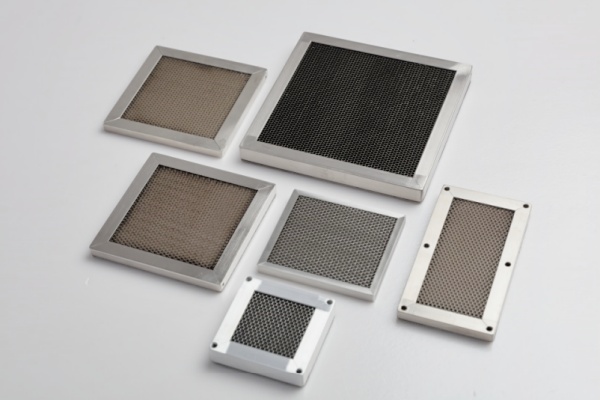
Honeycomb Waveguide Vent – The Real Deal
Metal honeycomb – aluminum or stainless – brazed into a frame. The cells act as waveguides. RF goes in, bounces around, doesn't come out.
Open area: 80‑90%. Excellent airflow.
Shielding: 40‑80 dB depending on frequency, cell size, depth. Real shielding.
Good: High airflow. High shielding. Can be weatherproof with gaskets. Many sizes and shapes.
Bad: Expensive. Heavier than mesh. Needs proper edge sealing.
Best for: Any industrial cabinet with sensitive electronics and EMC requirements. VFD cabinets. PLC enclosures. Control panels near radio transmitters.
This is what we make. The only type that gives real EMI shielding without choking your fans.
Combo Vents – Louvers + Waveguide
For outdoor industrial use. Need water protection and EMI shielding. Louvers in front. Waveguide behind.
Open area: 40‑60%. Lower because of the louvers.
Shielding: Same as the waveguide alone.
Good: Best of both outdoors. Rain protection. EMI protection. Airflow is okay for outdoor.
Bad: Thick. Expensive. Two pieces to install.
Best for: Outdoor telecom cabinets. Roadside electronics. Industrial controls in wet places.
We've made these for cell tower cabinets. Years in rain and snow. No water inside. No RF leaks.
What I Tell Customers
Cabinet has just basic controls – relays, contactors, no electronics? Perforated sheet or louvered is fine. No need for expensive shielding.
Cabinet has VFDs, PLCs, HMIs, or any communication gear? You need a waveguide vent. Those devices are noisy. They also get upset by outside noise.
I've seen VFD cabinets radiate so much RF that they crashed the office WiFi. Had expanded metal vents. Switched to waveguide vents. Noise dropped 40 dB. WiFi worked.
I've seen PLC cabinets with wire mesh vents. Had a radio nearby. Every time the radio transmitted, the PLC glitched. Switched to honeycomb. Glitches stopped.
So don't guess. If your cabinet has a microprocessor, put a real vent on it.
Bottom Line
Different industrial ventilation plates for different jobs.
Perforated sheet and louvered vents are cheap – no shielding. Expanded metal is strong – no shielding. Wire mesh keeps bugs out – nothing else.
Honeycomb waveguide vents give you high airflow and real EMI shielding. Cost more. Worth it when your electronics need protection.
Not sure what you need? Ask. I'll help you pick the right type. Need a waveguide? We make them. Don't need one? I'll tell you. No sense selling you something you don't need. That's not how we work.