To be a valuable global supplier
for metallic honeycombs and turbine parts


Contact number
0555-2813555

To be a valuable global supplier
for metallic honeycombs and turbine parts

Technological Innovation
Process Management
Continuous Improvement
Customer Satisfaction

Knowledge
Dedication
Diligence
Loyalty
Responsibility
Confidence
Tenacity
Respect

To be a valuable global supplier
for metallic honeycombs and turbine parts
Release time:2026-05-13
So you need a Planar Wave Shielded Ventilation Panel. You want it to block RF. But you also need it to breathe. If it chokes the fans, your equipment cooks. If it leaks RF, your equipment glitches.
Most people think a Planar Wave Shielded Ventilation Panel is just a block of honeycomb in a frame. Cut it, bolt it on, done.
It's not.
The hard part is making the honeycomb flow air evenly and shield RF consistently – at the same time. I've seen vents that shielded great but choked the fans. I've seen vents that flowed great but leaked RF like a screen door.
Getting the balance right starts with the honeycomb itself. Here's how we do it.
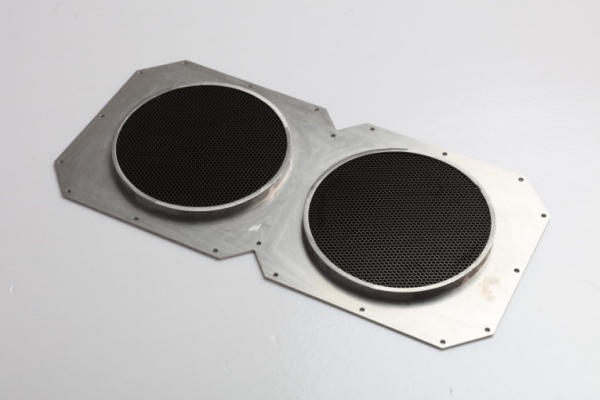
The Trade‑Off You Can't Escape
Cell size controls shielding. Smaller cells block higher frequencies. But smaller cells also mean less open area. Less open area means less airflow.
Cell depth controls attenuation. Deeper cells shield better. But deeper cells create more friction. More friction means higher pressure drop. Fans work harder.
You can't have it both ways. You pick a spot on the curve.
We ask customers two questions: what frequency do you need to block? How much airflow do you need? Then we pick the cell size and depth that hit both.
Most of the time, 1/8‑inch cells with 1/2‑inch depth is the sweet spot. Good shielding to a few GHz. Good airflow – about 85% open area, low pressure drop. That's why we sell so many.
Cell Size – Where You Start
We make honeycomb in standard sizes. 1/16 inch. 1/8 inch. 3/16 inch. 1/4 inch. Each has a different cutoff.
1/16 inch – shields from about 3 GHz up. 5G, radar, high‑frequency stuff. Airflow is okay – maybe 75‑80% open. Not great, but it works.
1/8 inch – shields from about 1.5 GHz up. This is the workhorse. 85% open. Good for telecom, data centers, medical gear.
3/16 inch – shields from about 800 MHz up. 88% open. Lower frequencies, better airflow.
1/4 inch – shields from about 600 MHz up. 90% open. Best airflow. But only for low‑frequency EMI.
We keep foil thickness matched to cell size. Small cells get thin foil. Large cells get thicker foil for stiffness.
Had a customer with a 5 GHz problem. They bought 1/8‑inch. At 5 GHz, that's right at cutoff. Shielding was weak. Switched to 1/16‑inch. Problem solved. Airflow dropped 10%, but they had fan margin.
Cell Depth – How Thick Is the Honeycomb?
Depth is how thick the honeycomb is. Usually 1/2 inch, 1 inch, or 1.5 inch.
Shallow cores flow more air. Deep cores shield better.
We tested 1/8‑inch cells at different depths. At 1/2 inch, about 50 dB at 2 GHz. At 1 inch, about 60 dB. But pressure drop roughly doubled.
One customer needed high attenuation – military application. We went to 1 inch depth. Shielding was excellent. But their fans were undersized. They had to upgrade the fans. They knew that going in.
Rule of thumb: start with 1/2 inch. Only go deeper if you need the extra dB and have fan budget to spare.
Uniform Cells – This Is Where Cheap Vents Fail
Cheap Planar Wave Shielded Ventilation Panels often have crooked cells. Squashed. Stretched. Misaligned.
That screws up two things.
First, airflow gets uneven. Some cells flow a lot. Some flow a little. Total pressure drop might be fine, but hot spots develop in your cabinet.
Second, shielding gets uneven. The cutoff frequency varies across the face. At some frequencies, parts of the vent shield. Other parts don't.
We check cell geometry during production. Every hour, we take a sample and measure cells with a magnifier. If they're out of spec, we stop and fix the forming rolls.
We also do a light test on every core. Shine a bright light through. If the pattern is patchy – dark spots or streaks – the cells are uneven. That core gets reworked or scrapped.
I remember a batch where the light test showed a dark band down the middle. We cut it open. The stacking fixture had shifted during brazing. Cells were crooked in the center. Scrapped the whole batch.
Foil Thickness – Stiffness vs. Airflow
Thicker foil makes a stiffer core. Less denting, better vibration resistance. But thicker foil also reduces open area. Same cell size, same depth. The walls just take up more space.
For 1/8‑inch cells, standard foil is 0.05 mm. That gives about 85% open area.
Go to 0.08 mm foil. Open area drops to about 80%. Not huge, but you notice.
We use thicker foil for vents that will see rough handling or high vibration. Industrial cabinets. Military gear. Mobile equipment. The loss of airflow is worth the durability.
For indoor data center vents, stick with thin foil. Maximize airflow.
Brazing – Hold It Together
The honeycomb is brazed. The brazed joints connect the cells. If brazing is uneven, the cells can shift.
We braze in a controlled‑atmosphere furnace. Temperature profile is critical. Too hot, thin foil warps. Too cold, braze doesn't flow.
After brazing, we do a peel test on a sample. Peel the layers apart. The foil should tear before the braze joint fails. If the braze gives first, the batch is bad.
We also check core flatness. A warped core won't mount right. Reject anything bowed more than 0.5 mm.
How We Test for Uniformity
We don't guess.
Light test. Even pattern = good.
Flow distribution. Put the core in a test fixture. Measure air velocity at multiple points across the face. Variation should be less than +/-10%.
Pressure drop. Test every batch on a flow bench. Same flow rate every time. If pressure drop is higher than spec, something's wrong.
Visual under magnification. Look for crushed cells, missing walls, debris.
Real Example – Data Center Rack
Customer had a server rack with hot spots. Some servers ran 15°C hotter than others. Same airflow. They blamed the fans.
We put a flow probe across their Planar Wave Shielded Ventilation Panel. Flow variation was 30%. Some cells flowing way more than others. That explained the hot spots.
We replaced it with our standard 1/8‑inch, 0.05 mm foil, 1/2‑inch depth panel. Flow variation dropped to 8%. Hot spots disappeared. They ordered 100 more.
What to Look For
If you're buying Planar Wave Shielded Ventilation Panels, here's what I'd check.
Ask for light test photos. If they can't show you even light, be suspicious.
Spec a flow variation limit. +/-15% is okay. +/-10% is good.
Check pressure drop data. Should be consistent batch to batch.
Look at cell walls under a magnifier. Straight or wavy?
Test a sample yourself. Put it over a light table. You'll see the pattern.
A Planar Wave Shielded Ventilation Panel has to breathe evenly and shield consistently. That starts with the honeycomb core.
Right cell size for your frequency. Right depth for attenuation. Uniform cell geometry. Consistent foil thickness. Solid brazing. Testing to prove it.
We do all that. Not because it's easy. Because it's the only way to make a vent that actually works in the real world.
If you need a Planar Wave Shielded Ventilation Panel that flows evenly and shields reliably, talk to us. We'll build the honeycomb that does both. Not just on the test bench – in your cabinet. That's the difference.