To be a valuable global supplier
for metallic honeycombs and turbine parts


Contact number
0555-2813555

To be a valuable global supplier
for metallic honeycombs and turbine parts

Technological Innovation
Process Management
Continuous Improvement
Customer Satisfaction

Knowledge
Dedication
Diligence
Loyalty
Responsibility
Confidence
Tenacity
Respect

To be a valuable global supplier
for metallic honeycombs and turbine parts
Release time:2026-05-12
I've tested a lot of planar wave vent panels over the years. Some were great. Some were terrible. And a lot were somewhere in the middle – they shielded a little, but not enough.
People assume shielding effectiveness is a fixed number. It's not. It changes with frequency, with installation, with age. A vent that works at 1 GHz might be useless at 5 GHz. A vent that passes the lab test might fail in the field because of a bad gasket.
Here's what actually affects how well a waveguide vent panel shields. Not from a textbook – from cutting them open and measuring.
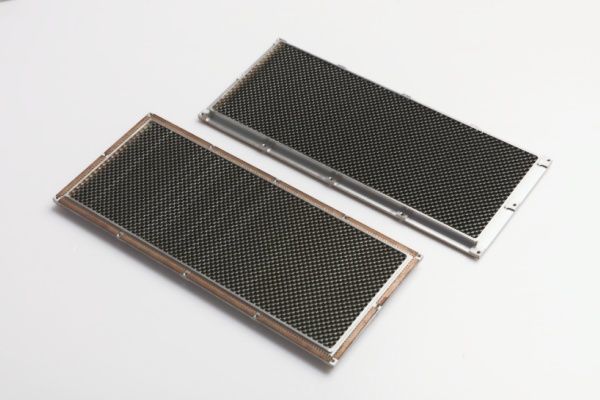
1. Cell Size – The Biggest Factor
The diameter of the honeycomb cells sets the cutoff frequency. Below that frequency, the vent does almost nothing. Above it, shielding increases as frequency goes up.
Standard 1/8‑inch (3.2 mm) cells have a cutoff around 1-2 GHz. That means a planar wave vent with 1/8‑inch cells will barely shield at 800 MHz. At 2 GHz, it might give you 40-60 dB. At 10 GHz, it could be 80 dB or more.
Smaller cells shield lower frequencies. 1/16‑inch cells cut off around 3-4 GHz. They're great for 5G and millimeter wave, but they restrict airflow more.
Larger cells – 3/16 inch or 1/4 inch – shield less but flow more air. They're fine for low-frequency EMI, like from power supplies or motors.
We had a customer with a 400 MHz problem. They bought a standard 1/8‑inch vent. Shielding was maybe 10 dB – useless. Switched to a 1/4‑inch vent (cutoff around 600 MHz). Shielding jumped to 40 dB. They just needed the right cell size.
Lesson: Match cell size to your problem frequency. Don't assume bigger is better.
2. Cell Depth – How Thick Is the Honeycomb?
Deeper cells give more attenuation. A 1‑inch deep honeycomb will shield better than a 1/2‑inch deep one – same cell size, same material.
But depth also restricts airflow. And it adds cost. Most applications use 1/2‑inch depth as the standard. It's a good balance.
For very high shielding requirements – military, TEMPEST – we go to 1 inch or more. For low frequency (below 500 MHz), depth doesn't help as much because the cutoff isn't reached.
We tested two vents with the same 1/8‑inch cells. One was 1/2‑inch deep, the other 1 inch. At 2 GHz, the deeper one had about 10 dB more shielding. At 500 MHz, both were useless. Depth only helps above cutoff.
Lesson: Deeper is better for high frequencies, but only if you need the extra dB. Don't overdo it.
3. Material Conductivity
Aluminum is great. Stainless is also good, but slightly less conductive. Steel is lower. Plastic with conductive coating is worse.
The shielding effectiveness depends on the conductivity of the material. Aluminum has about 60% of the conductivity of copper. That's plenty. Stainless has maybe 3-5% of copper. Still works, but you lose a few dB at high frequencies.
For most applications, aluminum is fine. For coastal or corrosive environments, stainless is the only choice. The loss of a few dB is worth the corrosion resistance.
We measured aluminum vs. 316 stainless at 5 GHz. Same cell size, same depth. Stainless was about 5 dB lower. Not nothing, but not a deal‑breaker.
Lesson: Choose material for the environment first, shielding second. A corroded aluminum vent shields zero.
4. Surface Finish – Oxide and Plating
Aluminum naturally forms an oxide layer. That oxide is non‑conductive. A raw aluminum vent has poor surface conductivity until the oxide is broken through – by the gasket or by mounting pressure.
We always recommend a conductive finish. Nickel plating is common. Chromate conversion (like Alodine) also works. These prevent oxide buildup and ensure consistent contact.
Bare aluminum can work if the gasket is aggressive – like beryllium copper fingers that scrape through the oxide. But foam gaskets with silver won't break through oxide well.
We had a batch of vents with no plating. The customer installed them, and shielding was all over the place. Some panels worked, some didn't. The problem was inconsistent oxide thickness. We replated them, problem solved.
Lesson: Specify a conductive finish. Don't trust bare aluminum.
5. The Gasket – Often the Weakest Link
The vent panel itself can be perfect. But if the gasket between the vent and the enclosure fails, you have a leak.
Gasket factors:
Compression. Too little, gap. Too much, gasket can split or take a permanent set.
Material. Foam with silver is common, but it can harden over time. Beryllium copper fingers are more durable but more expensive.
Width. Narrow gaskets are fine for small gaps, but they need to align perfectly.
Aging. Heat, ozone, and time degrade elastomer gaskets. After a few years, they may not spring back.
We test gaskets separately. A vent that passed the lab test with a fresh gasket might fail after a year in a hot enclosure. We recommend silicone or fluorosilicone for high‑temp environments, not standard polyurethane foam.
Lesson: The gasket is part of the shield. Spec it as carefully as the honeycomb.
6. Frame Flatness and Stiffness
A wavy frame won't seal. The gasket compresses only at the high spots. The low spots become air gaps. RF leaks through.
We measure frame flatness with a dial indicator. Good vents are flat within 0.1 mm across the face. Cheap ones might be 0.5 mm or more.
Thin frames warp easily, especially if the mounting holes are near the edge. We use 2-3 mm thick aluminum or steel for most frames.
We had a customer who kept getting RF leakage. We sent a technician. The frame was bowed because the installer had over‑torqued the screws in the middle. We replaced the vent, torqued to spec, problem gone.
Lesson: Use a stiff frame. Torque evenly.
7. Mounting Hole Pattern and Hardware
The screws that hold the vent also affect shielding. If the holes are too far apart, the gasket may not compress enough between screws. The gasket needs pressure all around.
Typical spacing is 50-75 mm (2-3 inches). For large panels, we add more screws.
Screw material matters. Steel screws on an aluminum frame with a silver gasket can create galvanic corrosion. Use stainless or coated screws.
We've seen vents where the installer used too few screws, and the gasket lifted in the middle. A simple fix – add more screws.
Lesson: Follow the manufacturer's mounting pattern. Don't guess.
8. Frequency – Shielding Is Not Flat
Shielding effectiveness varies with frequency. A vent might show 60 dB at 1 GHz and only 30 dB at 10 GHz. Or the opposite – some vents improve at higher frequencies.
We test across a range. Standard tests from 30 MHz to 18 GHz. Sometimes up to 40 GHz.
Cheap vents often only test at one frequency – say, 1 GHz – and claim that number. That's misleading. At 3 GHz, they might be 20 dB worse.
We once tested a vent that claimed 80 dB at 1 GHz. At 6 GHz, it was 25 dB. The customer had a 5 GHz problem. They bought the wrong part based on incomplete data.
Lesson: Get data at your problem frequencies. Not just a single number.
9. Corrosion Over Time
This is the slow killer. Aluminum in a salt environment oxidizes. The surface becomes non‑conductive. The gasket may lose contact.
We tested an aluminum vent after 500 hours of salt spray. Shielding dropped 30 dB. The same vent with nickel plating lost only 5 dB. Stainless lost none.
In coastal or chemical plants, use stainless or plated aluminum. Plain aluminum will fail within a few years.
Lesson: Match the material to the environment. Don't assume indoor is safe – humidity and air pollution also cause corrosion.
10. Installation Quality – The Human Factor
I've saved the most common for last. Most shielding effectiveness failures are installation problems.
Paint under the gasket. Wrong torque. Overtightened. Missing screws. Warped cabinet surface. Dirty mating surfaces. Wrong gasket. Gasket not aligned.
We've seen all of these. They are free to fix – just need attention. But they cause huge RF leaks.
We give customers a simple installation guide. Clean the surface. Remove paint. Use a torque wrench. Tighten in a cross pattern. Check flatness.
Lesson: Train installers. It's cheaper than fixing leaks later.
Shielding effectiveness of a planar wave vent panel is not a fixed number. It depends on cell size, depth, material, finish, gasket, frame, mounting, frequency, corrosion, and installer skill.
A good vent can be ruined by a bad gasket or a painted flange. A cheap vent can sometimes be improved with better installation.
We test vents in all these conditions. We know what works. If you're having shielding problems, start with the gasket and the mounting surface. That's where I'd put my money first.
And if you need help, call. I'd rather fix a simple problem over the phone than see you buy a new vent you don't need.