To be a valuable global supplier
for metallic honeycombs and turbine parts


Contact number
0555-2813555
To be a valuable global supplier
for metallic honeycombs and turbine parts
Technological Innovation
Process Management
Continuous Improvement
Customer Satisfaction

Knowledge
Dedication
Diligence
Loyalty
Responsibility
Confidence
Tenacity
Respect

To be a valuable global supplier
for metallic honeycombs and turbine parts
Release time:2026-05-11
I've been in too many plants where a machine is down and nobody can figure out why. The lights are on. The fans are spinning. But the control system is throwing random errors. Reboot. Works for a while. Then dies again.Sometimes it's heat. Sometimes it's interference. Often it's both. And both problems trace back to the same thing – a cheap or poorly installed shielded vent panel.
Here's how a high‑quality vent keeps your equipment running, and why skimping on that part can cost you days of production.
When electronic equipment stops working, I look at two things first.
Overheating. Components get too hot, they shut down or fail. This happens when airflow is blocked or fans can't move enough air.
EMI interference. A nearby radio, a motor starter, or even another board in the same cabinet radiates noise. That noise gets into sensitive circuits. The processor glitches. The sensor gives false readings. The machine stops.
A cheap vent panel can cause both.
I've cut open so‑called shielded vent panels that had maybe 60% open area. Small cells, thick walls, deep frame. The fans on the cabinet were running full speed but barely moving air.
We measured pressure drop on one. At the fan's rated flow, pressure drop was 0.8 inches of water. That's like trying to breathe through a straw.
The internal temperature was 15°C above ambient. That's a lot. Every 10°C roughly halves the life of electronics. So that cheap vent was cooking the boards.
A high‑quality waveguide vent has 85‑90% open area. Same fan, same cabinet, pressure drop drops to 0.2 inches. Temperature rise maybe 3°C. Fans run slower, quieter, and the electronics stay in their safe zone.
No overheating. No thermal shutdown. Less downtime.
A vent that doesn't shield is just a hole. RF gets in, RF gets out.
I had a customer with a CNC machine. Randomly, the spindle would stop mid‑cut. No error code. Just dead. They replaced boards, cables, even the whole controller. Nothing fixed it.
We put a spectrum analyzer near the cabinet. Big spikes at 150 MHz. That was a radio transmitter on a forklift driving by. The shielded vent panel they had was a cheap perforated sheet. At 150 MHz, it did almost nothing.
We replaced it with a real EMI vent – 1/8‑inch honeycomb, conductive gasket. The spikes disappeared. The machine never stopped again.
That cheap vent caused weeks of downtime. The good one fixed it in an hour.
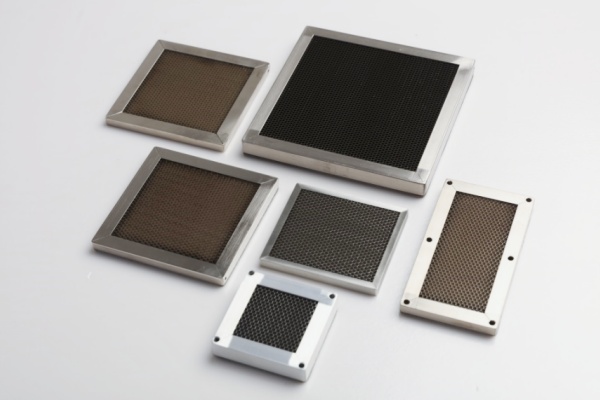
A high‑quality shielded vent panel that actually reduces downtime has a few things.
High open area. 85% minimum. You need to see light through it easily. If it looks dark, airflow is bad.
Proper cell size. 1/8 inch for most applications. Smaller cells shield higher frequencies but flow less air. Match to your RF environment.
Conductive gasket. Foam with silver, or beryllium copper fingers. No gasket, no seal. The gasket has to compress evenly.
Flat frame. If the frame is warped, the gasket won't seal. You get leaks. And the vent might not mount flush, causing airflow bypass.
Corrosion resistance. Outdoor or industrial environments need stainless or plated aluminum. Rust ruins both shielding and airflow.
We test every batch. Flow bench for pressure drop. Spectrum analyzer for shielding. Visual for straightness. That's how we know it won't cause downtime.
A customer had a control cabinet on a packaging line. The line stopped randomly, maybe once a week. Always different error codes. Electricians chased ghosts for months.
We looked at the cabinet. It had a shielded vent panel but it was the wrong type – small cells, low open area, aluminum frame with no gasket, just screwed to painted metal.
First, airflow was bad. The temperature inside was 50°C. That's hot for electronics. Some drives were throttling back.
Second, the lack of a gasket meant RF from a nearby variable frequency drive was coupling into the cabinet. That caused the random errors.
We replaced it with our standard vent – 1/8‑inch honeycomb, conductive gasket, aluminum frame, 85% open area. We cleaned the paint off the mounting surface and torqued the screws to spec.
Temperature dropped to 38°C. No more RF spikes on the spectrum analyzer. The line ran for six months without a single stop.
The plant manager called me. "Best $300 we ever spent."
Even a high‑quality shielded vent panel needs some care.
Dust. It collects on the honeycomb. Blow it out with compressed air once a year. In dirty environments, more often.
Gasket compression. If you ever remove the vent, inspect the gasket. If it's crushed flat or cracked, replace it.
Corrosion. In coastal or chemical plants, check for white powder on aluminum vents. That's corrosion. It degrades shielding.
We provide cleaning instructions with every vent. Most customers ignore them. Then they call us when something fails. We ask: when did you last clean your vents? Silence.
If you're having random downtimes and nobody can figure out why, check the vent panel.
Feel the air coming out. Is it weak? Fans running full speed but not much airflow? Probably a plugged or undersized vent.
Look for gaps. Shine a light around the edges. See light? RF sees it too.
Check the gasket. Is it missing? Crushed? Compressed unevenly?
Borrow a spectrum analyzer. Put the probe near the vent. See big spikes? Your vent isn't shielding.
Measure internal temperature. Above 40‑45°C, your cooling is inadequate. That vent is part of the problem.
We've walked customers through these checks over the phone. More than once, they found a vent that was completely clogged or missing a gasket. Fixed it themselves. Downtime stopped.
Downtime costs money. Sometimes a lot of money.
A cheap shielded vent panel can cause overheating, EMI failures, or both. That leads to random glitches, board failures, and hours of troubleshooting.
A high‑quality vent – high open area, proper cell size, conductive gasket, flat frame, right material – prevents those problems. Your equipment runs cooler. RF stays in or out. Fans work less. Boards live longer.
The price difference between cheap and good might be $100. The cost of one hour of downtime could be $1,000 or more.
Do the math. Buy the good vent. Your equipment will thank you. And you'll sleep better.