To be a valuable global supplier
for metallic honeycombs and turbine parts


Contact number
0555-2813555
To be a valuable global supplier
for metallic honeycombs and turbine parts
Technological Innovation
Process Management
Continuous Improvement
Customer Satisfaction
Knowledge
Dedication
Diligence
Loyalty
Responsibility
Confidence
Tenacity
Respect
To be a valuable global supplier
for metallic honeycombs and turbine parts
Release time:2026-04-30
I talk to a lot of equipment owners who are staring at new emission rules. Their old loader still runs fine. Engine's strong. Hydraulics are good. But the exhaust is dirty, and the local air board is cracking down.
They don't want to buy a new machine. Can't afford it. So they ask me: can we bolt a DOC converter onto the old girl?
Sometimes yes. Sometimes no. I've done enough retrofits on construction machinery to know what works and what doesn't. Here's the real story.
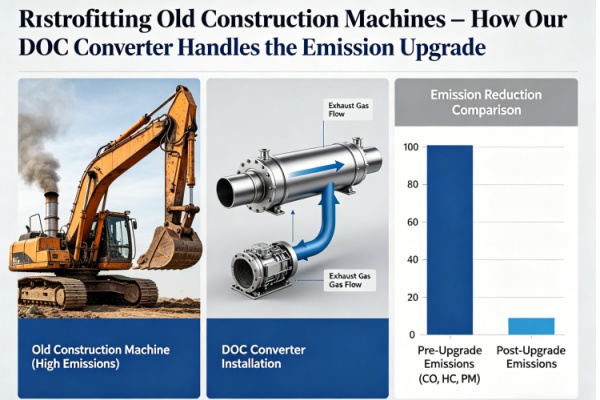
A loader from 2005. An excavator from 2010. They have no aftertreatment. Just a muffler. The engine runs clean enough for its time, but today's rules are tighter.
Some job sites now require Tier 4 Final or Stage V emissions. Your old machine might not be allowed on site. Or you get fined. Or you lose the contract.
So you have two choices. Buy a new machine – $300k for a decent loader. Or retrofit an exhaust aftertreatment system. A DOC converter is the cheapest and simplest option. No DPF. No regeneration. Just a diesel oxidation catalyst that burns CO and hydrocarbons.
It won't cut NOx. That takes SCR or EGR. But for many sites, cutting the smell and the carbon monoxide is enough to pass the sniff test – literally.
What a DOC Retrofit Actually Looks Like
You're not just bolting a DOC converter onto the exhaust pipe. There's more to it.
First, you need space. The old muffler comes off. The DOC goes in its place. But a diesel oxidation catalyst is bigger than a muffler. It needs some length to work. On a compact machine, space is tight.
Second, you need heat. A DOC needs exhaust temperature above 250°C to light off. Old construction machines often run cold – especially if they idle a lot or work light loads. We've had to add insulation to the exhaust pipe to keep the heat in. Sometimes a flex pipe to keep vibration from cracking the DOC.
Third, you need mounting. The DOC is heavier than a muffler. The original hangers might not be strong enough. We've seen retrofits where the DOC cracked because it was bouncing around. You need solid brackets.
A customer had a 2008 wheel loader, 5,000 hours, still strong. They needed to get it onto a Tier 4 job site. The requirement was "visible smoke reduction and odor control." No specific NOx limit.
We sized a 300 cpsi DOC converter – stainless, 0.08 mm foil. The old muffler came off. We installed the DOC in the same location, but had to fab new brackets because the DOC was longer and heavier.
We also wrapped the exhaust pipe upstream of the DOC with insulation. The old loader ran at about 280°C exhaust temp – marginal. Insulation bumped it to 320°C. That was enough for light‑off.
The customer ran it for a week. The smell was gone. No visible smoke at full load. The site supervisor approved the machine. Cost of the DOC retrofit was about $3,500. New loader would have been $250k.
Another customer, a 2012 excavator. Same idea – needed emissions upgrade to work near a school. But this machine idled a lot. The operator would sit with the engine running while waiting for trucks.
The DOC converter never got hot enough. Exhaust temp at idle was 180°C. Catalyst didn't light off. The smell was still there.
We had to change the operating procedure. Told the owner to use auto‑idle or shut the engine off when waiting. Then we added a pre‑heat system – a small electric heater in the exhaust pipe that warmed the diesel oxidation catalyst before start‑up.
The pre‑heater ran off the machine's battery. It took about 3 minutes to get the DOC to 250°C. After that, the engine exhaust kept it hot. The retrofit worked, but it added cost – about $2,000 for the heater and controller.
The owner said it was still cheaper than a new excavator.
I've seen plenty of failed retrofits. Usually for the same reasons.
Not enough heat. The DOC never lights off. You still have smell. Solution: insulation, load more, or pre‑heat.
Too much backpressure. The DOC chokes the engine. Old machines weren't designed for aftertreatment. You need low cell density – 200 or 300 cpsi, not 400.
Vibration cracks. The DOC is heavier than the old muffler. Mounting brackets fail. Substrate cracks. Solution: robust brackets, flex joints, thicker foil.
Fuel quality. Old construction machines often run on off‑road diesel with higher sulfur. That poisons the DOC faster. Solution: use ultra‑low sulfur diesel or plan to replace the catalyst more often.
Space constraints. No room for the DOC. Solution: custom shape – oval or rectangular. We've done that.
After a bunch of these jobs, we have a default starting point.
Cell density. 300 cpsi. Low enough backpressure for old engines. High enough surface area to clean.
Foil thickness. 0.08 mm stainless. Thicker than standard. Handles vibration.
Mounting mat. Heavy‑duty with high expansion ratio. Keeps the substrate tight when the can heats up.
Insulation. We supply exhaust wrap. Cheap and effective.
Brackets. We don't make them, but we give specs for what's needed. Customers often fab their own.
Pre‑heat. Not always required, but we offer a 12V electric heater kit for machines that idle a lot.
One thing people forget – a retrofit DOC converter doesn't come with a certificate of compliance to Tier 4 or Stage V. It's not an OEM part. The machine didn't go through certification with the DOC installed.
So can you legally run on a regulated site? It depends.
Some sites only require "visible smoke reduction" – a diesel oxidation catalyst is fine. Others require a verified retrofit system. That's a much higher bar – the whole kit has to be certified by EPA or CARB.
We don't offer certified retrofit kits. We offer DOC converters that work. It's up to the customer to check their local rules.
That said, we've supplied DOC units that helped machines pass opacity tests and smell complaints. For non‑regulated sites (private property, rural areas), it's fine.
A DOC retrofit typically runs $3,000 to $6,000 installed. That's parts, brackets, maybe insulation, maybe pre‑heat. Labor is extra if you don't do it yourself.
A new loader is $200k+. A new excavator is $150k+. So even if the DOC lasts only 2,000 hours, it's still cheaper than a new machine. And our DOC converters on construction machinery usually go 3,000–5,000 hours before they need replacement.
One customer told me: "I bought your DOC for my old loader. It's been two years. No problems. The machine is still earning. Best $4k I ever spent."
Once the DOC is on, you need to keep an eye on it.
Check backpressure. If the engine feels sluggish, the DOC might be plugging with soot. Old engines that burn oil or run rich will clog a diesel oxidation catalyst faster.
Look for cracks. Tap the DOC with a wrench. A solid ring is good. A dull thud means something's loose.
Monitor temp. If you have a pre‑heat system, make sure it's working. Cold DOC doesn't clean.
Change fuel. If you can, switch to ultra‑low sulfur diesel. It's better for the catalyst and better for the old engine anyway.
You don't have to scrap an old loader or excavator just because emission rules got tighter. A DOC converter retrofit can cut smoke and smell, and get you onto many job sites.
It's not always simple. Space, heat, vibration, fuel quality – all have to be right. But we've done enough of these to know what works.
300 cpsi stainless, 0.08 mm foil, heavy‑duty mat, insulation, and sometimes pre‑heat. That's the recipe.
If you've got an old construction machine that needs an emission upgrade, call us. Tell us the make, model, hours, and duty cycle. We'll tell you if a DOC retrofit makes sense – and we'll build you the diesel oxidation catalyst that fits.