To be a valuable global supplier
for metallic honeycombs and turbine parts


Contact number
0555-2813555
To be a valuable global supplier
for metallic honeycombs and turbine parts
Technological Innovation
Process Management
Continuous Improvement
Customer Satisfaction

Knowledge
Dedication
Diligence
Loyalty
Responsibility
Confidence
Tenacity
Respect

To be a valuable global supplier
for metallic honeycombs and turbine parts
Release time:2026-04-29
I've spent a lot of time around construction sites. Not in the office – in the mud, next to the machines. The one thing you notice is that those engines run different than a truck. A truck goes down the highway, steady RPM, steady load. An excavator digs, swings, idles, digs again. A loader pushes a pile, backs up, sits for a minute, then pushes again.
That stop‑start, load‑no load cycle is hard on a DOC. And the fuel? Sometimes it's not the cleanest. Off‑road diesel can have higher sulfur than what you buy at the truck stop.
So if you're putting a DOC on a piece of construction equipment, you can't just grab a truck part. You need something built for the abuse.
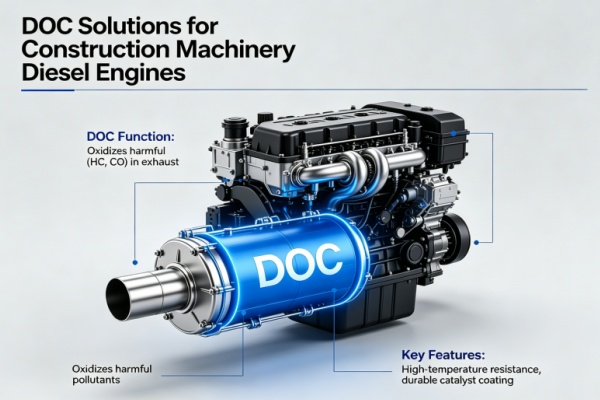
What a DOC Does on Construction Equipment
Same as any diesel – it oxidizes carbon monoxide and hydrocarbons, and it helps make NO2 for the DPF downstream. But on a wheel loader or an excavator, the DOC is often the only aftertreatment. Some smaller machines don't even have a DPF. Just a DOC and a muffler.
The goal is to cut the smell. You know that sharp diesel exhaust smell that hangs around a job site? That's hydrocarbons. A good DOC knocks that down. Also cuts the carbon monoxide, which matters when the machine is working in a trench or a confined area.
For machines with a DPF, the DOC is still the first thing in line. It heats up the exhaust during regen. If the DOC isn't working right, the DPF clogs. Then you're down for a cleaning or a replacement.
Why Construction Machinery Is Different
A truck engine runs at a pretty consistent temperature once it's warm. A construction machine? Not so much.
An excavator might idle for twenty minutes while the operator plans the next cut. Then it suddenly goes to full load to lift a heavy bucket. The exhaust temperature swings from 200 degrees to 500 and back. That's thermal cycling. It stresses the DOC substrate.
A loader does the same thing. Push a pile, high load, high exhaust temp. Back up, idle, temp drops. Repeat all day.
That thermal cycling can crack a cheap DOC. The foil expands and contracts, the brazed joints fatigue. We see it all the time. A DOC that works fine on a highway truck fails in six months on a loader.
The other difference is vibration. Construction machinery shakes. Not like a car on a smooth road – like a jackhammer. All that shaking works on the mounting mat and the substrate itself.
And then there's the fuel. Off‑road diesel isn't regulated as tightly as on‑road. Sulfur content can be higher. Sulfur poisons the catalyst. A DOC running on high‑sulfur fuel will lose activity faster.
What We Spec for Construction DOC Substrates
After building DOCs for dozens of construction equipment customers, we've settled on a recipe.
Material. Stainless. Always. Aluminum won't take the heat cycles. 304 is fine for most, 316 if there's any salt or corrosion risk.
Cell density. 300 cpsi. Lower than the 400 we use for trucks. Bigger cells are less likely to plug from soot during low‑load operation. And they create less backpressure when the engine is working hard.
Foil thickness. 0.08 mm. Thicker than automotive. The extra metal handles the thermal cycling and vibration better.
Brazing. High‑temperature nickel‑based filler. Standard brazing might soften during high‑load operation.
Mounting mat. Heavy‑duty, dense, with good vibration damping. We also add a mechanical retention ring in some applications – a metal lip that holds the substrate even if the mat loosens.
Coating. Higher precious metal loading than automotive. The catalyst needs to stay active longer because the fuel quality isn't guaranteed.
It's a heavier, more expensive part than a truck DOC. But it lasts.
Real Example – Wheel Loader
A customer with a fleet of wheel loaders kept losing DOCs after about 1,000 hours. The substrate would crack right down the middle. They were using a standard 400 cpsi, 0.05 mm stainless part.
We looked at their duty cycle. The loaders were doing short cycles – push, reverse, push, reverse. Exhaust temps were all over the place. The thermal cycling was killing the thin foil.
We switched them to a 300 cpsi, 0.08 mm stainless substrate with a denser mat. Also changed the brazing filler to a more flexible alloy. The first test unit went 3,500 hours before it needed replacement. They switched the whole fleet.
Real Example – Excavator Idle Problem
An excavator customer had a different problem. Their DOCs weren't cracking – they were losing activity. The smell came back. The check engine light would pop for catalyst efficiency.
We pulled one and cut it open. The substrate looked fine. No cracks. But the washcoat had a grayish tint. Sent it to the lab. Sulfur poisoning. The off‑road diesel they were using had high sulfur content.
We switched them to a DOC with a sulfur‑tolerant washcoat and higher precious metal loading. Also recommended they test their fuel supplier. The new DOC lasted twice as long. Not a permanent fix – sulfur still kills catalyst – but it bought them time.
What About Regeneration?
On machines with a DPF, the DOC has to support active regeneration. The engine management system adds extra fuel to the exhaust. That fuel burns in the DOC, raising the temperature to clean the DPF.
Those regens are hard on the DOC. The temperature spikes can be 100 or 200 degrees above normal operation.
For construction equipment that does a lot of low‑load operation (idling, light work), the DPF may try to regen more often. That's more stress on the DOC.
We build the DOC substrate with extra thermal margin. Thicker foil, high‑temp braze. And we recommend customers avoid excessive idling. It's bad for the engine and bad for the aftertreatment.
Maintenance Tips for Construction DOCs
If you're running construction machinery with a DOC, here's what I'd tell your mechanics.
Check for cracks during service. Tap the converter with a wrench. A solid DOC rings. A cracked one sounds dull. If it sounds dull, plan to replace it soon.
Monitor backpressure. If the engine feels sluggish or the exhaust brake isn't working right, the DOC might be plugging. Soot can build up if the engine isn't running hot enough.
Fix fuel quality issues. If you're seeing early DOC failures, test your fuel. High sulfur kills catalyst. You can get a fuel test kit cheap.
Don't let machines idle for hours. Idling doesn't get the DOC hot enough to clean itself. Soot builds up. Then when you finally work the machine hard, the DOC sees a big thermal shock.
Keep records. Track DOC hours and failure modes. If you see a pattern – always the left side of a dual exhaust, always on machines that idle a lot – you can adjust your maintenance or operating habits.
Bottom Line
Construction machinery diesel engines are not highway trucks. They idle. They surge. They see thermal cycling that cracks standard DOCs. The fuel can be dirty. The vibration is brutal.
A good DOC for a loader, excavator, or dozer needs thicker foil, stainless material, lower cell density, high‑temp brazing, a heavy‑duty mounting mat, and sometimes a sulfur‑tolerant coating.
We've built them for fleet customers. The ones who switched from truck‑style DOCs to our construction‑spec parts saw their failure rates drop by half or more.
If you're running heavy equipment and your DOCs aren't lasting, talk to us. Bring your duty cycle data. We'll spec a substrate that survives the job site – not just the highway.