To be a valuable global supplier
for metallic honeycombs and turbine parts


Contact number
0555-2813555
To be a valuable global supplier
for metallic honeycombs and turbine parts
Technological Innovation
Process Management
Continuous Improvement
Customer Satisfaction
Knowledge
Dedication
Diligence
Loyalty
Responsibility
Confidence
Tenacity
Respect
To be a valuable global supplier
for metallic honeycombs and turbine parts
Release time:2026-04-02
Most people think catalytic converter are just for cars and trucks. I get it. That's where most of them go. But I've been selling substrates to industrial customers for years, and there's a whole other world out there.
Factories. Chemical plants. Paint booths. Printing presses. Anywhere there's a process that gives off volatile organic compounds—VOCs—or carbon monoxide or other stuff that shouldn't go up a stack. They need to clean up their exhaust too. And a catalytic converter is often the best way to do it.
But here's the thing. Industrial waste gas is not engine exhaust. And if you treat it like it is, you're going to have problems.
How It's Different
Engine exhaust is hot. Like 300, 400, 500 degrees coming out of the turbo. Industrial exhaust? Could be 100 degrees. Could be 50. Could be room temperature.
Engine exhaust is pretty consistent. Mostly nitrogen, some CO2, some oxygen, a little CO and hydrocarbons. Industrial exhaust can be anything. Solvent vapors. Methane from a landfill. Styrene from a fiberglass plant. Stuff you don't want to breathe.
Engine exhaust flows steady. Industrial exhaust can be batchy. Big surge when the oven door opens, then nothing for a while.
So no, you can't just grab a catalytic converter off the shelf and bolt it onto a factory stack. You have to design for the specific process. I've seen people try. It doesn't end well.
What Gets Treated
The most common thing industrial catalytic converters handle is VOCs. Volatile organic compounds.
Paint solvents. Printing inks. Dry cleaning fluid. Gasoline vapors from a tank farm. These are hydrocarbons. Same chemistry as unburned fuel in an engine. They oxidize to CO2 and water.
Some processes give off carbon monoxide. Same deal. Oxidize it to CO2.
Others give off odors. Paper mills. Food processing. Rendering plants. That smell is usually organic compounds. Catalytic oxidation knocks it down.
And some give off hazardous air pollutants. Formaldehyde. Benzene. Ethylene oxide. Same idea. Heat plus catalyst equals less harmful stuff.
The Basic Setup
In an industrial application, the catalytic converter is usually part of a bigger system.
First, you might need to preheat the gas. If the exhaust is cold, the catalyst won't light off. So you put a burner or a heat exchanger in front of it.
Second, you need to make sure the gas is clean. No dust. No liquid droplets. No stuff that will coat the catalyst and poison it. So you put filters or scrubbers upstream.
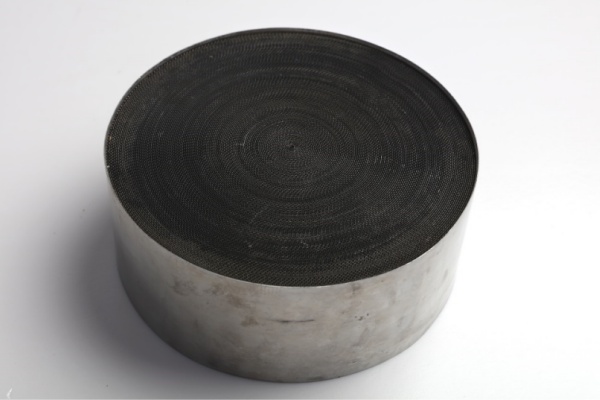
Then the gas goes through the catalyst. Same honeycomb substrate as an engine converter. Same washcoat. Same precious metals. Just bigger.
After the catalyst, the gas is clean. Hot, but clean. Sometimes you run it through a heat exchanger to recover that heat. That pays for the system over time.
What Substrate Works
For industrial applications, we usually use the same metal honeycomb substrates we make for engines. Just bigger.
Cell density is different though. Engines use 400 cpsi typically. Industrial applications sometimes go lower. 200 cpsi. 100 cpsi. Because the gas flow might be dirty. Bigger cells don't plug as easy.
Material matters too. Industrial exhaust can be corrosive. Acid gases. Chlorine. Sulfur. Aluminum doesn't like that. Stainless steel does better. For really nasty stuff, we use special alloys.
The substrate also has to handle thermal cycling. Industrial processes can start and stop. The converter heats up, cools down, heats up. That's hard on brazing. We use the same high-temp brazing we use for diesel DOC applications.
The Precious Metal Question
What catalyst do you use? Depends on what you're trying to oxidize.
Platinum and palladium work for most hydrocarbons. That's what's in a standard automotive converter.
For methane—like from a landfill or a natural gas engine—you need a different formulation. Methane is hard to oxidize. Takes more heat. Takes a different catalyst.
For halogenated compounds—stuff with chlorine or fluorine—you need something else. Those can poison standard catalysts. There are special formulations that resist poisoning.
We've learned to ask questions. What's in the exhaust? What temperature? What flow rate? What's the duty cycle? Without that, we're guessing. And guessing doesn't work.
What Goes Wrong
I've seen industrial catalytic converters fail in ways that don't happen on vehicles.
Poisoning is the big one. Something in the exhaust coats the catalyst and stops it from working. Silicon from paint overspray. Phosphorus from some chemicals. Sulfur from certain fuels. Once the catalyst is poisoned, it's done. You can't wash it off.
Plugging is another. Dust accumulates in the cells. The substrate is still active, but the gas can't get through. Backpressure builds up. The fan or blower can't push enough air. The process shuts down.
Thermal damage happens too. If the process surges and the temperature spikes, the substrate can melt. Or the precious metals can sinter—they clump together and lose surface area.
Physical damage is less common but happens. Vibration. Bad mounting. The substrate breaks loose inside the can.
We've seen all of these. Usually it's something upstream that caused the problem. The converter is just the first thing to show symptoms.
A Job I Remember
We worked with a printing plant a few years back. They had a web press running solvent-based inks. The solvent vapors were going up a stack. The neighbors were complaining about the smell.
They tried a thermal oxidizer. Burned the solvents with a flame. Worked fine. But it used a lot of natural gas. The fuel bill was killing them.
We put in a catalytic converter system. Preheater to get the gas up to 250 degrees. A metal honeycomb substrate with platinum-palladium coating. The catalyst oxidized the solvents at much lower temperature than the thermal oxidizer. Fuel consumption dropped by 70 percent.
The system paid for itself in 18 months. The neighbors stopped complaining. The plant manager was happy.
That's the kind of job that makes sense. Not just cleaning up the exhaust. Saving money while you do it.
When It Doesn't Make Sense
Catalytic converters aren't always the answer.
If the exhaust is really dirty—lots of dust, lots of liquids—you'll spend more on filters and pre-treatment than the converter is worth. A thermal oxidizer might be simpler. Burn everything. Don't worry about poisoning.
If the flow is really high and the concentration is really low, the heat recovery might not work. You spend more energy heating the gas than you save. A different technology—like carbon adsorption or biofiltration—might be better.
If the temperature is too low—below 200 degrees—you have to add a lot of heat. That costs money. At some point, it's cheaper to use a different method.
We tell customers this. Not every job is right for a catalytic converter. We'd rather lose a sale than sell something that doesn't work.
What to Look For in an Industrial Catalyst
If you're buying a catalytic converter for industrial waste gas, here's what I'd check.
Substrate material. Stainless for corrosive gases. Aluminum for clean, dry applications.
Cell density. Lower for dirty gas. Higher for clean gas. Ask about pressure drop.
Catalyst formulation. Platinum-palladium for most hydrocarbons. Special formulations for methane or halogenated compounds.
Pre-treatment. Filters? Scrubbers? Heat exchanger? Make sure the gas is clean and hot enough before it hits the catalyst.
Monitoring. Temperature sensors. Pressure sensors. Gas analyzers before and after. You need to know when the catalyst is losing activity.
Replacement plan. Industrial catalysts don't last forever. They poison slowly. They sinter slowly. Have a plan to swap them out every few years.
Bottom Line
Catalytic converters aren't just for cars. They're for any process that gives off organic vapors or carbon monoxide. Factories. Chemical plants. Paint booths. Printing presses. Landfills.
The same basic technology works. Metal honeycomb substrate. Precious metal coating. Exhaust flows through, gets oxidized, comes out cleaner.
But the details are different. Cell density. Material. Catalyst formulation. Pre-treatment. Industrial exhaust is not engine exhaust. You have to design for the specific process.
When it works, it works well. Low operating cost. Good destruction efficiency. Heat recovery can pay for the system over time.
When it doesn't, it's usually because someone skipped the engineering. Didn't ask about the gas composition. Didn't pre-treat the dust. Didn't preheat enough.
Ask the right questions up front. Get the right design. And the converter will run for years. I've seen it happen.