To be a valuable global supplier
for metallic honeycombs and turbine parts


Contact number
0555-2813555
To be a valuable global supplier
for metallic honeycombs and turbine parts
Technological Innovation
Process Management
Continuous Improvement
Customer Satisfaction

Knowledge
Dedication
Diligence
Loyalty
Responsibility
Confidence
Tenacity
Respect

To be a valuable global supplier
for metallic honeycombs and turbine parts
Release time:2026-04-01
I've been in enough data centers to know that high-power server cabinets are a different animal. The gear inside is pushing hundreds of watts per square foot. The fans are screaming. The heat coming off the back is enough to warm a small office.
And the EMI? Forget about it. All those processors, all those high-speed interconnects, all that switching power—it's a radio nightmare.
Most people think about cooling first. Then they think about shielding later. Or they don't think about shielding at
all. That's backwards. In a high-power server cabinet, you need both from the start.
The Problem With Just Cutting Holes
Here's what I see all the time. Someone builds a server cabinet. They put in high-power gear. They cut holes in the back door for airflow. Maybe they slap some wire mesh over it to keep fingers out.
Works great for cooling. Terrible for EMI.
That mesh does almost nothing at the frequencies modern servers put out. 10-gig networking. High-speed memory buses. Switching power supplies. All that RF goes right through the holes and broadcasts to everything nearby.
I've walked through data centers with a spectrum analyzer and watched the noise floor jump every time I passed a cabinet with open vents. The gear inside those cabinets? It's getting interference too. Not enough to crash, maybe. But enough to cause retransmits. Enough to slow things down. Enough to make you wonder why your network seems flaky sometimes.
What a Waveguide Array Does
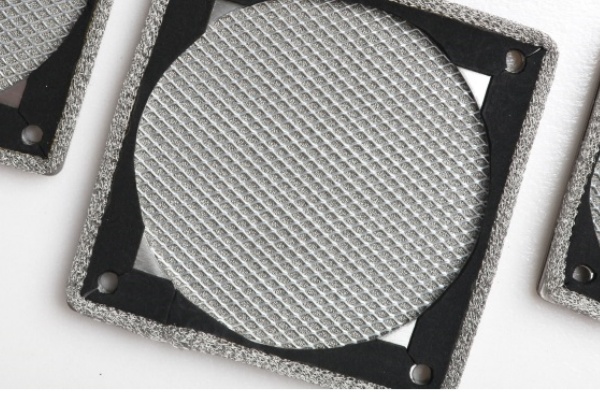
A waveguide array vent is basically a piece of honeycomb. But it's designed specifically to let air through while blocking RF.
The principle is called waveguide below cutoff. The cells are sized so that electromagnetic waves above a certain frequency can't propagate through. They hit the cell walls, bounce around, and lose their energy before they make it out the other side.
Air molecules don't care about cutoff frequency. They go right through.
For high-power server cabinets, we typically use cells around 1/8 inch. That blocks frequencies up into the gigahertz range. For higher frequencies—like what you see with 25-gig or 100-gig networking—you might need smaller cells.
The depth matters too. Deeper cells give more attenuation. But deeper cells also restrict airflow more. So there's a trade-off. For most server cabinets, half-inch depth is the sweet spot. Good shielding. Good airflow.
The Heat Problem
High-power servers put out a lot of heat. I'm talking cabinets pulling 10, 15, sometimes 20 kilowatts. That heat has to go somewhere. If it doesn't, the gear cooks. Lifespan drops. Performance tanks.
A waveguide array vent has to move enough air to keep that gear cool. That means open area matters.
A good waveguide vent runs 80 to 90 percent open area. That's almost as much as an open hole. The honeycomb structure doesn't block much airflow. But the open area number alone doesn't tell the whole story. The cell depth affects pressure drop too.
We measure pressure drop across the vent at the expected airflow rate. If it's too high, the fans have to work harder. If it's too low, maybe the cells are damaged or the depth isn't enough.
For high-power cabinets, we often run CFD models to figure out the right vent design. Where are the hot spots? Where does the air want to go? Put the vent where it does the most good.
Where the Heat Actually Goes
This is something people get wrong. They put vents on the back of the cabinet, figure that's where the heat comes out. And yeah, that's where the hot air is.
But the pressure in the cabinet matters. If the front door is solid and the back door is mesh, the air path is simple. If both doors have vents, the airflow might short-circuit. Cold air comes in the front, goes right out the back without passing through the gear.
We've worked with customers on cabinet layouts where we put vents in specific places to drive airflow through the hot spots. Not just anywhere. Where it's needed.
What Happens When You Ignore Shielding
I had a customer once who was building high-performance computing clusters. Lots of cores. Lots of memory. Lots of high-speed interconnects.
They had a problem with random packet loss. Not constant. Just enough to be annoying. They swapped switches. Replaced cables. Updated firmware. Nothing helped.
Finally someone put a spectrum analyzer near the cabinets. The noise coming out of the back vents was massive. All that high-speed signaling was radiating out through the open mesh and interfering with itself. The EMI was bouncing around the room and getting back into the cables.
They swapped the back doors for waveguide array vents. Same airflow. Same temperature. The packet loss went away. The problem had been a vent the whole time.
What to Look For in a Server Cabinet Vent
If you're buying vents for high-power server cabinets, here's what I'd look for.
Cell size. 1/8 inch covers most data center frequencies. If you're running 25-gig or 100-gig, ask about smaller cells. Make sure the cutoff frequency is above whatever your gear is putting out.
Depth. Half inch is standard. For higher attenuation, go deeper. But check the pressure drop. Deeper cells flow less air.
Open area. 80 percent or more. Less than that and you're choking the airflow.
Material. Aluminum is fine for data centers. It's light. It conducts well. It doesn't corrode in a climate-controlled environment. Stainless is overkill unless your data center is near salt water.
Frame. The frame needs to be flat. Warped frames don't seal. Gaskets matter. If the vent doesn't have a conductive gasket, it's not making good electrical contact with the cabinet. That's a leak.
Installation Matters
I've seen good vents fail because someone installed them wrong.
The vent has to be bonded to the cabinet. That means conductive gaskets. That means clean mounting surfaces. No paint where the gasket sits. No corrosion.
Bolt torque matters too. Too tight and you warp the frame. Too loose and the gasket doesn't compress enough. We give torque specs for a reason. Use them.
If the vent is going on a door that opens and closes, the hinge side matters. A vent that's too heavy can put stress on the hinges. Not usually a problem with aluminum frames. But if you're using stainless for some reason, it adds weight.
What the Newer Racks Are Doing
The trend I'm seeing is toward higher density and higher power. That means more heat and more EMI in the same footprint.
Some manufacturers are building waveguide arrays directly into the cabinet doors. Instead of a separate vent panel, the door itself is the waveguide structure. Fewer interfaces. Fewer places for leaks.
Others are using variable-density vents. More open area where the hot spots are, less where they're not. Custom layouts for specific cabinet configurations.
And some are moving to liquid cooling for the highest-density racks. That changes everything. If the heat is carried away by water, the vents don't have to do as much cooling work. You can focus on shielding.
High-power server cabinets need both cooling and shielding. You can't have one without the other. If you cut holes for airflow and ignore EMI, you'll have problems. If you seal the cabinet tight for shielding, your gear cooks.
Waveguide array vents solve both problems. They let air move. They block RF. They're not magic. They're just honeycomb. But the cell size, depth, material, and installation all matter.
If your cabinets are running hot and your network seems flaky, take a look at the vents. That's usually where the problem is. And it's usually the last place anyone thinks to look.