To be a valuable global supplier
for metallic honeycombs and turbine parts


Contact number
0555-2813555
To be a valuable global supplier
for metallic honeycombs and turbine parts
Technological Innovation
Process Management
Continuous Improvement
Customer Satisfaction
Knowledge
Dedication
Diligence
Loyalty
Responsibility
Confidence
Tenacity
Respect
To be a valuable global supplier
for metallic honeycombs and turbine parts
Release time:2026-03-30
A DOC only does oxidation. It doesn't reduce NOx. That's what the SCR does later in the system. So the DOC's job is narrower. Simpler in some ways.
The substrate is different too. Gasoline converters run hotter. They need to light off fast on cold start. Diesel exhaust is cooler. A DOC doesn't need to light off as fast, but it needs to stay active at lower temperatures.
The coating is different. Different precious metals. Different loading. Different washcat formulation. A DOC is designed for diesel exhaust, which has different chemistry than gasoline exhaust.
How It Actually Works
Here's what happens inside, step by step.
Exhaust comes in. Hot—maybe 200 to 400 degrees Celsius, depending on the engine. Flows through the honeycomb cells.
The precious metal on the washcoat acts as a catalyst. That means it speeds up the reaction without getting used up itself. Oxygen in the exhaust combines with CO to make CO2. Combines with hydrocarbons to make water and CO2.
The reaction needs heat. Below about 200 degrees, not much happens. That's why DOCs have a light-off temperature. Once the exhaust gets hot enough, conversion starts.
The reaction also needs oxygen. Diesel engines run lean. Plenty of oxygen in the exhaust. That's why oxidation works. The DOC doesn't need to control the air-fuel ratio like a gasoline converter does.
The NO2 Part (This Throws People)
DOCs also oxidize nitric oxide—NO—into nitrogen dioxide—NO2.
Why would you want that? NO2 is more reactive. It helps the downstream DPF burn off soot at lower temperatures.
Without the DOC making NO2, the DPF would need a lot more heat to clean itself. That means more fuel. The DOC helps the system run more efficiently.
So the DOC does two jobs:
Cleans up CO and hydrocarbons
Sets up the chemistry for the rest of the exhaust system
Breaking Down the Structure
Here's how it all fits together.
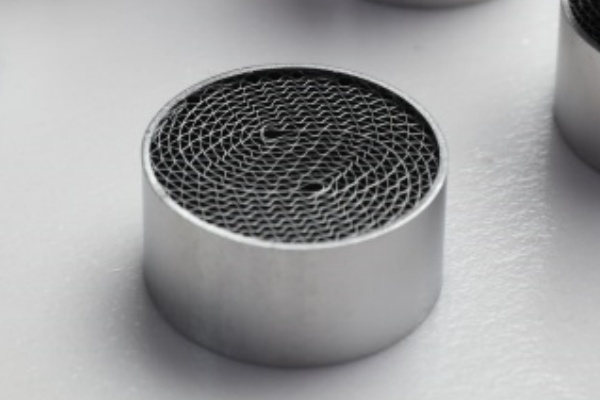
The substrate – The metal honeycomb. That's what we make. Has to be strong enough to hold up under vibration and thermal cycling. Has to have enough open area to not choke the engine.
The washcoat – Applied after the substrate is brazed. It's a slurry. The substrate gets dipped or coated, then dried, then fired. The washcoat sticks to the metal but doesn't plug the cells. That's the tricky part. Too much coating and backpressure goes up. Too little and you lose surface area.
The precious metals – Added after the washcoat. Usually by dipping again, this time in a solution containing platinum, palladium, or both. Then another firing to fix it in place.
The can – Holds it all together. The substrate gets mounted in the can with a mat that holds it in place and seals around the edges. The mat expands when it gets hot, so the substrate stays put even under vibration.
Why DOCs Are Everywhere Now
Look at any modern diesel—truck, car, construction equipment, generator—there's a DOC on it.
They've been around for decades. But they became standard when diesel emissions regulations tightened.
The reason is simple. DOCs work. They knock down CO and hydrocarbons by 80 or 90 percent. They don't cost that much relative to the rest of the aftertreatment system. No moving parts. No complex controls. Just sit there and do their job.
The other reason is the NO2 thing. Without a DOC, the DPF has to work harder. That means more fuel for regeneration. The DOC pays for itself in fuel savings over the life of the vehicle.
What Goes Wrong
DOCs are pretty reliable. But they do fail sometimes.
Thermal damage is the most common. If the engine runs hot—a problem with the injection system, for example—the DOC can overheat. The substrate melts. Cells get blocked. Backpressure goes up. Engine loses power.
Poisoning is another one. The catalyst gets coated with stuff it can't burn off. Oil ash. Coolant. Fuel with too much sulfur. Over time, the catalyst stops working. Conversion drops off.
Physical damage happens too. Vibration can break the substrate loose from the mat. The substrate moves around inside the can. Eventually it breaks.
We see all of these in the shop. Usually it's the engine that caused the problem, not the DOC itself. But the DOC is the one that gets replaced.
Bottom Line
A DOC is a simple device that does a simple job. Oxidizes CO and hydrocarbons. Makes NO2 for the DPF. Sits in the exhaust stream and works without any moving parts.
The structure is the same as any catalytic converter. Metal honeycomb substrate. Washcoat. Precious metal. Can.
The difference is in the details. The substrate is designed for lower temperatures. The coating is optimized for diesel chemistry. The whole thing is tuned to work with the rest of the aftertreatment system.
If you're buying a DOC or replacing one, same rules as any other converter. Match the cell density. Match the material to the environment. Make sure the brazing is solid. And fix the engine before you replace the part. Because a DOC that fails is usually telling you something else is wrong.